
Place Value Beyond the Point
Aim
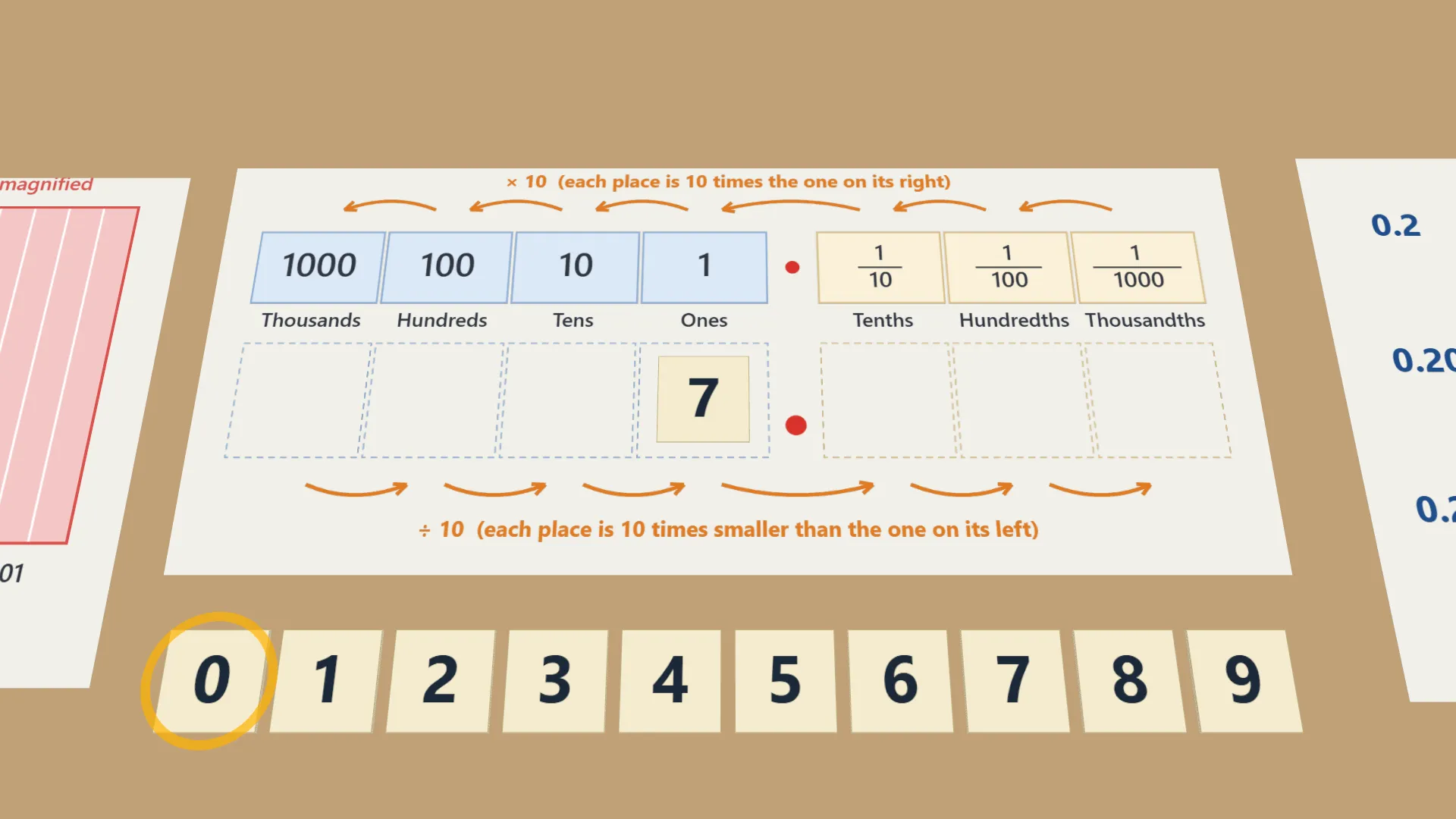
Extend the Indian place value system to tenths, hundredths and thousandths, and write and read numbers in decimal notation using a place value chart. Recall: each place is 10 times the place on its right, and 10 times smaller than the place on its left.
Apparatus
- Chart paper or a notebook to draw a place value chart
- Small cards labelled with digits 0–9
- Coloured squares for units, and small strips/dots for tenths and hundredths
- Ruler, pencil and coloured sketch pens
Procedure
- Draw a place value chart: Thousands to Ones, the point, then Tenths, Hundredths, Thousandths.
- Mark × 10 moving left and ÷ 10 moving right on your chart.
- Split one into 10 to get a tenth, a tenth into 10 for a hundredth, a hundredth into 10 for a thousandth.
- Place digit cards to build 705, then 70.5, then 7.05. Read each one. The point tells where the ones end.
- Build each quantity of the table in the chart, write it in decimal form and read it aloud correctly.
- Shade 0.2, 0.20 and 0.200 on grid strips. Then build 0.2, 0.02 and 0.002 and compare them.
Interactive 3D Experiment
Loading simulation…
What to observe
- Moving one place to the left multiplies the value by 10; moving one place to the right divides it by 10.
- The same cards 7, 0 and 5 make three different numbers, 705, 70.5 and 7.05, because the point moves.
- Digits after the point are read one by one, 2.35 is 'two point three five', not 'two point thirty-five'.
- 0.2, 0.20 and 0.200 shade the same amount, so zeros at the right end do not change the value.
- 0.2, 0.02 and 0.002 are different, 0.2 > 0.02 > 0.002.
- The decimal system continues unbroken across the point, each place being one-tenth of the place to its left.
Notes
- Clavius and then Napier used the point '.' to separate the whole and fractional parts; Viète used a comma.
- Even today several countries write 1,000.5 as 1 000,5, with a comma for the decimal and a space for thousands.
- In 2013 Amsterdam paid out €188 million instead of €1.8 million because a program used cents, not euros.
- Draw the columns of the chart equally wide and keep the decimal point in a column of its own.
- Write only one digit in each column, and line up the decimal points when writing numbers one below the other.
- Read the digits after the point one by one, 3.456 is 'three point four five six'.
- Do not add or drop zeros carelessly after the point; 0.5 and 0.05 are different numbers.
- Check that each place is exactly ten times smaller than the one on its left.