
Picking Parity: Odd, Even and Pairs
Aim
To use counters and dot pictures to see even numbers as pairs and odd numbers as pairs with one left over, and to discover and prove the parity rules for sums and products.
Apparatus
- 30 or more counters, beads or bottle caps
- Two-colour tokens or two coloured pencils
- Dot grid notebook and ruler
- A set of number cards (as in Kishor's puzzle)
Procedure
- Take a handful of counters and set them in two equal rows. None left over is even; one left over is odd.
- Build 2, 4, 6, 8 and 1, 3, 5, 7 as pair pictures. Every odd picture is pairs + 1 left over.
- Combine two odd groups, 5 and 3. The two leftovers pair up, so the total is even.
- Combine an even group and an odd group. The single leftover stays, so the total is odd.
- Add 3, then 4, then 5, then 6 odd numbers. Record the parity each time.
- Kishor's puzzle: pick 5 odd number cards that add to 30. Predict first, then check.
- Count the squares in a 3 × 3, a 3 × 4 and a 4 × 4 grid. When is m × n even?
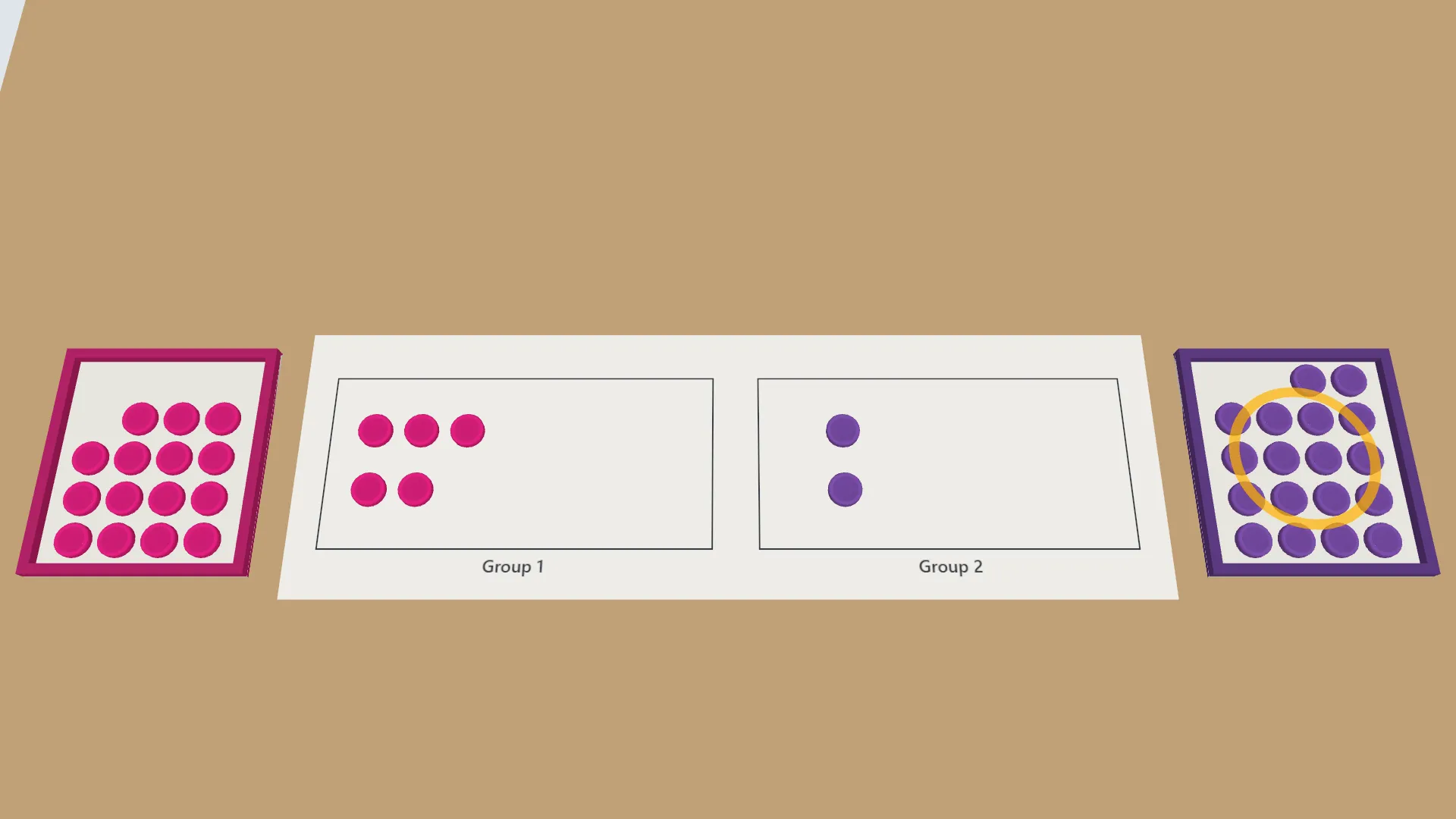
Interactive 3D Experiment
Loading simulation…
What to observe
- An even number splits into pairs; an odd number always has exactly one counter left over.
- odd + odd and even + even are even; even + odd is odd.
- An odd count of odd numbers is odd, so 5 odd cards can never add to 30.
- m × n is odd only when both m and n are odd.
Notes
- 'Parity' comes from the Latin par, 'equal'. A glance at odd or even can prove a task impossible.
- Computers send a 'parity bit' to catch errors in data.
- Arrange counters in exact pairs, in two straight equal rows, so the leftover is easy to see.
- An odd number leaves exactly one counter over. If two are left, the pairing is incomplete.
- Keep the groups apart until the leftovers are matched.
- Test each rule with several examples, small and large, before writing it as a conclusion.