
Watching the Moon Change Its Shape
Aim
To observe, record and analyse the changing phases of the Moon over a lunar month, and to relate each phase to the position of the Moon with respect to the Sun.
Apparatus
- Science notebook and pencil
- A set of blank circles to shade the bright part of the Moon each day
- A clear view of the sky at sunrise and at sunset
- A local newspaper or Panchang giving moonrise and moonset times (optional)
- Chart paper and sketch pens
Procedure
- On the morning after a full Moon, just after sunrise, spot the Moon in the western sky.
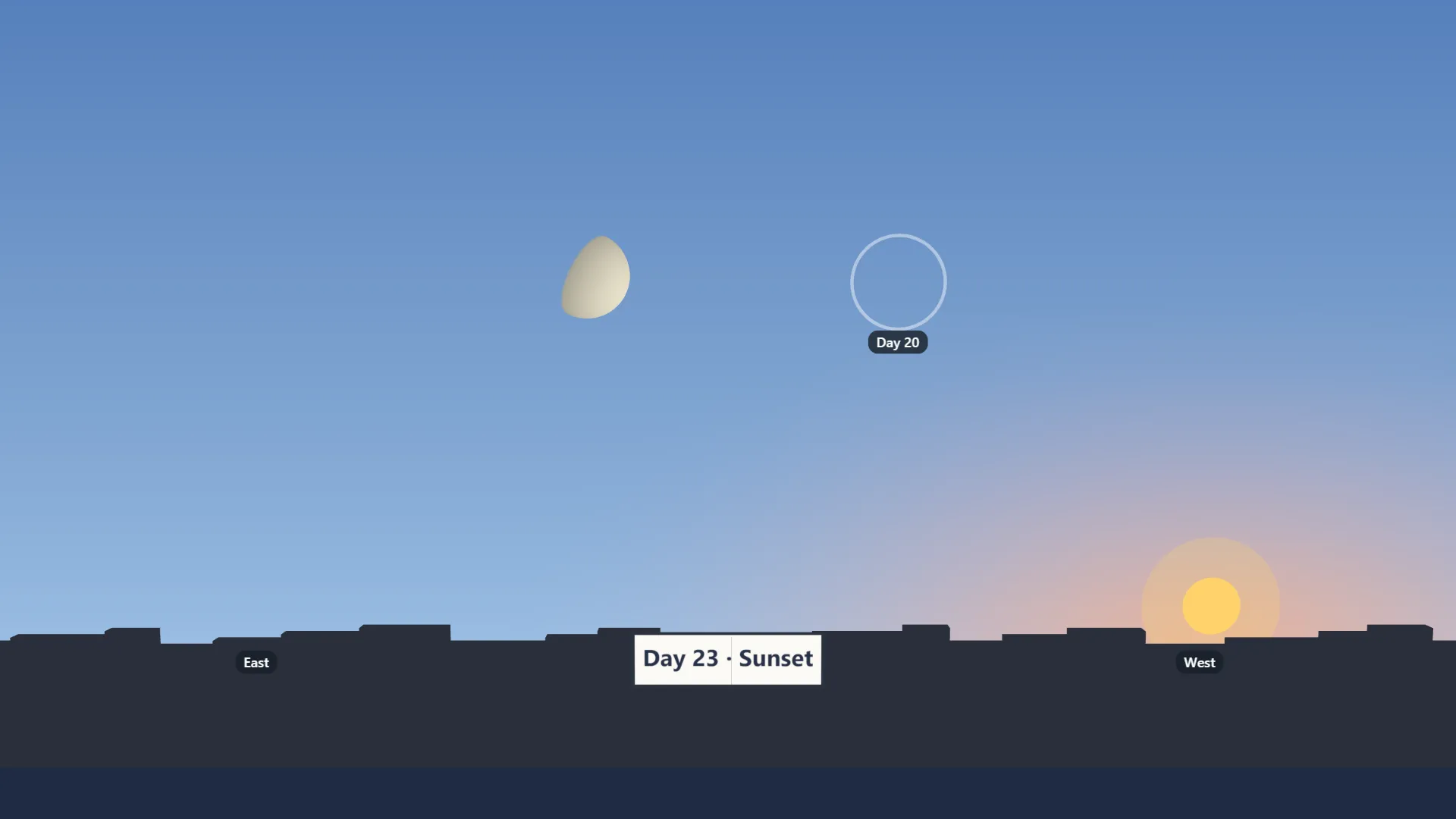
- Each day, record if you saw the Moon at sunrise or sunset, and shade a circle to show its bright part.
- From the second day, note if the bright part has increased or decreased.
- Note if the Moon is closer to or farther from the Sun in the sky than before.
- After about 15 days the Moon is not seen; from then on, observe at sunset.
- On chart paper, arrange the shaded circles in order - full Moon, new Moon, full Moon.
Interactive 3D Experiment
Loading simulation…
What to observe
- After full Moon the bright part shrinks day by day to a thin crescent, and the Moon comes closer to the Sun.
- Near new Moon the Moon is beside the Sun and cannot be seen.
- Then the bright part grows again, and the Moon moves farther from the Sun, back to a full disc.
- The bright side always faces the Sun.
- The cycle from full Moon to full Moon takes about 29 to 30 days - the lunar month.
Safety
- Observe from a safe, open place such as a terrace, with an elder present; never lean over a railing.
- Never look at the Sun directly while searching for the Moon near sunrise or sunset.
- Observe at about the same time each day, and record the date and time with every sketch.
- Shade only the bright part, exactly as it appears, and keep the circles the same size.
- Do not skip days. If clouds hide the Moon, write "not visible - cloudy".
- Never copy shapes from a calendar, an app or a friend's notebook.
- Note whether the Moon was seen at sunrise or sunset - the same shape can appear at either.
Notes
- Science Spark: the Moon is slowly drifting away from the Earth - about 3.8 cm every year, roughly as fast as your fingernails grow.
- The Moon does not change shape. One half of it is always lit by the Sun; we see more or less of that half as the Moon goes round the Earth.
- In the simulation the days pass quickly and every third day is recorded; the Moon is drawn larger than it looks in the sky.