
Measuring the Perimeter of Plane Figures
Aim
Measure, calculate and identify the perimeter of a rectangle, a square, a triangle and regular polygons, using string, a ruler and paper, and find simple perimeter formulas from what you see.
Apparatus
- Ruler or measuring scale and a ball of thread or string
- Coloured sketch pens or pencils (at least 3 colours)
- Graph paper or dot-grid notebook and plain sheets
- A pair of scissors and a few small cut-outs (rectangle, square, triangle)
Procedure
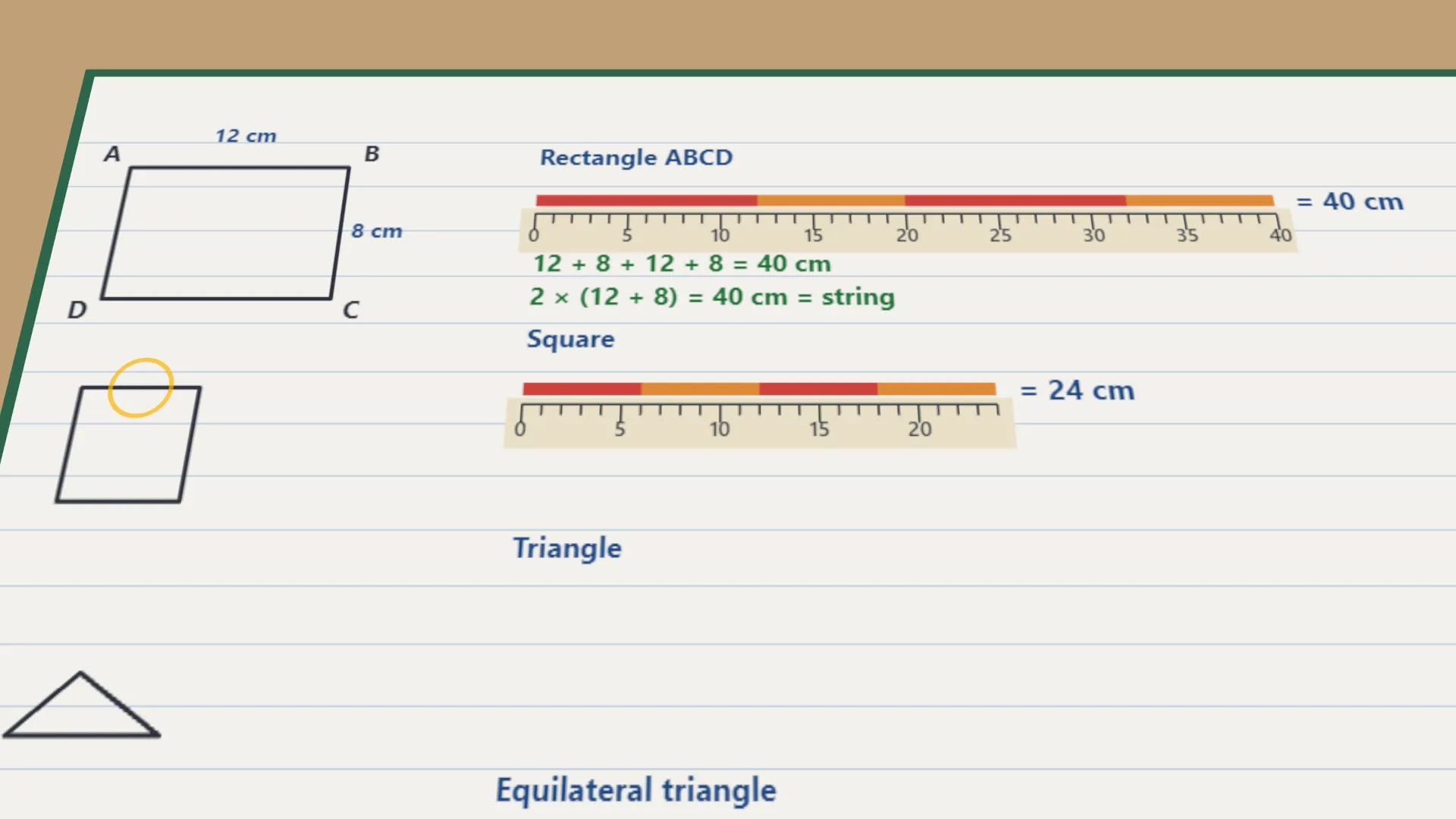
- Lay a string exactly along the rectangle's boundary, mark where it returns to the start, straighten it and measure it.
- Measure the length and breadth. Compare length + breadth + length + breadth with the string.
- Do the same for the square. Is the perimeter 4 × side?
- Measure the three sides of the triangle and add them. Is that the perimeter?
- Do the same for the equilateral triangle, the regular pentagon and the regular hexagon. Measure one side only.
- On the dot grid, count the straight units (s) and the diagonal units (d) separately. Write "… s + … d".
- Write the perimeter rule for each figure in your own words.
Interactive 3D Experiment
Loading simulation…
What to observe
- Is the string's length the same as the sum of the sides, for every figure?
- What is the rule for the rectangle? For the square? For any regular polygon?
- Why can a straight unit and a diagonal unit not be added together?
Notes
- The word "perimeter" comes from the Greek peri (around) and metron (measure) — the measure around a shape.
- Athletics tracks, the boundary rope of a cricket field and the lace around a tablecloth are all perimeters.
- For any regular polygon, perimeter = number of sides × length of one side.
- Lay the string exactly along the boundary without stretching it. A stretched string gives too large a perimeter.
- Mark the point where the string returns to its start before lifting it off.
- Straighten the string fully against the ruler and read from the zero mark, not from the edge of the scale.
- Keep your eye directly above the mark you read. Looking sideways gives an error.
- Use the same unit for every side and measure to the nearest millimetre.
- Count straight units and diagonal units separately. A diagonal is longer than one grid unit.