
Percentages on a Hundred Grid
Aim
Write fractions, ratios and decimals as percentages, and percentages back as fractions and decimals, using a 10 × 10 hundred grid and bar models. Show that a percentage is simply a fraction with denominator 100.
Apparatus
- Hundred-grid (10 × 10) sheets — at least six per student or group
- Coloured pencils or sketch pens (at least four colours)
- Ruler, pencil and eraser
- Scissors and a glue stick
- Strips of squared paper, 10 cm long, for building bar models
Procedure
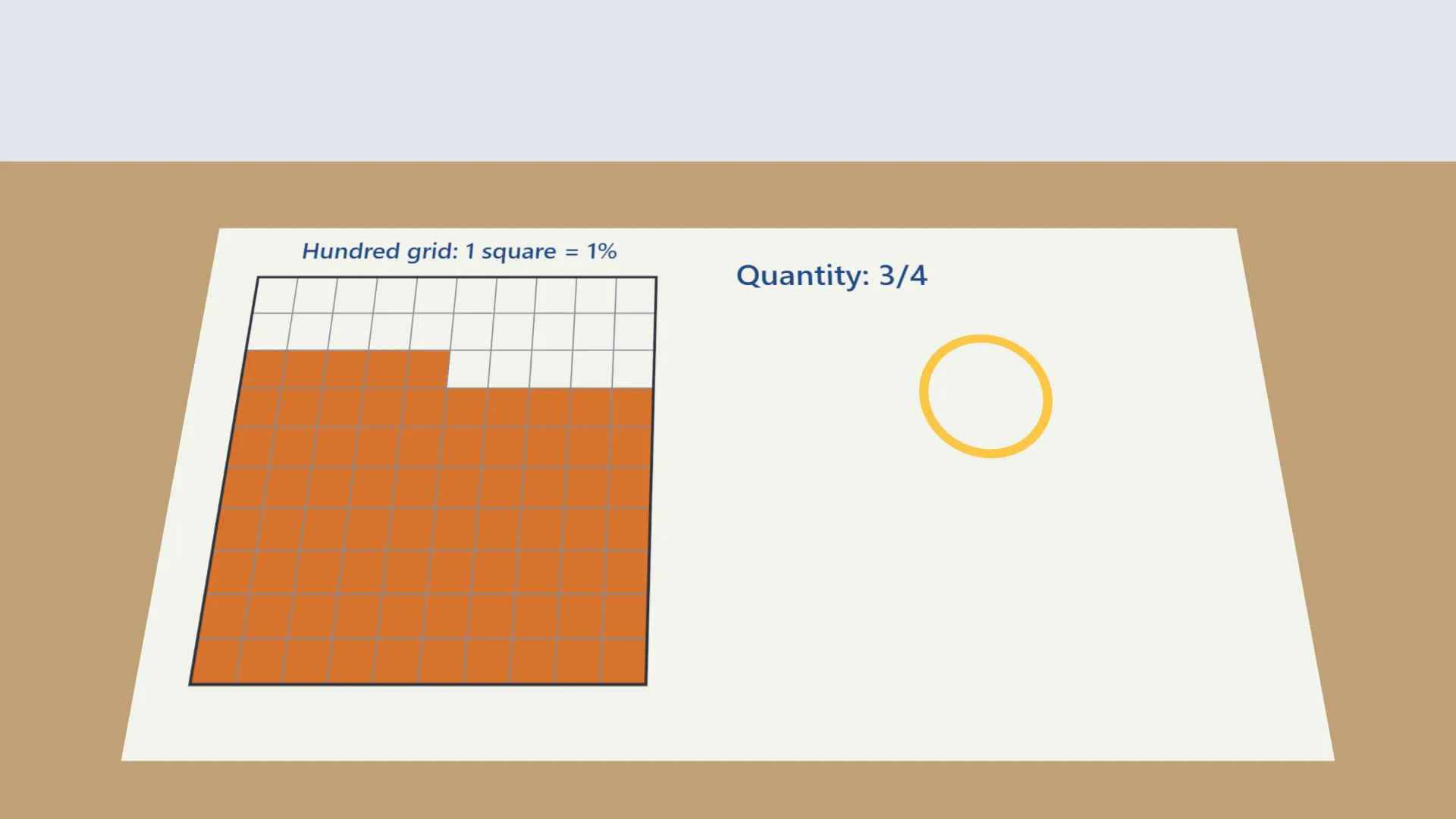
- Shade 75 of the 100 squares. Write the shaded part as a fraction, a decimal and a percentage.
- Show 3/4 as an equivalent fraction out of 100: 3/4 = 75/100. Check it against your shading.
- Repeat for 2/5, 9/20 and 72/150. Write the fraction out of 100 before shading.
- Try 1/3: 33 whole squares and one-third of the next square. What does this say about 33.33%?
- Given 24%, shade 24 squares and write the fraction in simplest form and the decimal.
- Cut the shaded grid into ten strips, paste them end to end, and draw a 0% to 100% scale marking 25%, 50%, 75%.
- Complete the observation table and check in each row that fraction × 100 = percentage.
Interactive 3D Experiment
Loading simulation…
What to observe
- Each small square is one hundredth, or 1%, of the whole grid.
- A fraction becomes a percentage by writing it out of 100: 3/4 = 75/100 = 75%.
- 1/3 needs 33 squares and a third of the next one, so it is 33.33…%, not a whole number.
- A percentage is a fraction whose denominator is 100, so percentages can be compared directly.
Notes
- Math Spark: ‘per cent’ comes from the Latin per centum, ‘by the hundred’. Kautilya’s Arthashastra (4th century BCE) already fixes interest rates ‘per month per cent’. Italian merchants wrote ‘xx p cento’ for 20%, and over time this was squeezed into the symbol %.
- Check that the grid is exactly 10 × 10 = 100 squares before shading.
- Shade complete squares and count them carefully; shade half a square only when the value ends in .5, and count it as 0.5%.
- Convert the fraction to an equivalent fraction with denominator 100 before shading, not by guesswork.
- Always write the % sign: 25 and 25% are not the same thing.
- When converting a percentage back to a fraction, reduce it to lowest terms.
- The whole grid is 100%, so a shading can never exceed one grid.
- Keep the bar-model strips exactly 10 cm long and divide them into equal parts.