
Why Did My Pen Stop Writing? — Practising the Scientific Method
Aim
To apply the steps of the scientific method to solve a simple, real-life problem and to record each step as scientists do.
Apparatus
- Science notebook / lab record and pencil
- A ball pen (preferably one that has stopped writing, or any pen for demonstration)
- Any two or three everyday objects with a simple, observable mystery (a wilting leaf, a flat bicycle tyre, a torch that won’t switch on)
- Chart paper and sketch pens (for the flow-chart activity)
Procedure
- Take a pen that has stopped writing.
- Observe the pen carefully. Write down exactly what you notice. (Step 1 - Observe)
- Frame your question - ‘Why did my pen stop writing?’ (Step 2 - Question)
- Write down your first guess - ‘the ink has finished.’ (Step 3 - Hypothesise)
- Test your guess by opening the pen and checking the ink refill. (Step 4 - Test)
- Record what you found. If the guess was wrong, write a new guess and test it the same way.
- Analyse your results and write a one-line conclusion. (Step 5 - Analyse)
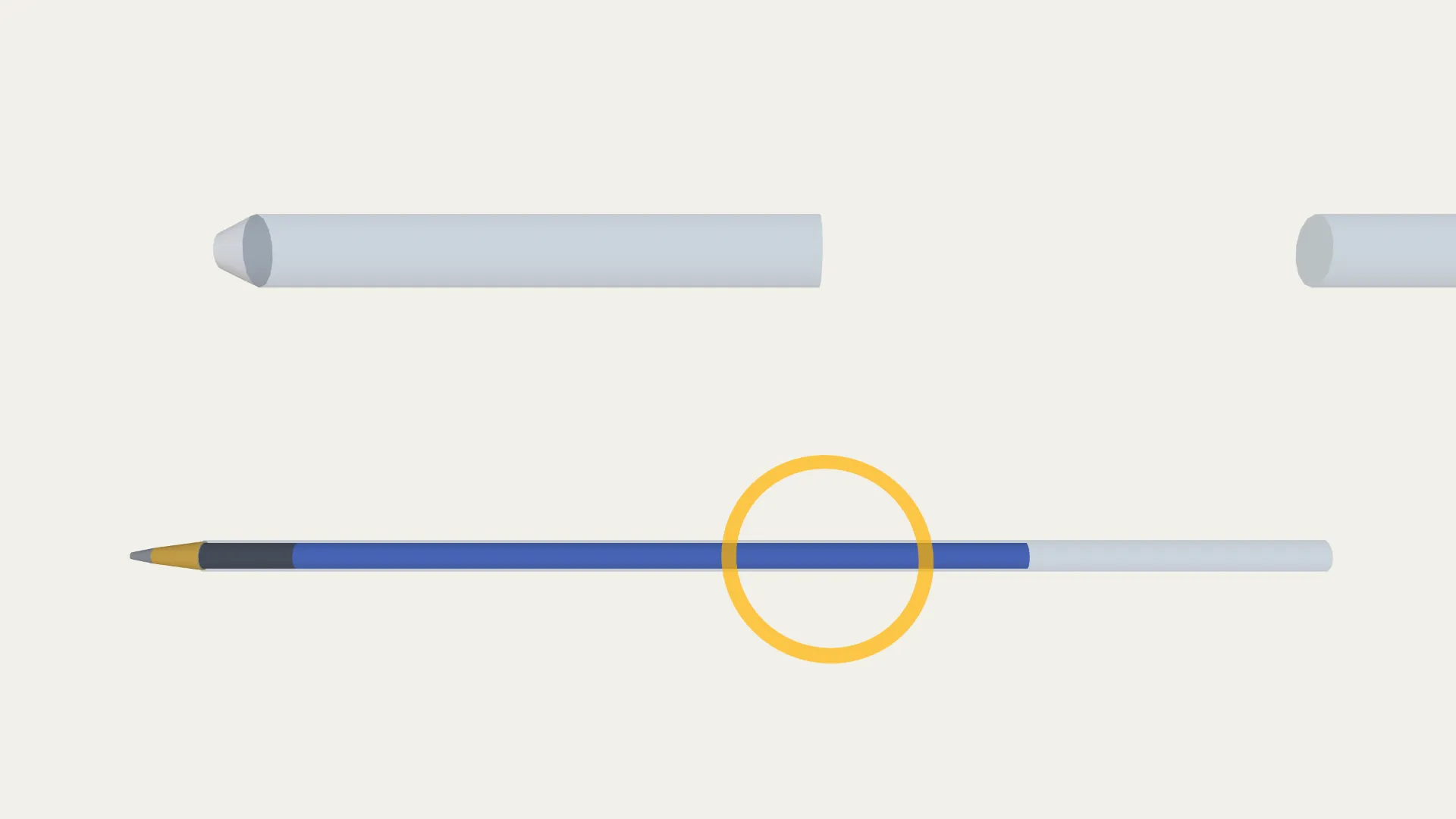
Interactive 3D Experiment
Loading simulation…
What to observe
- The first guess was wrong, and it stays in the notebook. A wrong guess is a normal part of science.
- Testing one guess after another gives a more reliable answer than guessing once.
Safety
- Open the pen over your desk or a sheet of paper so that the spring, nib and refill are not lost. Keep the pointed nib away from your face and your neighbour’s face.
- Never put the refill, nib or pen cap in your mouth. Ink is not safe to taste and a loose cap is a choking hazard.
- Do not force a stuck pen apart, and never use a blade, knife or scissors to open it. Ask your teacher for help.
- Choose only safe objects for the other ‘mysteries’. Do not open or investigate anything electrical, battery-leaking, pressurised or gas-operated.
- Wash your hands after handling ink, and record each step exactly as it happened. A wrong hypothesis must not be erased.
Notes
- The word ‘scientist’ is younger than you might think. It was coined only in 1833 by the British scholar William Whewell. Before that, people who studied nature were simply called ‘natural philosophers’!