
Patterns that Hide a Rule
Aim
Build growing patterns with matchsticks and square tiles, write the number of pieces at any position as a rule, then frame and solve an equation to answer questions like "which step uses exactly 99 sticks?".
Apparatus
- About 40 matchsticks or toothpicks
- 20 to 25 small square tiles, or paper squares of the same size
- Dot grid or graph paper notebook
- Ruler, pencil and coloured pens
Procedure
- Build the matchstick triangles — position 1 is one triangle, each new position adds one triangle.
- Count the sticks at positions 1 to 5, record them, write the rule 2n + 1 and test it on built positions.
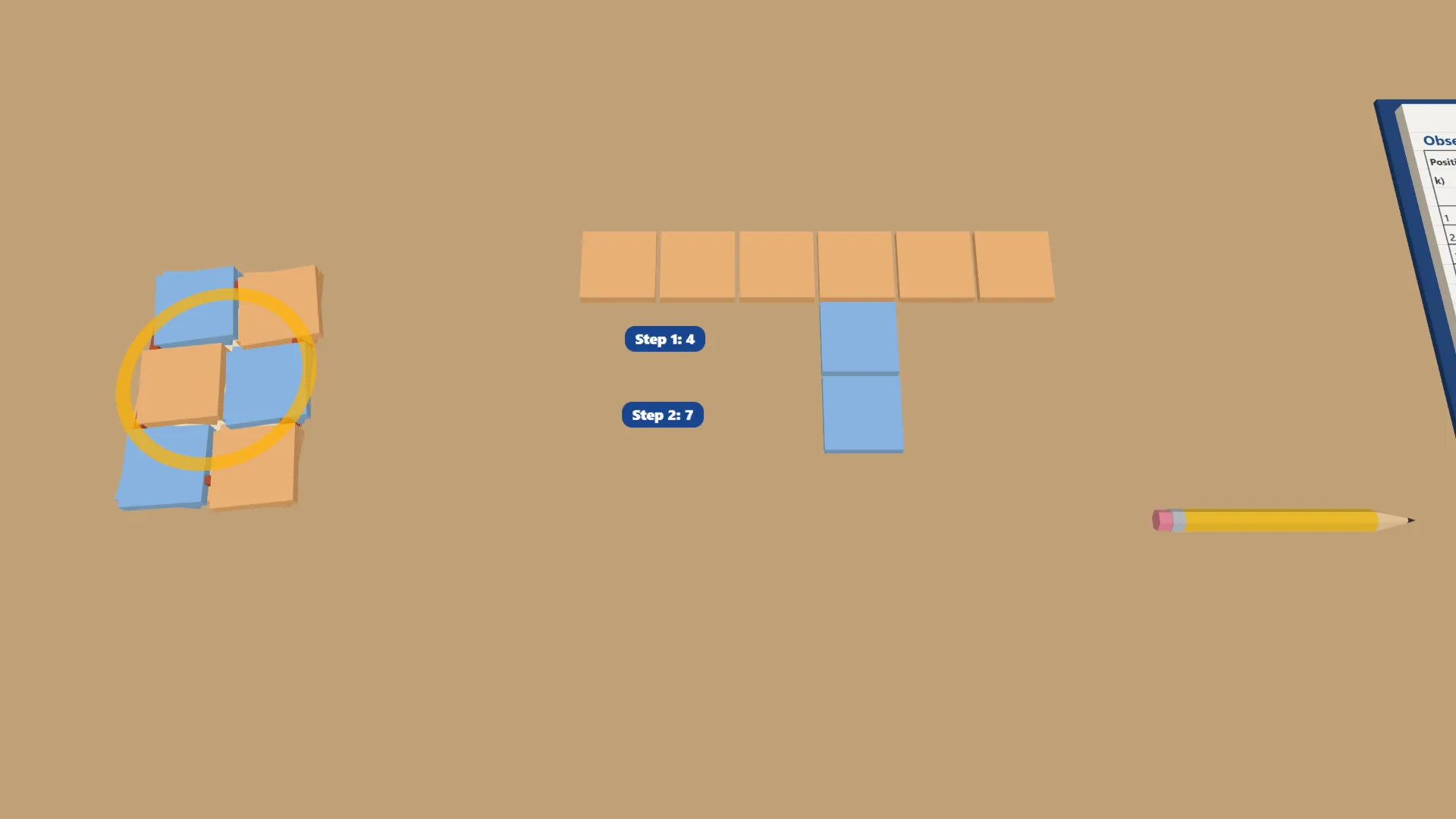
- Build the tile "T" and count the tiles at Steps 1 to 5. Write the rule 3k + 1.
- Frame an equation. For exactly 99 sticks, write 2n + 1 = 99.
- Do the same to both sides to solve it, and check that this position really exists.
Interactive 3D Experiment
Loading simulation…
What to observe
- The triangles use 3, 5, 7, 9, 11 sticks — 2 more at each position, rule 2n + 1.
- The tile "T" uses 4, 7, 10, 13, 16 tiles — 3 more at each step, rule 3k + 1.
- Solving 2n + 1 = 99 gives n = 49, so position 49 uses exactly 99 sticks.
- Substituting n = 49 back into the rule gives 99 — one equation answers a far-off position.
Notes
- Jasmine wanted exactly 99 sticks. Because position n uses 2n + 1 sticks, she solved 2n + 1 = 99 to get n = 49 — no need to build all 49 shapes.
- A single rule like 2n + 1 generalises a whole pattern, so one equation answers infinitely many questions.
- Build each position carefully and count shared matchsticks only once.
- Enter the counts in the table before dismantling a position, and check them for a constant difference.
- n stands for the position number, not the number of sticks.
- Test the rule against at least two positions you have built before using it.
- Substitute the solution back into the equation to verify it.
- Keep the tiles and matchsticks aligned so the pattern does not distort as it grows.