
Change One Thing at a Time — Designing a Fair Test with a Paper Spinner
Aim
To design and carry out a fair test — changing only one variable while keeping all others the same — and to see how careful measurement and repeated trials make a conclusion reliable.
Apparatus
- Science notebook (lab record) and a pencil
- A few strips of paper, all cut to the same size (20 cm × 4 cm)
- A pair of scissors
- A few identical paper clips
- A ruler and a stopwatch or phone timer
- Chart paper and sketch pens for a results graph (optional)
Procedure
- Build a spinner: cut a slit at the top of a strip, fold the two flaps out as wings, clip the bottom.
- Drop it and watch how it falls. Ask a question, e.g. does wing length change the fall time?
- Change only the wing length. Keep paper, strip size, clip and drop height the same; no fan or breeze.
- Write your hypothesis, e.g. longer wings make the spinner fall more slowly.
- Make spinners that differ only in wing length. Drop each from 2 m and time its fall.
- Repeat each drop three times and record every reading.
- Find the average time for each wing length, draw a graph and write your conclusion.
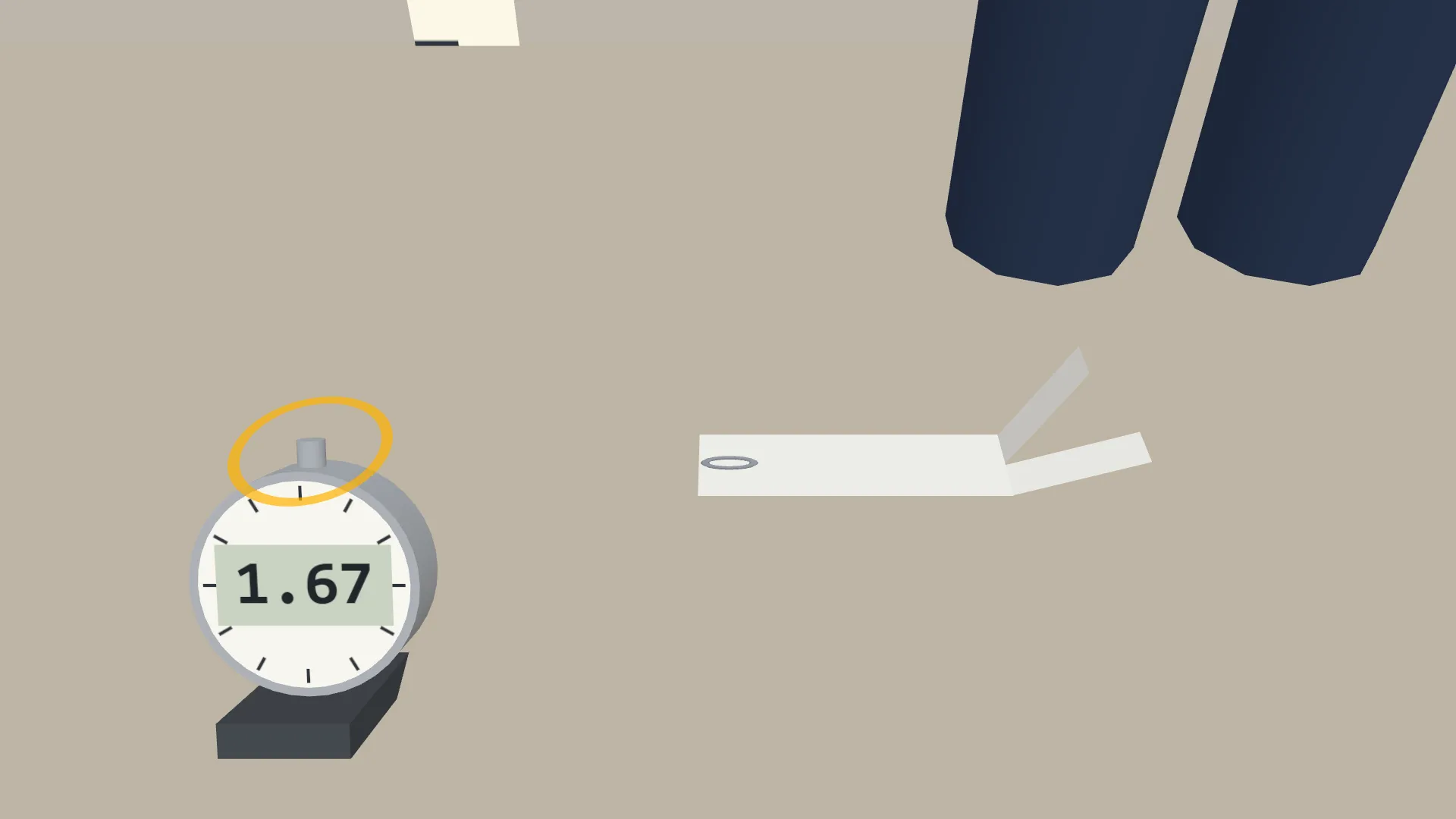
Interactive 3D Experiment
Loading simulation…
What to observe
- Spinners with longer wings take longer to reach the floor — they spin more slowly.
- The three drops of the same spinner are not exactly equal; the average is more reliable than one reading.
- Only the wing length was changed, so the difference in time comes from the wings — a fair test.
Safety
- Cut all strips to exactly the same size; only the wing length should differ.
- Use the same paper and the same number of identical paper clips for every spinner.
- Drop each spinner from exactly the same height. Release it gently — do not push or throw it.
- Switch off fans and close windows. Even a slight breeze spoils the readings.
- Start the stopwatch at release and stop it when the spinner touches the floor, every time.
- Repeat every drop at least three times and record each reading before working out the average.
- Handle scissors carefully and cut away from your fingers.
Notes
- Science Spark: one of the first recorded fair tests was in 1747. Ship's surgeon James Lind gave groups of sailors with scurvy different treatments, keeping food and living conditions the same. Those given oranges and lemons recovered.
- The times in the simulation come from a simple model (about 1.6 s, 2.1 s and 2.5 s for 6, 8 and 10 cm wings); each drop varies a little, as real drops do.