
Let Learning Take Flight — Designing a Fair Test with Paper Planes
Aim
To find out how changing one feature of a paper plane affects the distance it flies, and to understand why a fair test needs repeated trials and only one changed factor.
Apparatus
- Science notebook (lab record) and a pencil
- Six to eight sheets of A4 paper, all of the same size and thickness
- A measuring tape (5 m or longer) or a metre scale
- Chalk or masking tape to mark the launch line
- Four or five paper clips, to add weight to the nose
- A stopwatch or a phone timer (optional)
- Chart paper and sketch pens for the bar graph
Procedure
- Mark a launch line in a clear corridor and lay the measuring tape along the floor from it.
- Fold two identical planes from the same paper with the same folds. This is the standard design (A).
- Change ONE thing only: two clips on the nose of B, wider wings on C. Keep everything else the same.
- Write down your prediction before the first throw.
- Throw plane A from behind the line. Measure to where its nose first touched the floor, in cm.
- Throw it twice more, same person and same force. Record all three readings.
- Make the one change (clips on B, then wider wings on C) and repeat the three throws for each.
- Find each design's average: add the three readings and divide by three.
- Draw a bar graph of the average distance for each design.
- Compare with your prediction. If they disagree, do not rub it out — write what you now think.
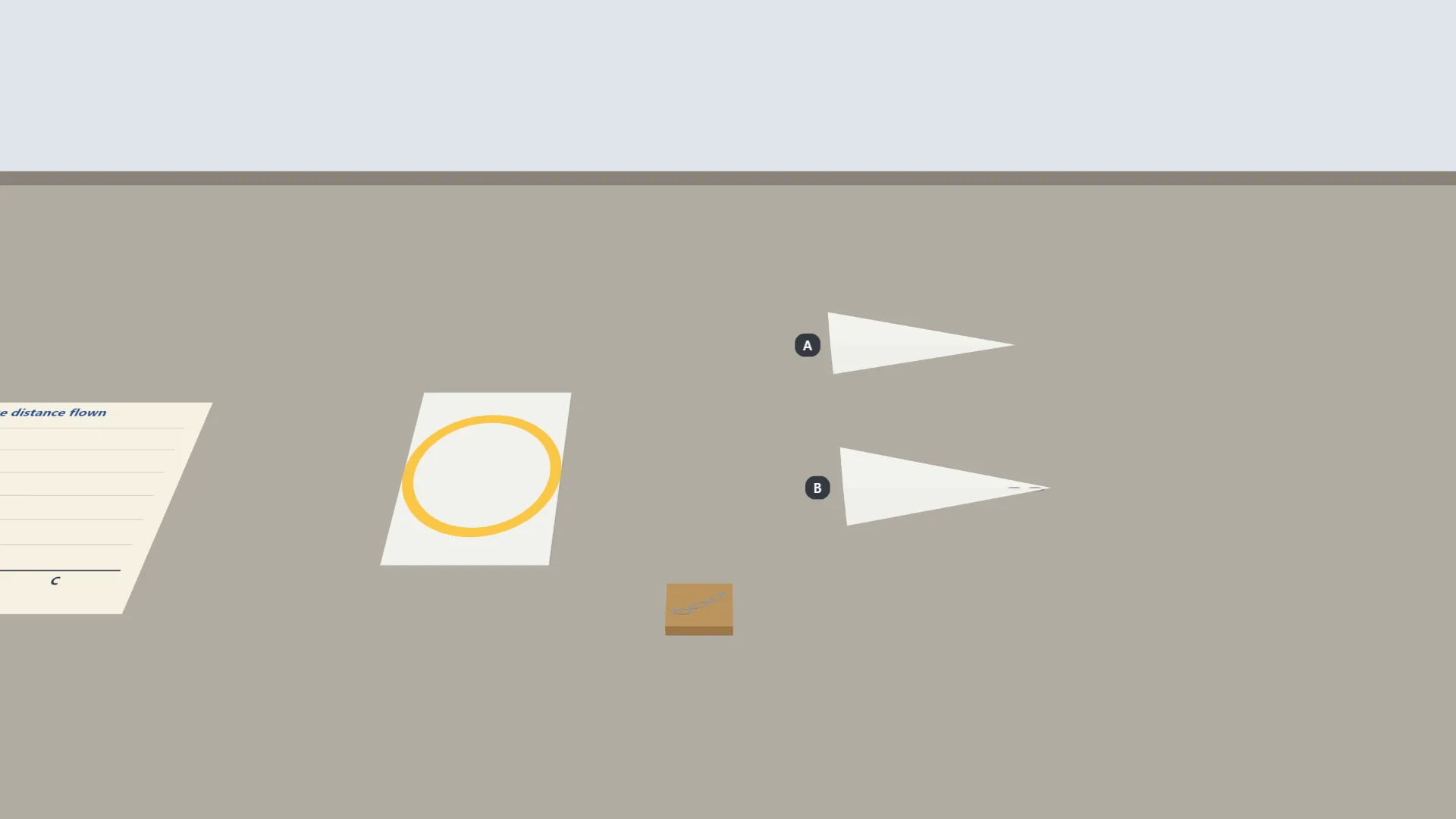
Interactive 3D Experiment
Loading simulation…
What to observe
- The plane with wider wings (C) flies the farthest on average; the plane with two clips on the nose (B) the shortest.
- The three throws of the same plane are not exactly equal — one throw can be unusually good or bad.
- The average of three readings is a better guide than any single throw.
- Only one thing was changed for each plane, so the difference in distance comes from that change — a fair test.
Safety
- Use the corridor or open ground only with the teacher's permission, and only when it is clear of people.
- Never aim a plane at anyone's face. Throw along the corridor, never across it, one student at a time.
- Do not sharpen the nose into a stiff point, and never fit pins, staples or blades. Only paper clips, pressed on firmly.
- Walk, do not run, to fetch the plane, and never step on the measuring tape. Roll it up after each set of readings.
- Keep the throwing force gentle and the same every time — a fair test, not a longer throw, is the aim.
Notes
- Science Spark: the farthest a paper plane has ever flown is 98.43 m — a record set after months of studying aerodynamics and testing one folded design after another, exactly as you are doing here.
- The distances in the simulation come from a simple model (A about 410 cm, B about 310 cm, C about 490 cm); each throw varies a little, as real throws do.