
Studying a Cell — Preparing an Onion-Peel Mount
Aim
Make a temporary mount of onion peel, look at it under a microscope and find the basic parts of a plant cell.
Apparatus
- A fresh onion bulb and a pair of forceps
- Glass slides, coverslips and a fine brush
- Safranin (red stain), glycerin and clean water in petri dishes
- A dissecting needle, a dropper and blotting paper
- A compound microscope or a foldscope
- Science notebook and pencil
Procedure
- With forceps, pull the thin, see-through layer from the inside of an onion piece.
- Put the peel in safranin for about 30 seconds, until it turns light pink.
- With a fine brush, move the peel to clean water to rinse off the extra stain.
- Lay the peel flat on a clean glass slide with the brush, without folding it.
- Put a drop of glycerin on the peel so the cells do not dry out.
- Lower a coverslip slowly with a needle, at about 45°, so no air bubbles get trapped.
- Wipe the extra glycerin from the edges with blotting paper.
- Put the slide on the microscope stage. Look at low power first, then high power.
- Draw what you see, label the parts and fill in the observation table.
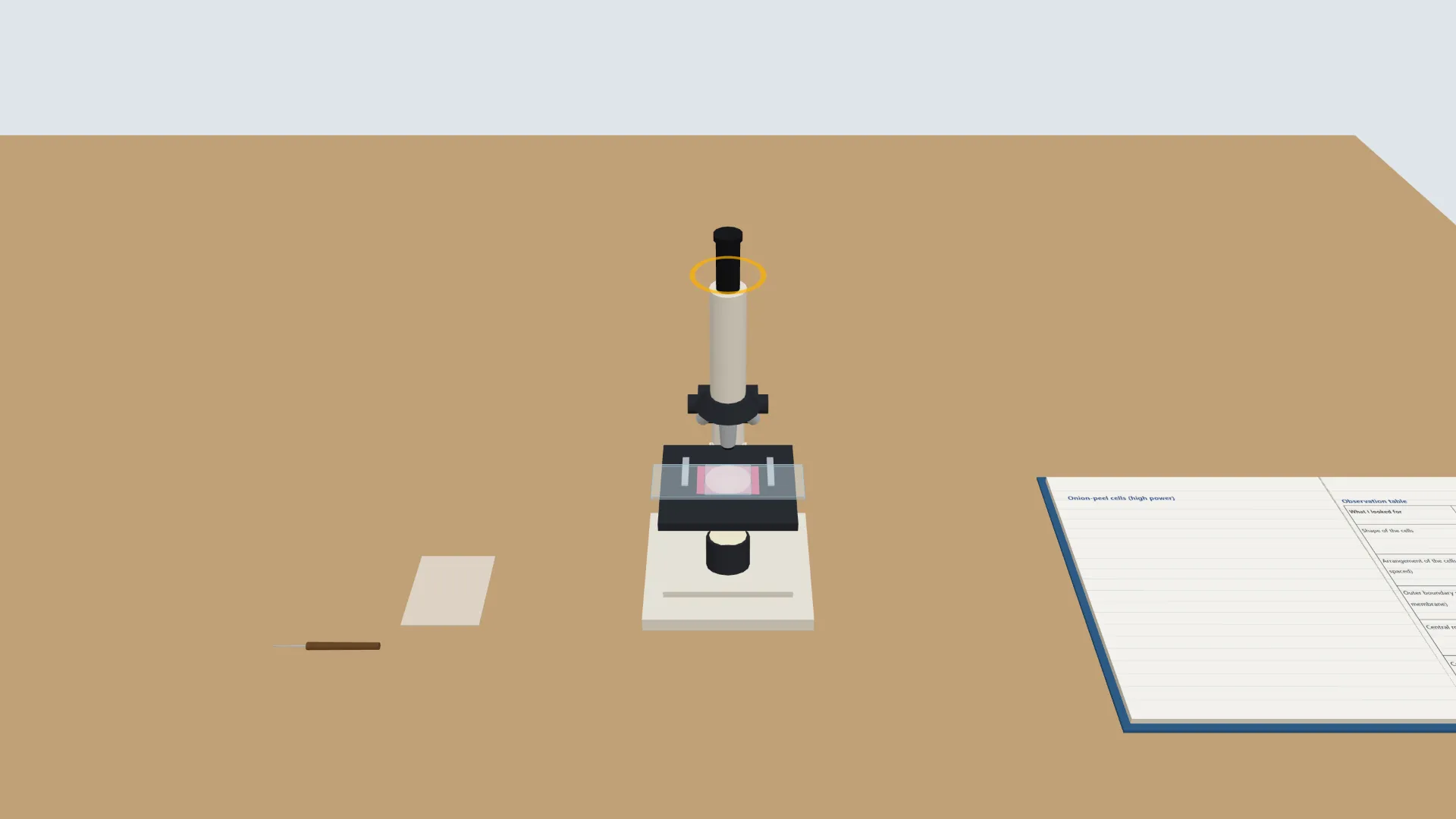
Interactive 3D Experiment
Loading simulation…
What to observe
- What shape are the cells, and how are they arranged?
- Can you see the thick cell wall and the cell membrane just inside it?
- Which round structure in each cell takes up the most stain?
- What is the large clear space in the middle of each cell?
Safety
- Handle slides, coverslips and the needle carefully — the edges are sharp and glass breaks easily.
- Peel the onion with forceps, not your fingernails, and take a thin, see-through layer.
- The peel must lie flat, without folding, curling or tearing.
- Do not over-stain — about 30 seconds in safranin is enough; rinse off the extra stain.
- Lower the coverslip slowly at about 45° so no air bubbles are trapped — bubbles can look like cells.
- Wipe off extra glycerin so the slide does not stick to the microscope stage.
- Focus with low power first, then high power, using the fine adjustment screw.
- Wash your hands after using the stain, and never taste anything in the lab.
Notes
- The word 'cell' was first used in 1665, when Robert Hooke looked at a thin slice of cork and saw rows of tiny empty boxes like a honeycomb.