
Numbers Built from Primes
Aim
Write numbers as products of prime factors with factor trees and the division method, then use the prime factors to find the HCF (least powers of the common primes) and the LCM (greatest powers of every prime) of a pair.
Apparatus
- Notebook and coloured sketch pens
- Ruler and pencil
- Small cards or slips of paper to write prime factors
- A prepared list of numbers: 90, 105, 96, 360, 84, 112
Procedure
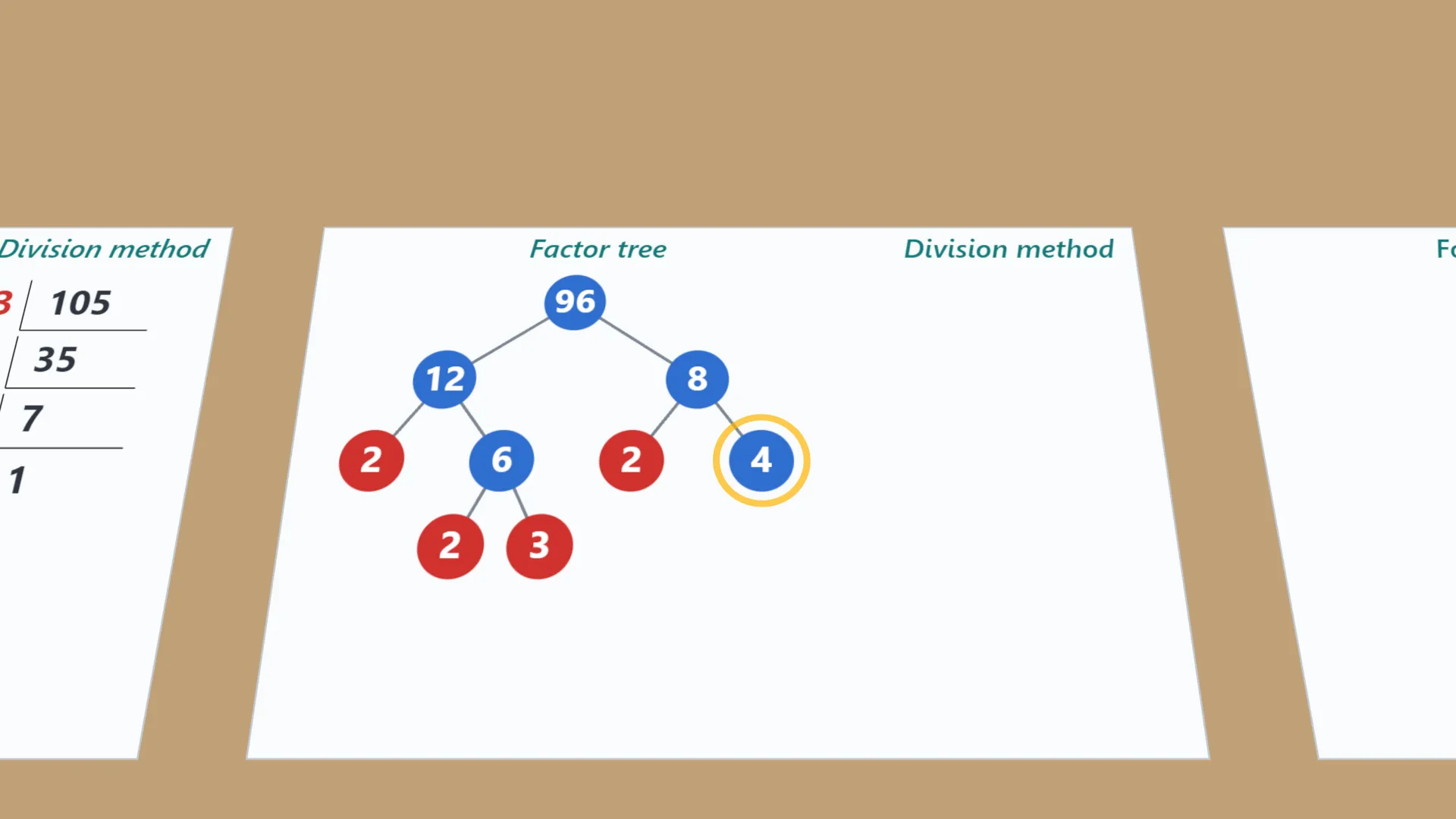
- Build a factor tree for 90. Split each number into two factors until only primes are left.
- Split 90 again with a different first step, 3 × 30. Do you reach the same primes?
- Write 90 by the division method. Divide by the smallest prime that fits, again and again.
- Do the same for each number in the list and write its prime factorisation in the table.
- For the HCF of a pair, keep the common primes, each the least number of times it appears. Multiply.
- For the LCM of a pair, take every prime, each the greatest number of times it appears. Multiply.
Interactive 3D Experiment
Loading simulation…
What to observe
- Do different first splits and the division method give the same primes?
- Is the HCF always a factor of both numbers, and the LCM a multiple of both?
- Is the HCF × LCM equal to the product of the two numbers?
Notes
- Every whole number greater than 1 has exactly one prime factorisation, apart from the order of the factors. This is the Fundamental Theorem of Arithmetic.
- Primes never stop. The largest prime known so far has 41,024,320 digits and was found on 12 October 2024.
- Continue splitting until every branch of the tree ends in a prime.
- 1 is not a prime, so a branch must never end with 1.
- In the division method, divide by the smallest prime that fits at each stage.
- Write repeated factors in index form carefully. 2 × 3² × 5 is not the same as 2 × 3 × 5².
- Least power for the HCF, greatest power for the LCM. They are easily swapped.
- Check your answer. The HCF must divide both numbers and the LCM must be a multiple of both.