
Under the Open Sky — Planning a Night-Sky Watch
Aim
To plan and safely carry out a night-sky observation session under adult supervision, and to record the stars, constellations and planets identified.
Apparatus
- Science notebook / lab record and pencil
- A sky-mapping mobile app such as Sky Map or Stellarium (installed with adult help), or printed star charts
- A torch covered with red cellophane, to preserve night vision
- A magnetic compass (optional)
- Warm clothing / mat to sit on, as appropriate
Procedure
- With an adult, pick a dark, open area away from streetlights, tall buildings and trees.
- Use a sky-mapping app to choose a clear, moonless night.
- At the site, wait about half an hour for your eyes to adjust to the dark.
- Look north and find the Big Dipper, then the Pole Star from it.
- Find the constellation Orion and the bright star Sirius near it.
- Find a planet such as Venus at dusk or dawn by its steady, non-twinkling light.
- Record each object, its time, direction and feature in the table.
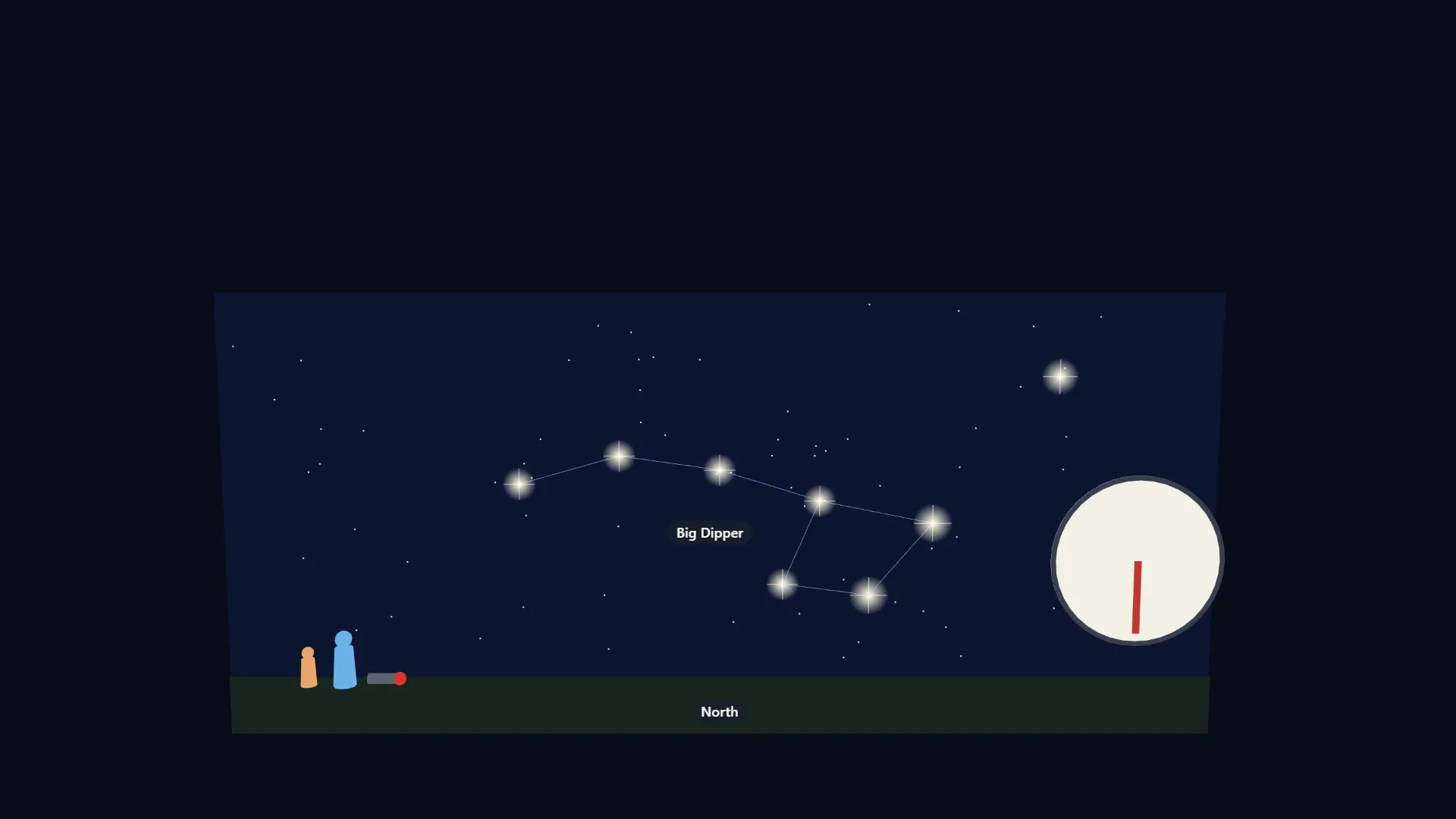
Interactive 3D Experiment
Loading simulation…
What to observe
- Stars twinkle, but a planet such as Venus shines with a steady light.
- A dark, open place with a clear, moonless night shows the most stars.
- Ask yourself how easy it was to spot objects, and how light pollution could affect it.
Safety
- Never go for night observation alone. A parent or guardian must plan the session, accompany you and stay throughout.
- Tell your parents the exact place and return time, and carry a charged mobile phone.
- Observe only from a safe, familiar, open place such as your terrace, courtyard or school ground. On a terrace, stay well away from the edge and any open water tank.
- Use a normal torch for walking and the red-cellophane torch for observing. Never shine a torch into anyone's eyes or towards a road.
- Wear full sleeves and closed shoes, use mosquito repellent, sit on a mat and stay out of tall grass.
- Cancel the session in rain, lightning or strong wind, or if the area is unsafe, and do the indoor chart alternative instead.
- Never point binoculars, a telescope or a camera at the sun.
Notes
- Did you know? At the Indian Astronomical Observatory in Hanle, Ladakh, local residents are trained as 'Astronomy Ambassadors'. They use small telescopes to guide visitors through the Hanle Dark Sky Reserve, one of the darkest skies in India!