
Nature Detectives — Exploring Diversity Around Us
Aim
To observe and record the diversity of plants and animals in a local natural area, noting the features of stems, leaves and flowers, and the habits of animals.
Apparatus
- Science notebook and pencil
- Hand lens (if available)
- Water bottle
- Collection bag for fallen leaves or flowers (do not pluck)
Procedure
- Plan a short nature walk with your teacher to a park, garden or open ground near your school.
- As you walk, note the weather conditions - hot, cold, windy and so on.
- Observe at least four different plants. Note if the stem is soft or hard, and the shape and arrangement of leaves and flowers.
- Record your plant observations in Table A.
- Observe the animals around you. Note where each one lives, what it eats and how it moves.
- Record your animal observations in Table B.
- Without disturbing any living thing, close your eyes for 30 seconds and picture the plant and animal that impressed you most. Sketch both.
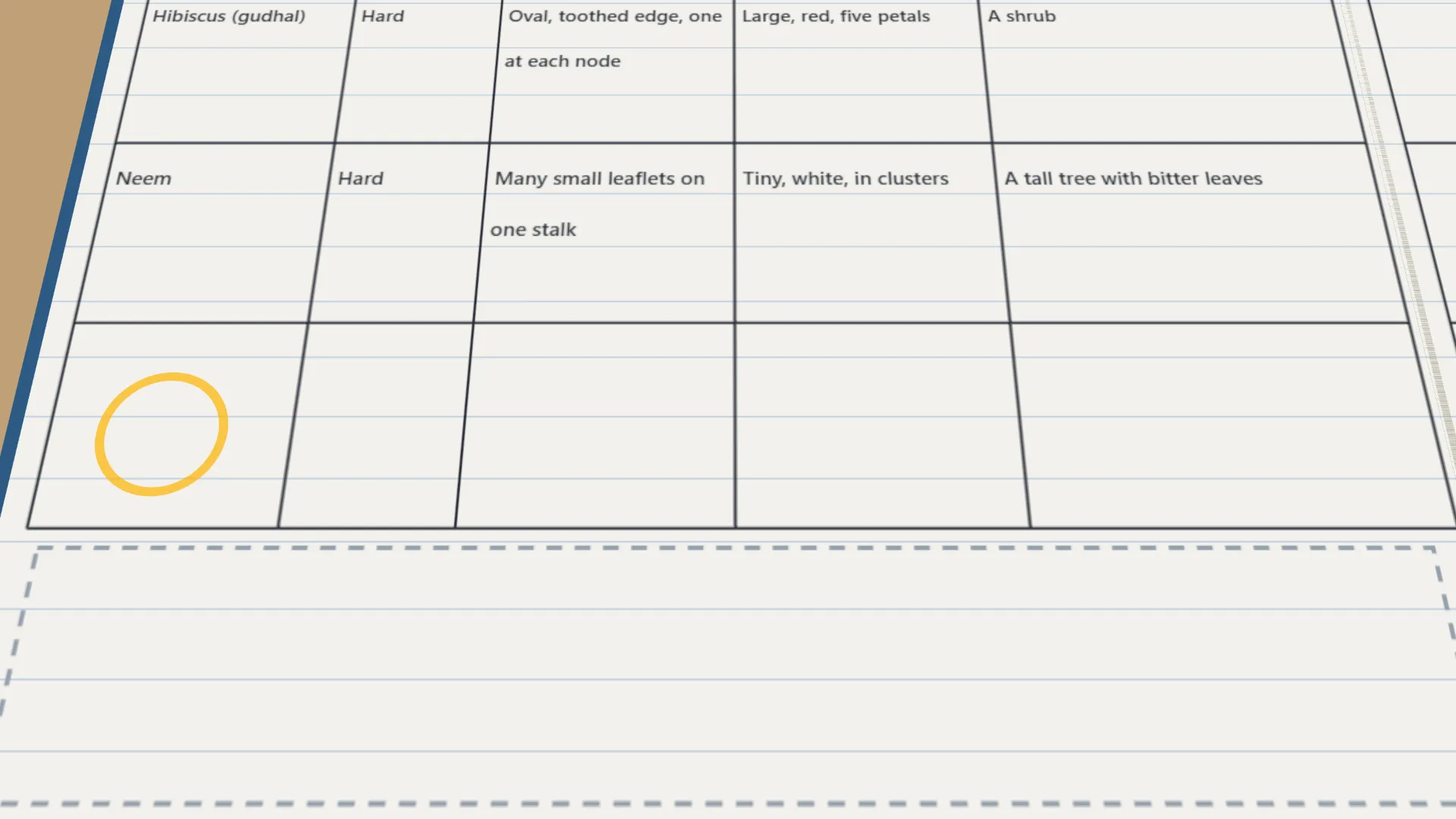
Interactive 3D Experiment
Loading simulation…
What to observe
- Plants differ in their stems (soft or hard), leaves and flowers.
- Animals differ in where they live, what they eat and how they move.
- Biodiversity means the many different kinds of living things around us.
Safety
- Stay with your group and within your teacher’s sight throughout. Never wander off alone or leave the group to follow an animal.
- Observe all animals from a safe distance. Do not touch, catch, chase, feed or frighten any creature, and do not disturb nests, anthills or beehives.
- Do not pluck leaves, flowers or branches - collect only what has already fallen. Never taste any wild leaf, seed, berry, fruit or mushroom.
- Wear full sleeves and closed shoes, carry a cap and drinking water, avoid thorny and stinging plants, and watch your step on uneven ground.
- Tell your teacher at once if you are bitten, stung, scratched or feel giddy, and wash your hands with soap before eating after the walk.
Notes
- No two zebras have exactly the same stripe pattern, much like human fingerprints. Researchers use this natural variation to identify and track individual zebras in the wild.