
Categorising Natural Resources
Aim
To sort ten natural resources in two ways: by use (essential for life, materials or energy) and by renewability (renewable or non-renewable).
Apparatus
- A textbook reference (the chapter's sections on categories of natural resources)
- A notebook
- Coloured pencils
Procedure
- Revisit the two ways of sorting natural resources, by use and by renewability.
- Study the diagram that shows both ways side by side.
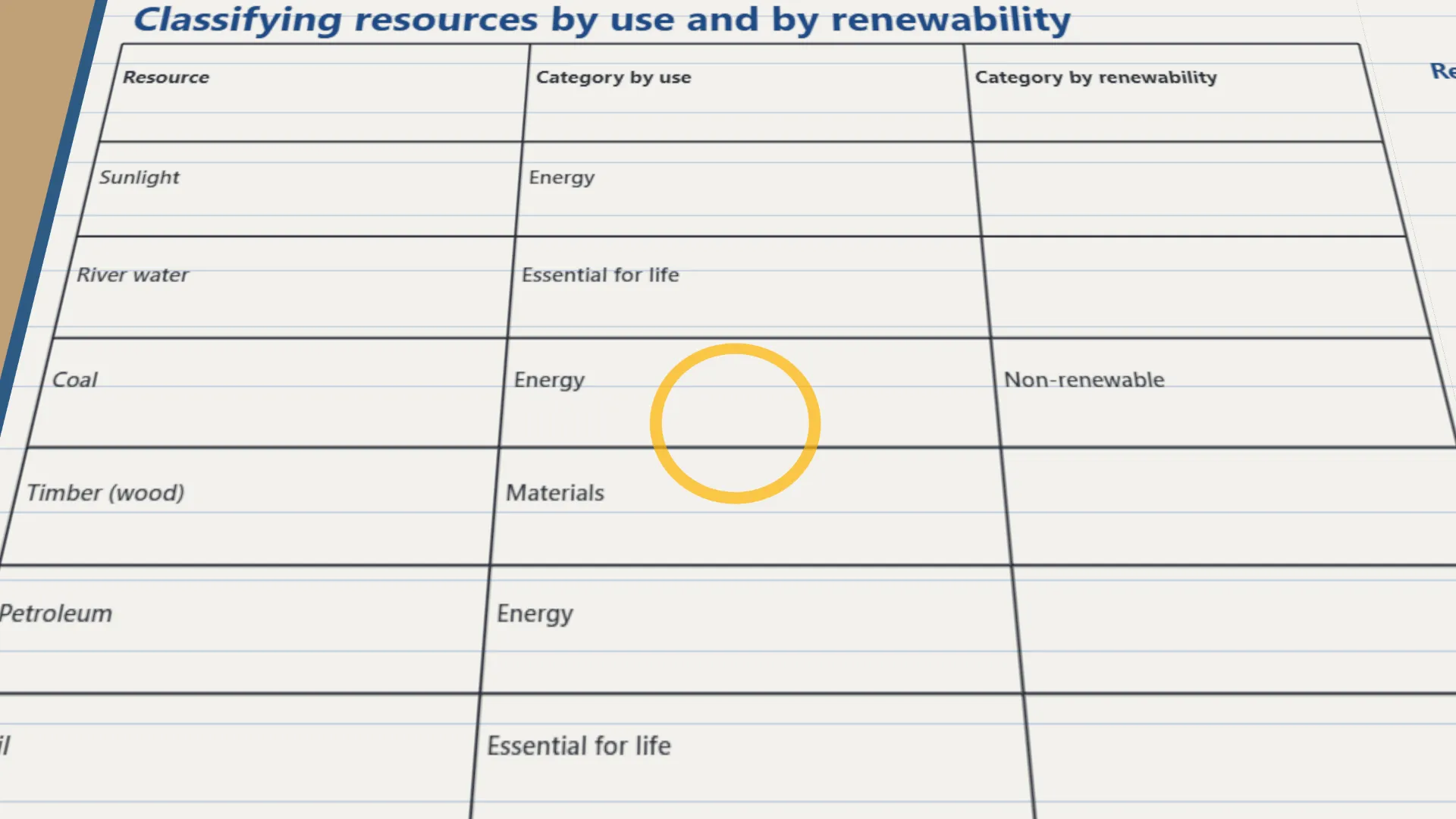
- Draw a table with three columns, Resource, Category by Use and Category by Renewability.
- Read the ten resources. Decide the use category of each and whether it is renewable or non-renewable.
- If a resource fits more than one use, choose the use the chapter stresses most and note why.
- Compare your table with a partner's and talk about any resource you disagreed on.
Interactive 3D Experiment
Loading simulation…
What to observe
- Air, river water and soil are essential for life; sunlight, wind and river water can also give energy.
- Coal, petroleum, iron ore and gold cannot be replaced once used, so they are non-renewable.
- Timber is renewable only if trees regrow as fast as they are cut.
Notes
- Social Science Spark: a mature tree makes about 275 litres of oxygen a day, while a person needs about 350 litres a day. Human life depends directly on renewable resources like trees.
- Put each resource in only one use category, even if more than one seems possible. Use the chapter's definitions of renewable and non-renewable when in doubt.