
Modelling Multiplication with the Unit Square
Aim
To model and work out the product of two fractions with unit-square area diagrams, and to discover Brahmagupta's rule (multiply the numerators, multiply the denominators) and the idea of cancelling common factors.
Apparatus
- Square dot or graph-paper notebook (with at least 5 × 5 grids)
- Coloured pencils or sketch pens (at least 3 colours)
- Ruler, pencil and a pair of scissors
- A few square sheets of paper for paper-folding
Procedure
- Take a square sheet. The whole square is 1 (area = 1 square unit).
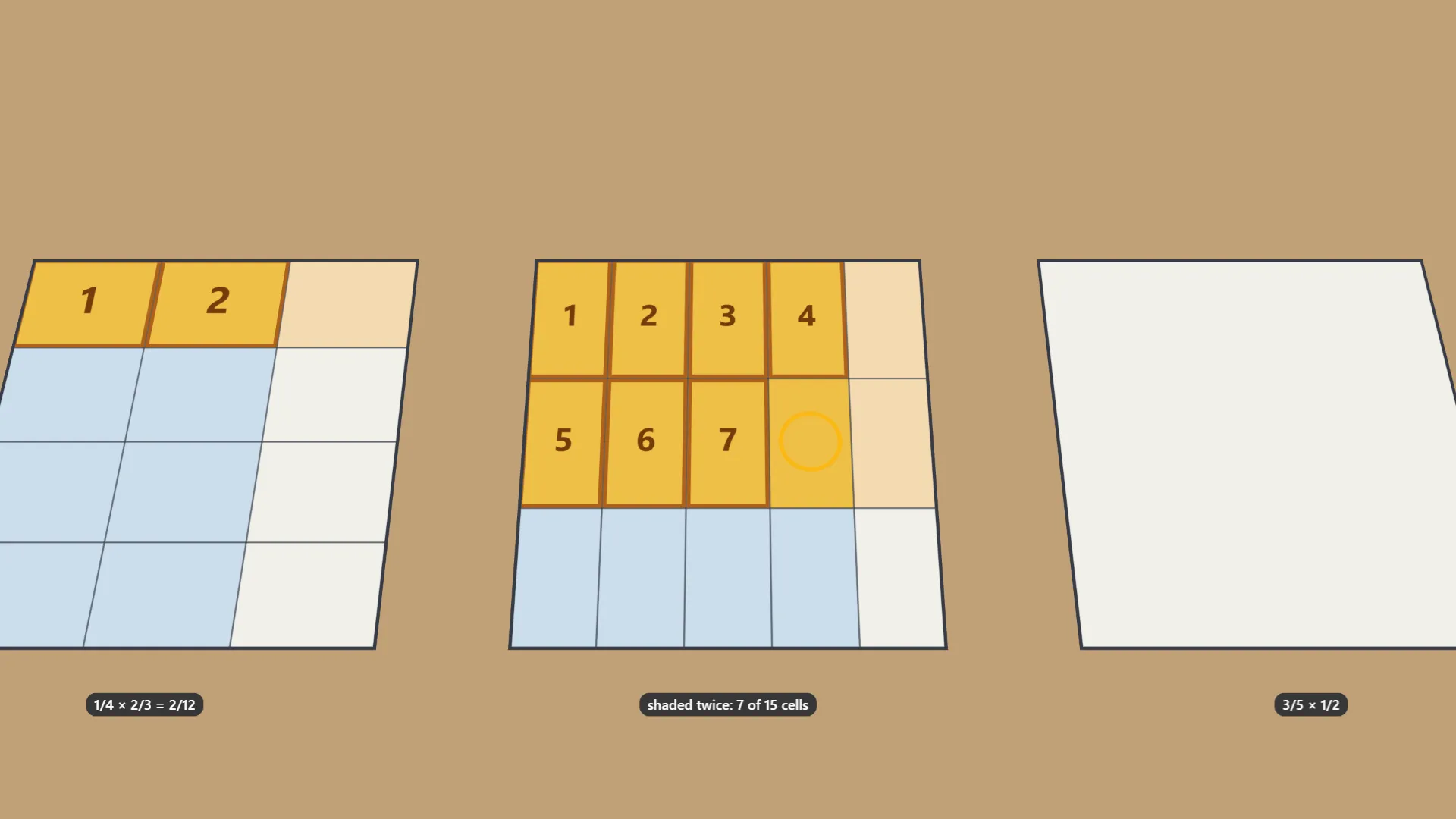
- To model 2/3 × 4/5, divide it into 3 equal rows and 5 equal columns, making 15 equal cells.
- Shade 2 of the 3 rows in one colour and 4 of the 5 columns in another colour.
- Count the cells where the two shadings overlap (8) out of all 15 cells, so 2/3 × 4/5 = 8/15.
- Fold a square into quarters, shade one, fold that strip in half and shade again: 1/2 × 1/4 = 1/8.
- Work out each product by multiplying the numerators and the denominators. Compare with the diagram.
- Try 12/7 × 5/24. Cancel the common factor 12 first to get 5/14, then check by multiplying first.
Interactive 3D Experiment
Loading simulation…
What to observe
- The cells shaded twice, out of all the cells, give the product (2/3 × 4/5 = 8/15).
- The number of rows × columns is the product of the denominators; the overlap is the product of the numerators.
- Half of a quarter is one part out of eight, so 1/2 × 1/4 = 1/8.
- Cancelling first and multiplying first give the same answer, 5/14.
Notes
- Brahmagupta first stated the rule "multiply the numerators, multiply the denominators" in 628 CE.
- In India, reducing a fraction to lowest terms was called apavartana; Umasvati (c. 150 CE) used it as a simile.
- Divide the square into exactly equal rows and columns; unequal parts make the count meaningless.
- Use rows for the first denominator and columns for the second, every time.
- Count only the cells shaded twice for the numerator, and all the cells for the denominator.
- The whole square stands for 1, so the answer is a fraction of the whole.
- Cancel only a factor common to a numerator and a denominator, never two numerators.
- Use light shading or two see-through colours so the overlap stays visible.