
Multiples, Factors and the Idli-Vada Game
Aim
Explore multiples, common multiples and common factors by playing the Idli-Vada and Jump Jackpot games and by organising the results in a Venn diagram.
Apparatus
- Printed number grid up to 60 (or a hundred chart)
- Counters, beads or bottle caps (about 30 per group)
- Two coloured sketch pens
- A long piece of string or wool
- Chart paper, ruler and pencil
Procedure
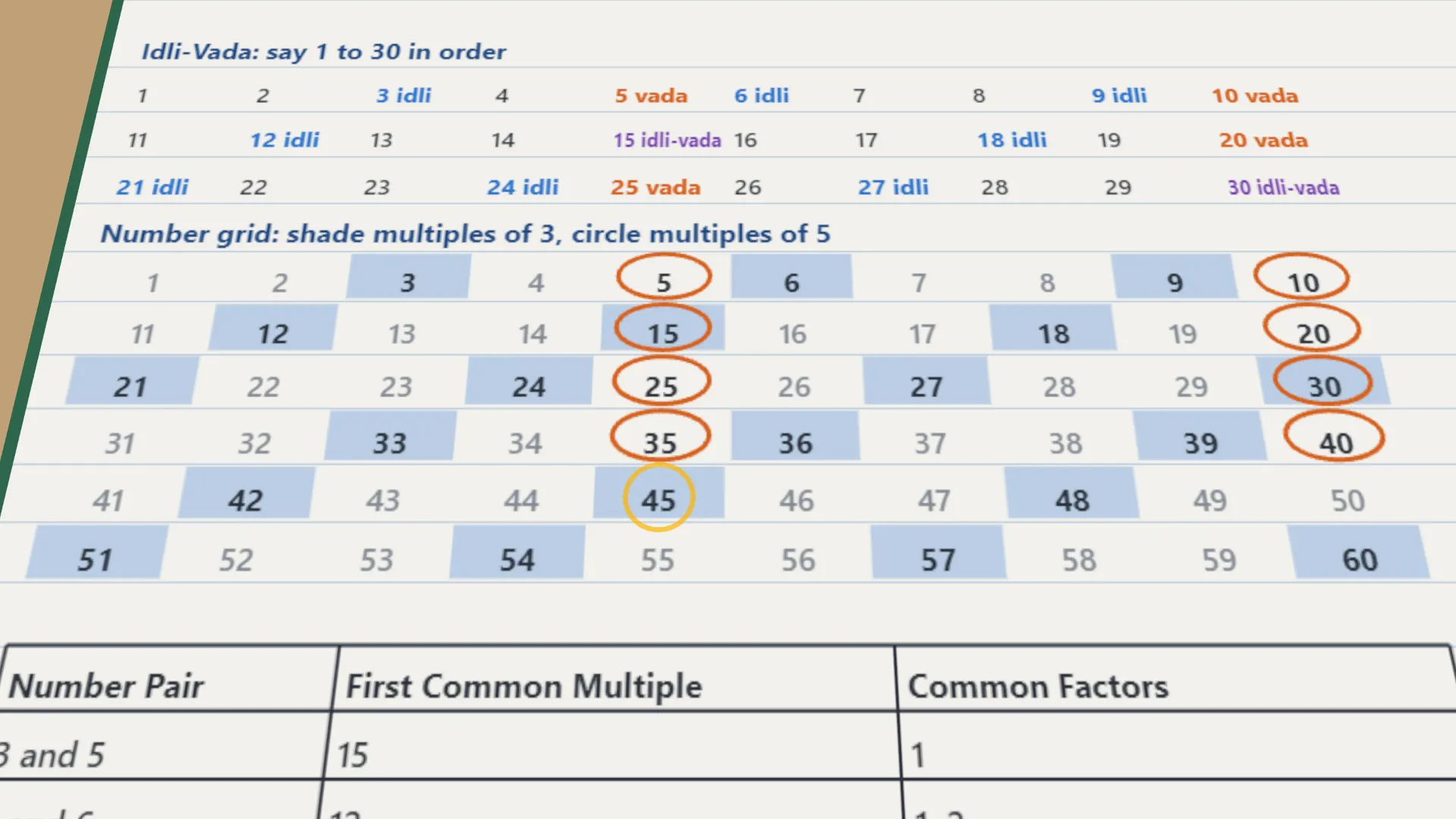
- Play Idli-Vada from 1 to 30 in strict order. Say idli for a multiple of 3, vada for 5, idli-vada for both.
- On the number grid, shade the multiples of 3 and circle the multiples of 5.
- List the numbers that are both shaded and circled.
- Draw a Venn diagram. Put the common multiples only once, in the overlap.
- Play Jump Jackpot from 0. Find the jump sizes that land exactly on 24, then on 36.
- Keep two treasures, on 14 and 36. Find the jump sizes that land on both.
- For each pair, write the first common multiple and the common factors in the table.
Interactive 3D Experiment
Loading simulation…
What to observe
- At which numbers is idli-vada called? What is the first of them?
- Which numbers are both shaded and circled? Where do they go in the Venn diagram?
- Which jump sizes land exactly on a number? What are they called?
Notes
- Idli-vada marks the common multiples of 3 and 5. The very first is 15, the smallest common multiple.
- A jump size lands on a number only when it is a factor of that number. Multiples and factors are the same big idea from opposite sides.
- Play in strict order around the circle. One missed number spoils the count.
- Say idli-vada, not only idli or vada, when a number is a multiple of both 3 and 5.
- Use two clearly different colours for the two sets of multiples.
- Write each common multiple only once, in the overlap of the Venn diagram.
- In Jump Jackpot always start from 0 and keep every jump the same size.
- Check jump sizes right up to the number itself, so no factor is left out.