
Why the Moon Has Phases — A Ball-and-Lamp Model
Aim
To model, using a ball and a lamp, how the lit part of the Moon seen from the Earth changes as the Moon moves around the Earth, and to relate the model to the real phases of the Moon.
Apparatus
- A small soft ball (a sponge ball or a tennis ball)
- A short stick or pencil pushed into the ball to hold it
- A torch or a table lamp (the Sun)
- A dark room, or an open space at night
- Science notebook and pencil
Procedure
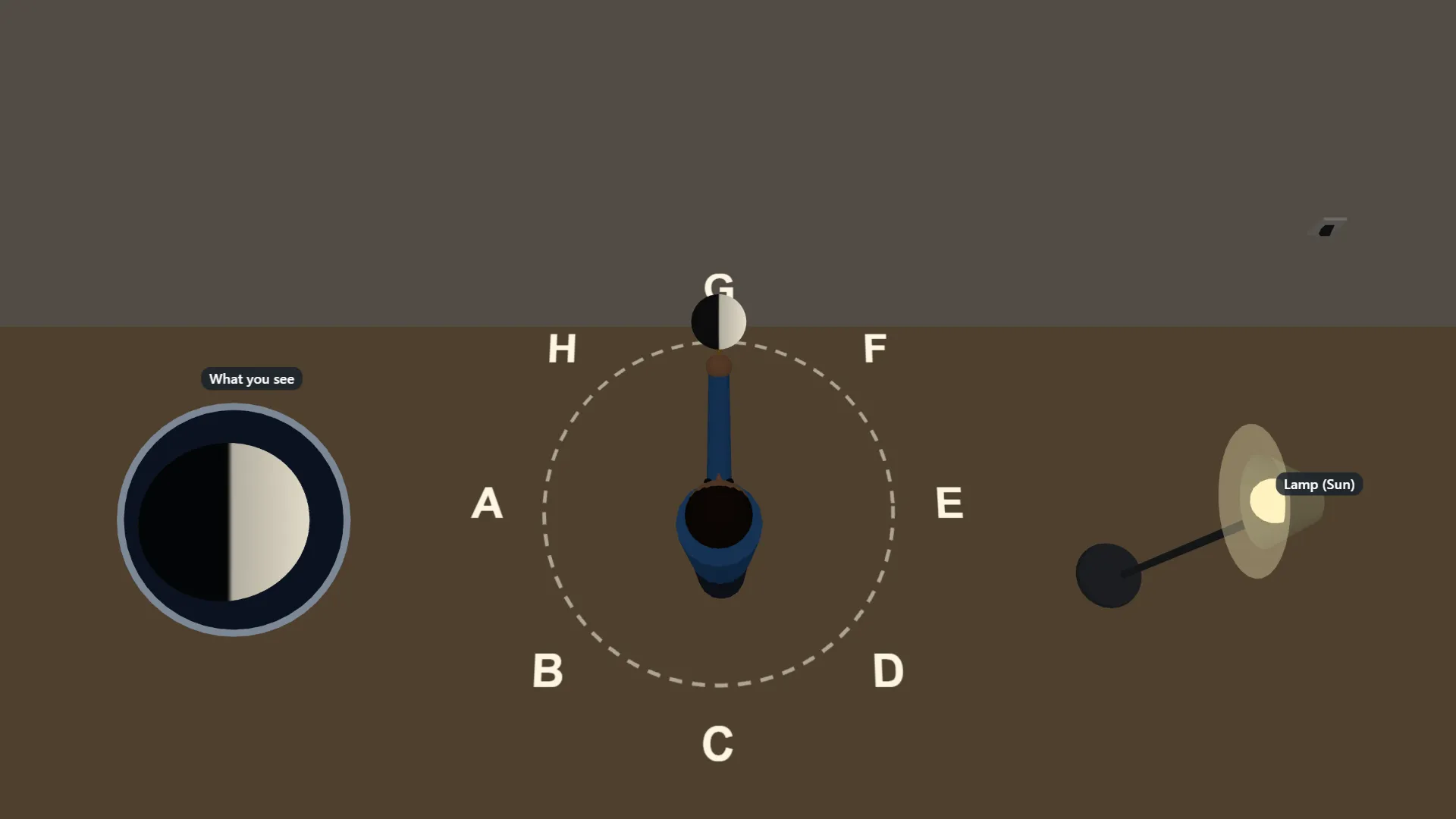
- Push the stick into the ball. The ball is the Moon; your head is the Earth.
- In a dark room, switch on a lamp about 3 m away. The lamp is the Sun.
- Hold the ball at arm's length, a little above your head, towards the lamp (E). Bright or dark?
- Turn slowly anti-clockwise, arm out, and stop at each position A to H.
- At each position, note how much of the lit part you see, and if the edge looks curved.
- Match each position to a Moon phase - A (away from the lamp) is full Moon, E is new Moon.
- Record your observations in the table.
Interactive 3D Experiment
Loading simulation…
What to observe
- At every position exactly one half of the ball - the half facing the lamp - is lit.
- Only how much of that lit half faces your eyes changes as you turn.
- Opposite the lamp (A) you see the whole lit face - a full Moon. Towards the lamp (E) you see none - a new Moon.
- At C and G you see half of the lit face - the half Moons; in between, crescents and gibbous shapes.
- The edge between bright and dark is curved, because the ball is a sphere; it looks straight only at the half Moons.
Safety
- Clear the space around you before turning, so your arm does not strike anything or anyone.
- Push the stick in carefully and keep it away from your face and eyes.
- Keep the lamp about 3 m away; never shine it into anyone's eyes.
- Keep a lamp's cable out of the way and do not touch a hot bulb.
- Hold the ball slightly above your head, so your own shadow does not fall on it.
- Turn your whole body slowly anti-clockwise, keeping the ball at the same height and distance.
- Keep the lamp as the only light in the room.
- Stop at each position long enough to look carefully at the edge between light and dark.
Notes
- Science Spark: the Moon always keeps the same face towards the Earth, so we never see its far side from here. It was first photographed by a spacecraft in 1959.
- In the simulation the lamp is drawn closer than 3 m and you see the ball from above while turning; a small round window shows what your eyes see.