
Trapping the Sun’s Heat
Modelling the Greenhouse Effect
Aim
Model the greenhouse effect with two jars, and see how trapped heat keeps a planet warm enough for life.
Apparatus
- Two identical clear glass jars
- Two similar thermometers (0–100 °C)
- Cling film and a rubber band
- A sunny windowsill or open ground in direct sunlight
- A clock or watch
- Notebook and pencil
Procedure
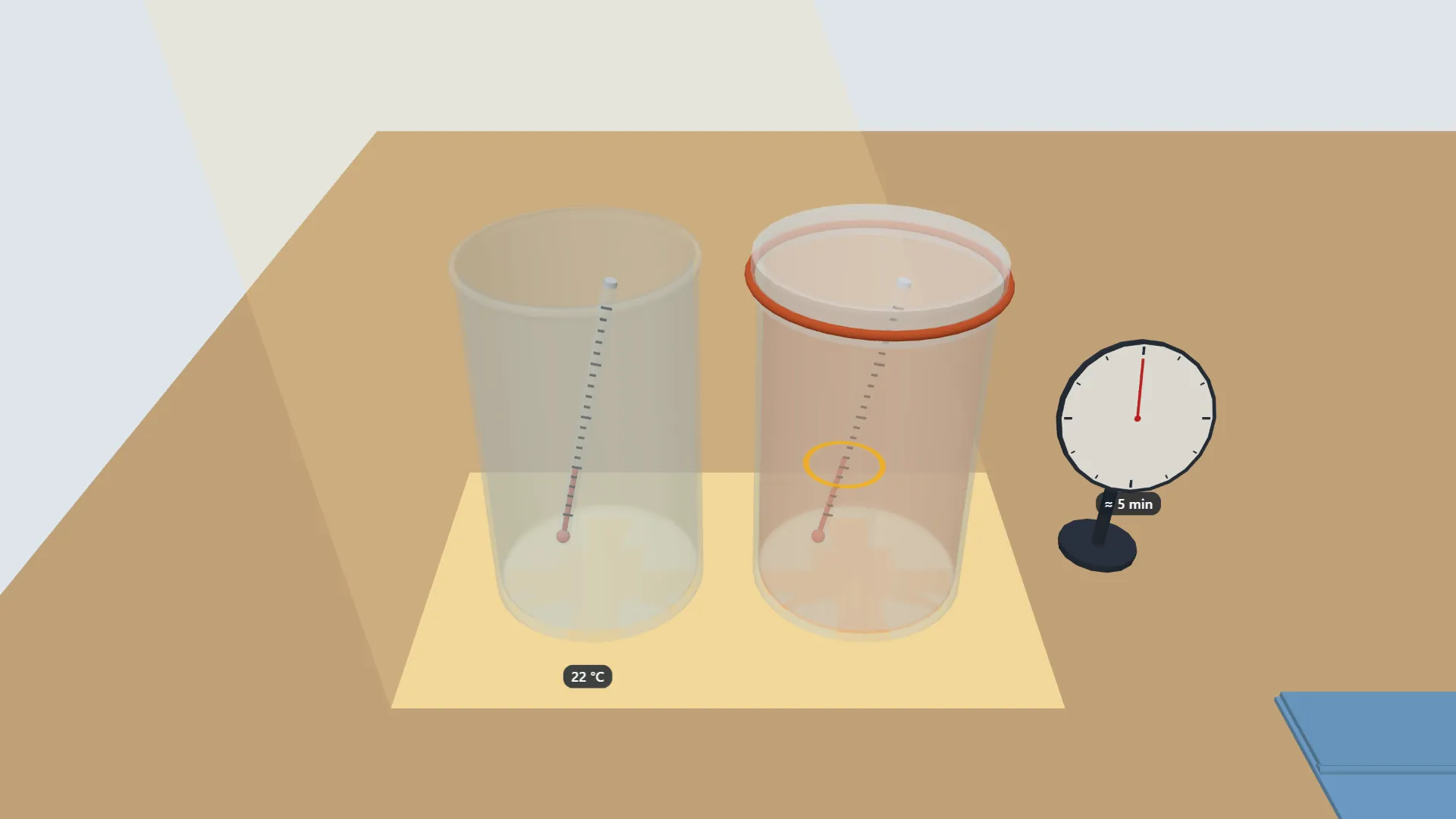
- Stand a thermometer in each jar, its bulb off the bottom. Note both starting temperatures.
- Leave one jar open. Cover the other tightly with cling film and seal it with a rubber band.
- Put both jars side by side in direct sunlight.
- Read both thermometers every 5 minutes for 30 minutes and record them.
- Note which jar becomes warmer, and by how much.
- Move both jars into the shade and see how quickly each one cools.
- Look at your readings and write a one-line conclusion.
Interactive 3D Experiment
Loading simulation…
What to observe
- Which jar warms up faster and reaches a higher temperature?
- How much warmer is the covered jar after 30 minutes?
- In the shade, which jar cools more slowly?
- The cover lets sunlight in but keeps the warm air in — like the Earth's atmosphere.
Safety
- Use two identical jars, and check that both thermometers read the same at the start.
- Place each thermometer bulb in the same position, off the bottom and the sides.
- Keep both jars side by side in the same sunlight — the cover must be the only difference.
- Seal the cling film tightly with the rubber band so no air escapes.
- Read both thermometers every 5 minutes, at eye level, and note the time.
- Read the covered jar through the film — never open it during the test.
- Handle thermometers gently; never shake or heat them. Report a breakage at once.
- Do not leave the jars in strong sunlight longer than needed; let them cool before handling.
Notes
- Venus is the hottest planet — hotter than Mercury, which is closer to the Sun. Its thick carbon dioxide traps so much heat that its surface stays near 450 °C.
- Greenhouse gases keep the Earth's average temperature near 15 °C instead of about −18 °C.