
Modelling Integers on the Number Line
Aim
Show integers on a number line and model adding and subtracting them as movements, using Bela's lift in the 'Building of Fun': '+' moves up (right), '−' moves down (left), and the ground floor is 0.
Apparatus
- A long paper strip for a number line from −10 to +10
- A small counter, bead or bottle cap as the pawn (the lift)
- Coloured pencils or sketch pens
- Ruler and pencil
- Dot grid or graph paper notebook
Procedure
- Draw a line, mark 0 at the centre, then equal steps 1, 2, 3 … to the right and −1, −2, −3 … to the left.
- The line is Bela's lift: '+' moves the pawn right (up), '−' left (down). Put the pawn on 0.
- Addition: Start + Movement = Target. From +1 press +2: (+1) + (+2) = +3. Then try (0) + (−4).
- Cross zero, counting 0 as a hop. From +2 press −3 to reach −1. Then hop from +5 down to −5.
- Subtraction: Target − Start = Movement. Count the hops from +2 to +5: (+5) − (+2) = +3.
- On the tens line, count +80 − (−150) from −150 up to +80, then do +80 + (+150).
- Record the start, the movement and the target, with the matching addition and subtraction.
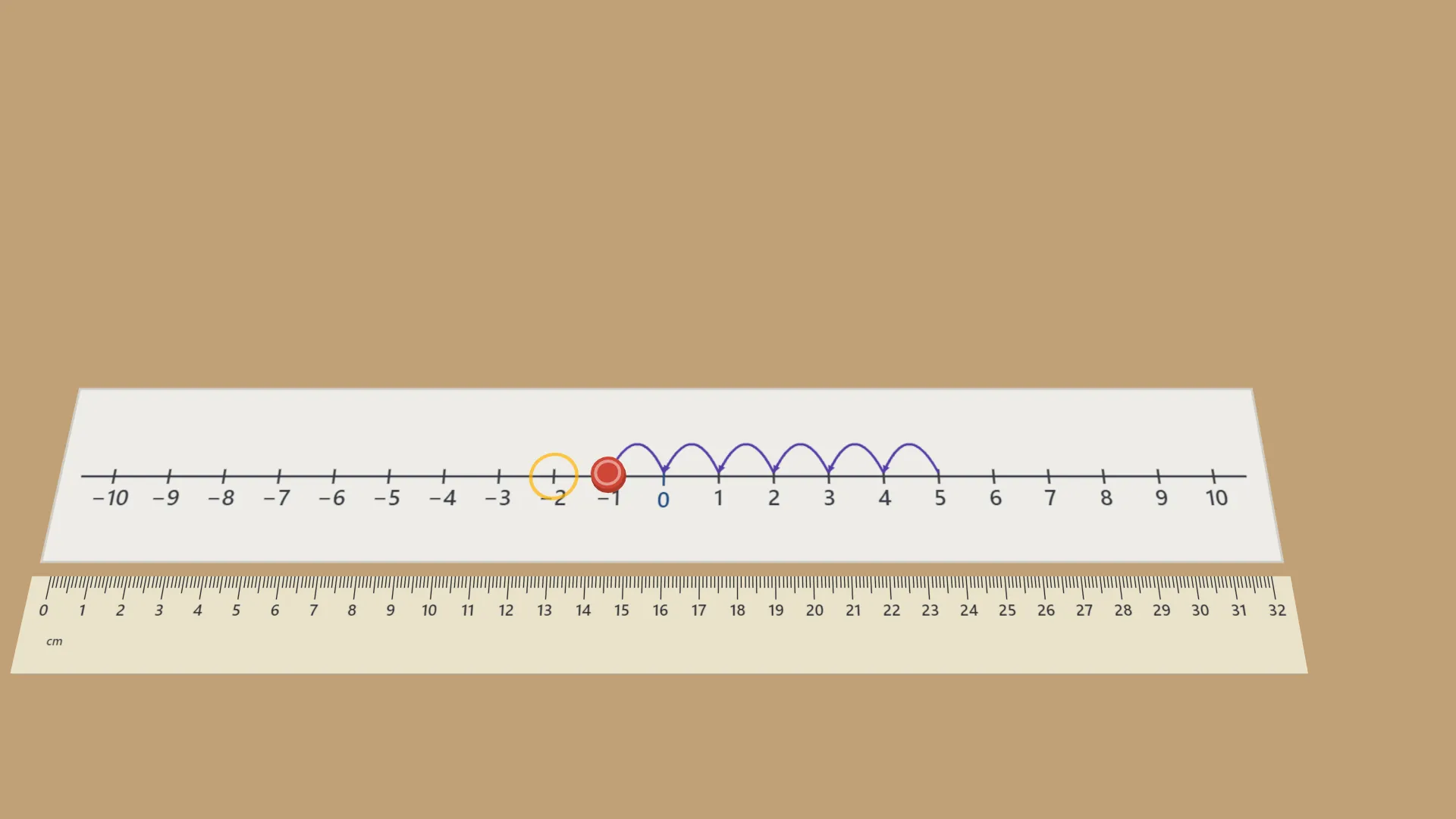
Interactive 3D Experiment
Loading simulation…
What to observe
- '+' always moves the pawn right (up) and '−' left (down). Crossing zero, 0 is one of the hops.
- +80 − (−150) and +80 + (+150) both give +230: subtracting a negative is adding the positive.
Notes
- Around 628 CE the Indian mathematician Brahmagupta treated positive numbers, negative numbers and zero as real numbers and gave rules for adding and subtracting them.
- In the 18th century the French mathematician Lazare Carnot still called negative numbers 'absurd'. Today we use them for bank balances and temperatures below zero.
- Mark 0 at the centre and keep all the steps exactly equal.
- Write the minus sign on every number to the left of 0. A missing sign changes the answer.
- Always count the hops from the starting position, not from 0, one hop at a time.
- Move right for a '+' press and left for a '−' press.
- Write the sign of every integer in the table, including the sign of the movement.