
Modelling Decimal Multiplication
Aim
To model and discover the rule of decimal multiplication, a whole number times a decimal and a decimal times a decimal, using 10 × 10 area grids and strip diagrams, and to explain how the decimal point in the product is placed.
Apparatus
- Square grid or graph-paper notebook (with 10 × 10 blocks)
- Coloured pencils or sketch pens (at least 3 colours)
- Ruler and pencil
- A few small objects such as buttons, coins or bottle caps
Procedure
- Outline a 10 × 10 grid. The whole grid is 1, one column is 0.1 and one small square is 0.01.
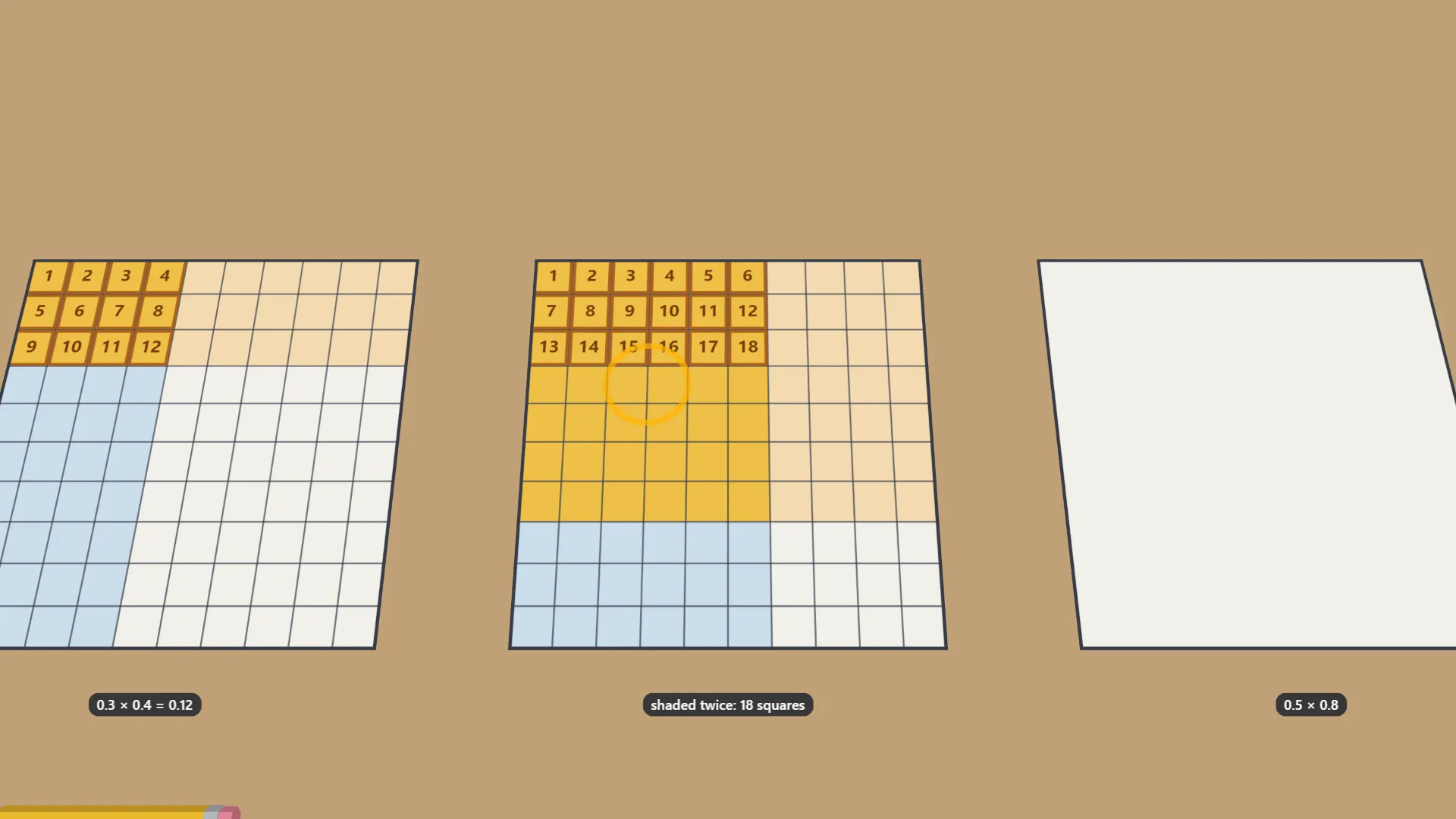
- For 0.3 × 0.4, shade 4 columns and 3 rows in two colours. Count the squares shaded twice (12) = 0.12.
- Repeat on fresh grids for 0.7 × 0.6 and 0.5 × 0.8. Count the double-shaded squares each time.
- For 3 × 0.4, draw 3 groups of 4 tenths. Count 12 tenths and regroup them as 1 one and 2 tenths = 1.2.
- Remove the decimal points and multiply as whole numbers (3 × 4 = 12). Compare the decimal places.
- Write, in your own words, a rule that tells where to put the decimal point in the product.
Interactive 3D Experiment
Loading simulation…
What to observe
- The squares shaded twice, counted as hundredths, give the product (0.3 × 0.4 = 0.12).
- Three groups of 4 tenths make 12 tenths, which is 1.2.
- The product has as many decimal places as the two factors together (2 + 1 = 3, so 147.808).
- Multiplying by a number less than 1 makes the result smaller.
Notes
- If 596 × 248 = 147808, then 5.96 × 24.8 = 147.808, because 2 + 1 = 3 decimal places.
- 0.25 × 0.8 = 0.2 is less than both 0.25 and 0.8, a surprise the first time you see it.
- Draw the 10 × 10 grid accurately and agree at the start that the whole grid stands for 1.
- Shade rows for one factor and columns for the other, using two light or see-through colours.
- Count only the double-shaded squares, and count them as hundredths of the whole grid.
- Count the decimal places from the right-hand end of the product.
- Do not drop a needed zero. 0.2 × 0.4 is 0.08, not 0.8.
- Check that the result is reasonable before recording it.