
Mixing in a Ratio — Stronger, Lighter or the Same?
Aim
Prepare mixtures in different ratios, write every ratio in its simplest form, and use proportional reasoning to decide which mixtures have exactly the same strength as a standard mixture.
Apparatus
- Five or six transparent glasses or small bottles
- A 10 mL or 20 mL measuring cup, a medicine cup, or a clean syringe without the needle
- Water, and a colouring agent — a spoonful of tea or coffee decoction, a few drops of food colour, or squash/sharbat
- Marker pen and slips of paper for labelling
- Notebook, ruler and coloured pencils for the bar diagrams
Procedure
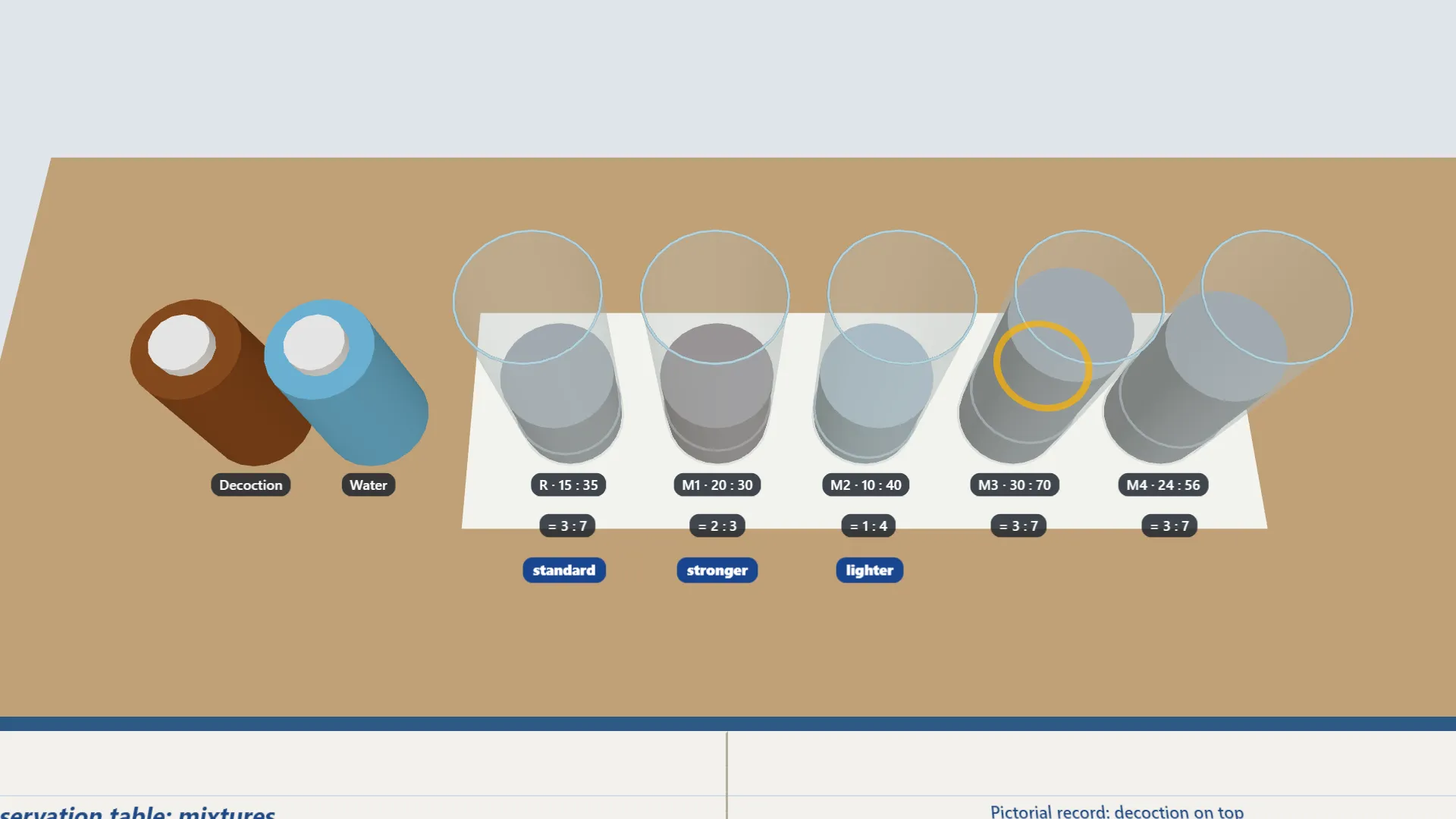
- Prepare the standard mixture R: 15 mL of decoction and 35 mL of water. Label it 15 : 35.
- Prepare M1 to M4: 20 + 30, 10 + 40, 30 + 70 and 24 + 56 mL. Label each glass with its ratio.
- Reduce every ratio to its simplest form by dividing both terms by their HCF.
- Predict from the simplest forms which mixtures look as strong as R. Then hold the glasses side by side and check.
- Record whether each mixture is stronger, lighter or the same as R, and whether its ratio is proportional to 15 : 35.
- Draw every mixture as a two-colour bar of the same height, with the decoction part on top.
- Draw a double number line for R: 15 : 35, 30 : 70, 45 : 105. How much water is needed for 45 mL of decoction?
- Write, in your own words, the rule you used to decide that two mixtures have the same strength.
Interactive 3D Experiment
Loading simulation…
What to observe
- Mixtures 30 : 70 and 24 : 56 reduce to 3 : 7, the same as R, and match its colour exactly.
- 20 : 30 (2 : 3) looks stronger than R and 10 : 40 (1 : 4) looks lighter.
- Two mixtures have the same strength when both parts are multiplied by the same factor, not increased by the same amount.
- On the double number line, 45 mL of decoction needs 105 mL of water to keep the strength 3 : 7.
Notes
- Math Spark: an ORS packet must be dissolved in exactly one litre of water — less water makes it too strong, more makes it too weak. Cooks use ratios too: rice and urad dal 2 : 1 for idlis, rice and water 1 : 2 for cooking.
- Safety: these mixtures are for measuring and comparing only. Do not drink or taste them.
- Use the same measure for every pour and hold it level; read the level at eye level, at the bottom of the meniscus.
- Rinse and dry the measure before changing from decoction to water.
- Stir each mixture well before comparing; an unstirred mixture looks streaked.
- Compare the glasses side by side against the same white sheet, in the same light, using glasses of the same size.
- Label every glass with its ratio as soon as it is prepared.
- Wipe spills at once and keep the liquids away from books and notebooks.