
Measuring Area with Unit Squares
Aim
Measure the area of rectangles and squares by counting unit squares, check that area = length × width, and find out whether the perimeter of a region can measure its area.
Apparatus
- 1 cm square grid (graph) paper, at least two sheets per student
- Ruler, pencil and eraser
- Coloured pencils or sketch pens (at least three colours)
- Scissors and a glue stick
- A thread or string 32 cm long, with its ends joined to make a loop
- Chart paper or thick cardboard
Procedure
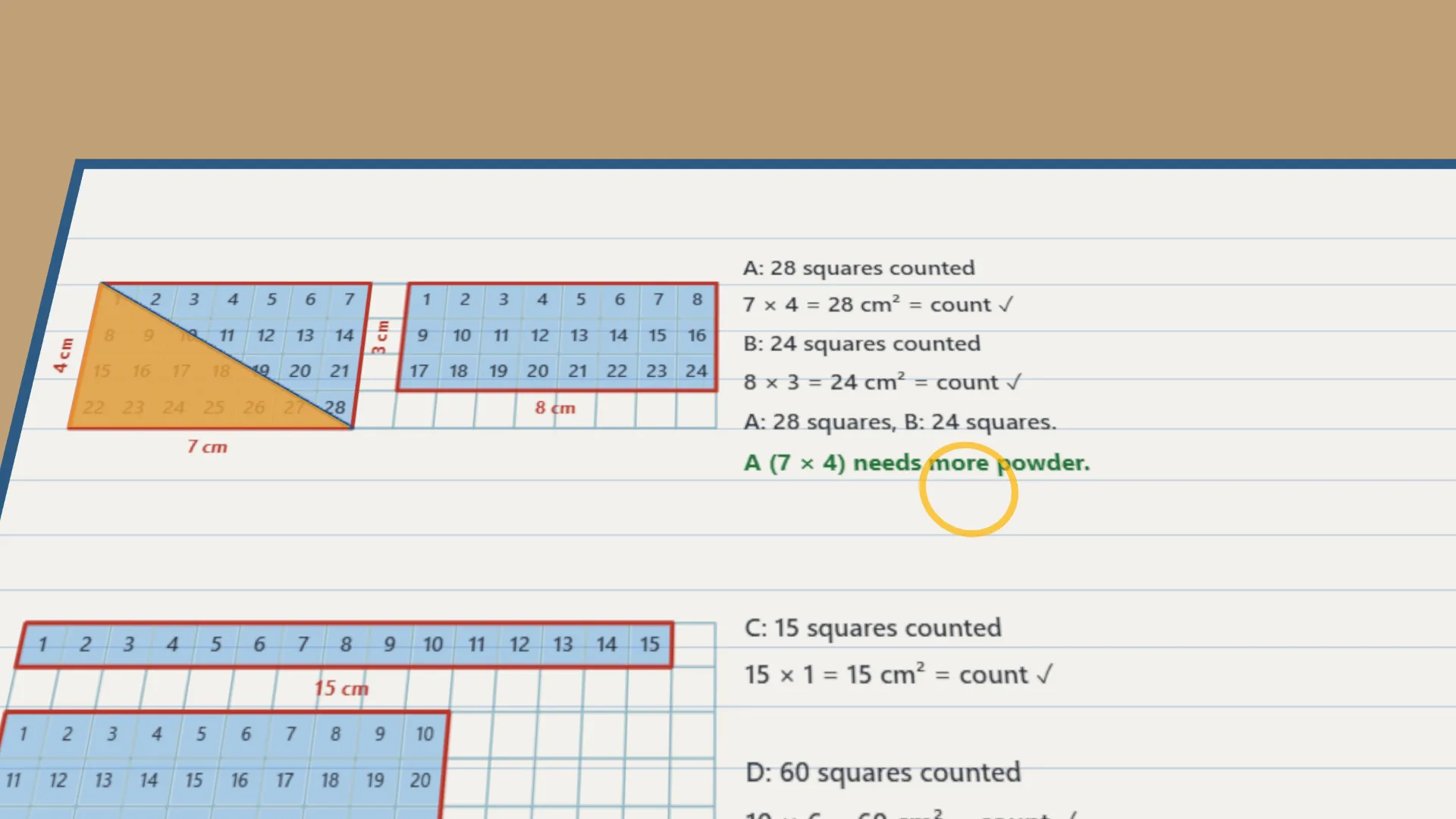
- Draw a 7 cm × 4 cm rectangle on the grid. Colour it and count its unit squares.
- Draw an 8 cm × 3 cm rectangle and count its squares. Which would need more rangoli powder?
- Do the same for 15 × 1, 10 × 6 and 8 × 8. Compare each count with length × width.
- Draw one diagonal of a rectangle, cut along it and place one triangle over the other. What fraction is each?
- Use the 32 cm loop to form 15 × 1, 12 × 4, 10 × 6 and 8 × 8 rectangles. Find each area by counting.
- Compare two regions, one with the larger perimeter but the smaller area. Why can't perimeter measure area?
- Fill in the observation table.
Interactive 3D Experiment
Loading simulation…
What to observe
- The number of unit squares in each rectangle equals its length × width (28 for 7 × 4, 24 for 8 × 3).
- The 7 × 4 rectangle would need more rangoli powder than the 8 × 3 rectangle.
- A diagonal cuts a rectangle into two triangles that cover each other, so each is half of the rectangle.
- With the same 32 cm loop the areas are 15, 48, 60 and 64 cm². Perimeter cannot measure area.
- Of all rectangles with the same perimeter, the square encloses the greatest area.
Notes
- Math Spark: In ancient Egypt the Nile's yearly flood washed away field boundaries. Officials called 'rope stretchers' remeasured each farmer's land with knotted ropes, so tax was charged on the area actually held.
- A farmer with a fixed length of fencing gets the largest field by making it a square.
- Draw every rectangle along the grid lines so that whole unit squares fit inside it.
- Count each unit square once only; tick or shade squares as you count them.
- Use the same unit for the length and the width before multiplying.
- Write area in square units (cm²) and perimeter in units (cm); do not interchange them.
- Keep the thread loop taut but not stretched, so the perimeter stays 32 cm. Check that length + width = 16 cm.
- Cut exactly along the diagonal, and place one triangle over the other to check they match.
- Compare areas only after all the counts have been recorded.