
Through It, Partly Through It, or Not at All — Materials and Shadows
Aim
To classify materials as transparent, translucent or opaque by testing how light passes through them, and to find out what decides whether a shadow forms and how large and how sharp it is.
Apparatus
- Science notebook, pencil and a 15 cm ruler
- A torch
- Sheets of cardboard, plain paper, glass, tracing paper, thick cloth, polythene and a metal plate
- Opaque objects of different shapes and sizes — a ball, a small box, a spoon, a pair of scissors
- Two objects of the same shape but different colours
- A white cardboard sheet, or a plain wall, as a screen
Procedure
- Work in a darkened corner. Switch on the torch so that a clear spot of light falls on the screen.
- Before testing a material, predict in Table 2.1 — will light pass fully, partly or not at all?
- Hold the material between the torch and the screen. Record what happens beside your prediction.
- Repeat for every material, then classify each one as transparent, translucent or opaque.
- Place the ball between the torch and the screen and get a clear shadow.
- Do each action in Table 2.2, one at a time, and record what happens to the shadow.
- Keep the torch and screen fixed. Move the ball near each and measure the shadow's width for Table 2.3.
- Replace the ball with two objects of the same shape but different colours. Note each shadow's colour.
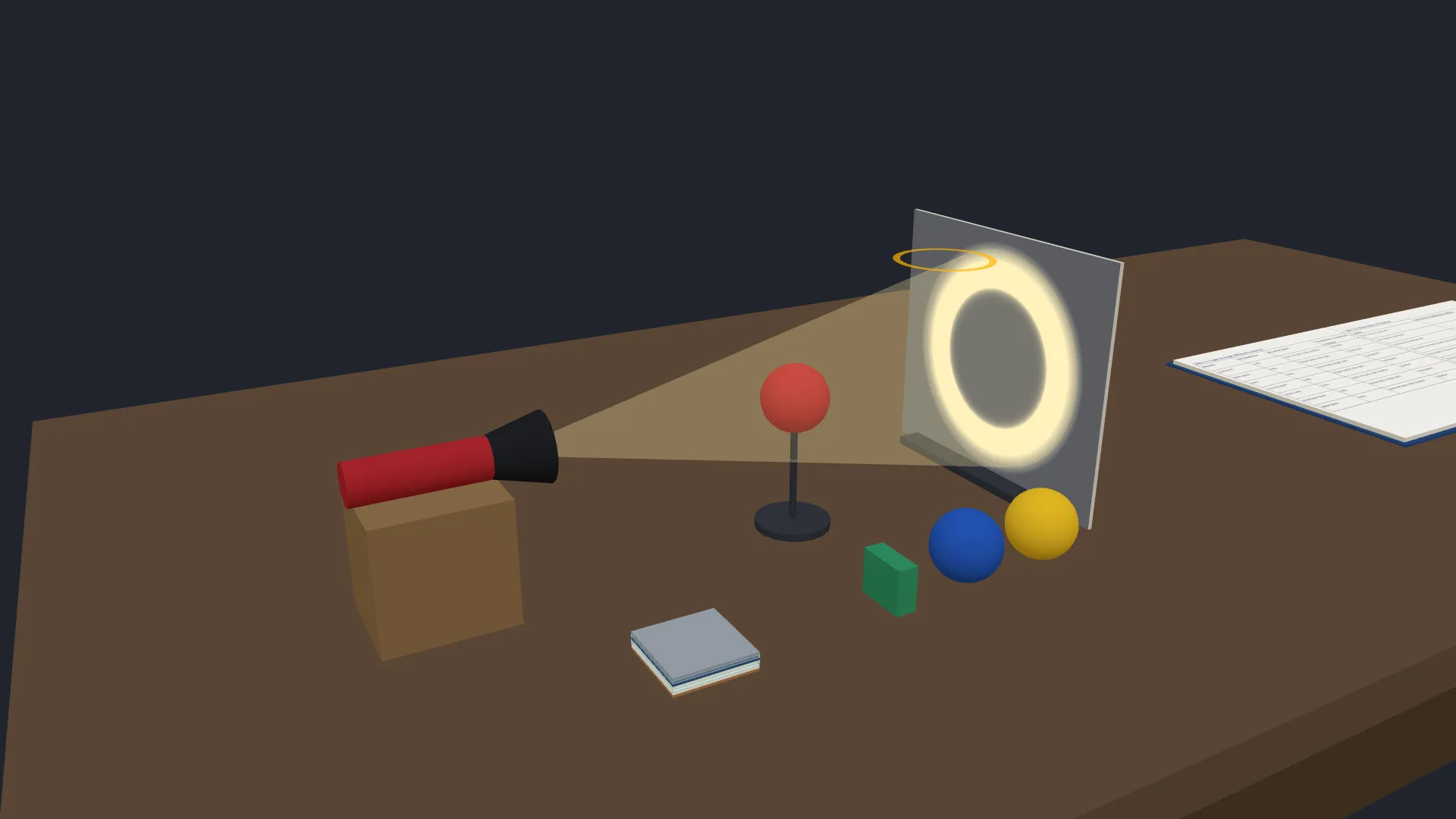
Interactive 3D Experiment
Loading simulation…
What to observe
- Light passes fully through transparent materials, partly through translucent ones, and not at all through opaque ones.
- A shadow needs a source of light, an opaque object in its path, and a screen or surface for it to fall on.
- Nearer the torch the shadow is larger; nearer the screen it is smaller and sharper.
- Translucent materials cast fainter, less sharp shadows than opaque objects.
- Objects of the same shape but different colours cast equally dark shadows. A shadow gives only the outline, never the colour.
Safety
- Do not shine the torch into anybody's eyes, and never use a laser pointer in its place.
- Darken the room by drawing the curtains only. Keep the aisle clear, move slowly, and do not run or chase shadows in the dark.
- Hold the glass by two edges with both hands, check it has no chipped edge, lay it flat and never balance it on its edge. Tape the edges, or use clear acrylic instead.
- Tell the teacher at once if any glass breaks, and do not pick up the pieces. Hold the metal plate by its flat faces, as its edge may be sharp.
- Keep scissors closed and pass them handle-first. If a table lamp is used, the teacher places it and nobody touches the hot bulb.
Notes
- Shadow puppetry is one of India's oldest performing arts. Flat leather cut-outs are held between a lamp and a cloth screen, and moving a puppet nearer the lamp makes its shadow loom larger. Tholu Bommalata of Andhra Pradesh, Togalu Gombeyaata of Karnataka, Ravana Chhaya of Odisha, Tholpavakoothu of Kerala and Charma Bahuli Natya of Maharashtra each has its own style.