
Matching Payment Modes & a Financial Safety Audit
Aim
To match everyday financial transactions to the most appropriate payment mode, and to classify digital banking practices as safe or unsafe.
Apparatus
- A set of Transaction Scenario Cards
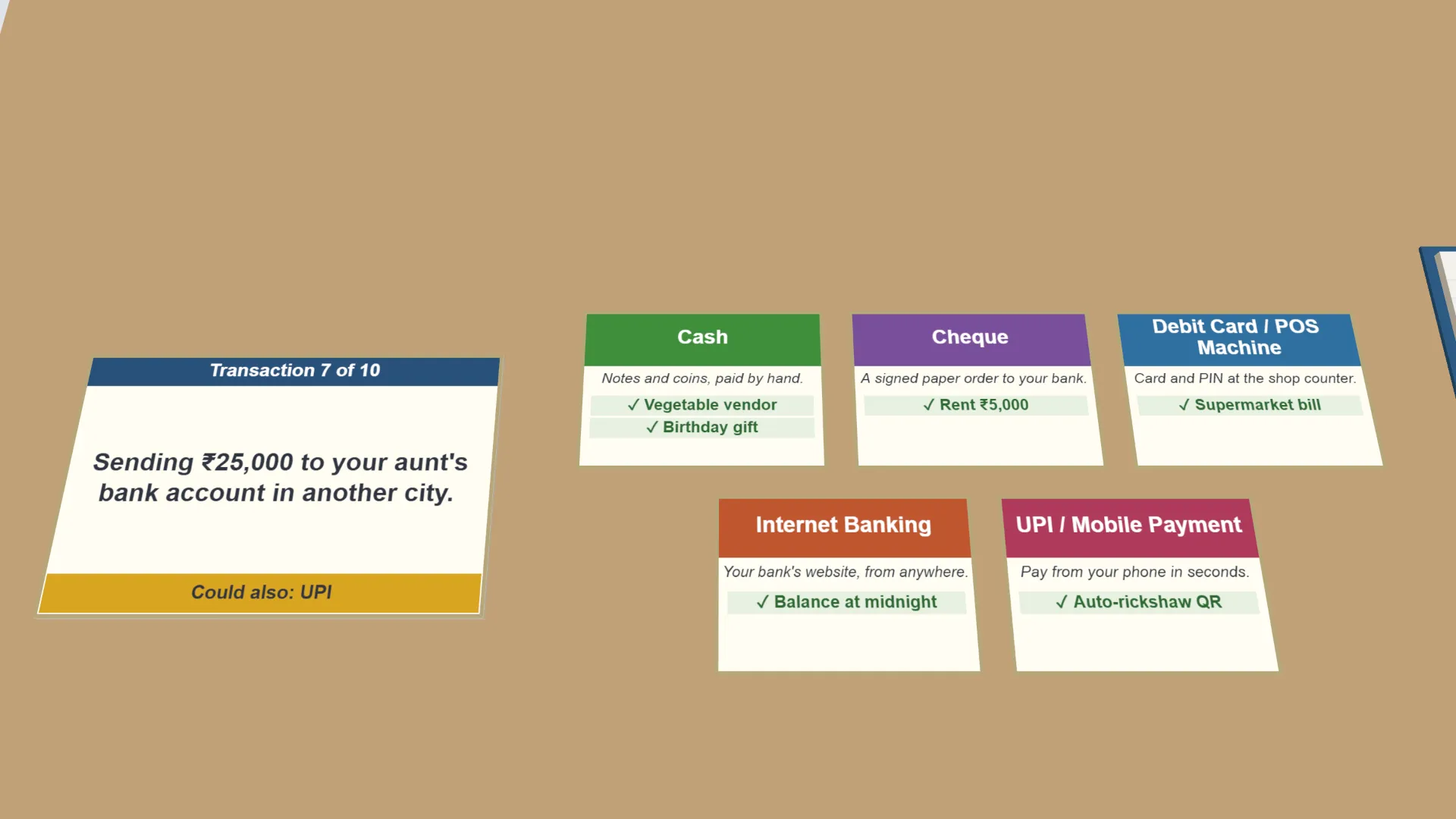
- Payment Mode Cards: Cash, Cheque, Debit Card / POS Machine, Internet Banking, UPI / Mobile Payment
- A set of Digital Safety Practice Cards
- A two-column chart labelled Safe and Unsafe
Procedure
- Read each Transaction Scenario Card carefully.
- Discuss which Payment Mode Card best suits that scenario, and why.
- Match each Scenario Card to the most suitable mode, and record it in the observation table.
- Next, read each Digital Safety Practice Card.
- Sort each Digital Safety Practice Card into the Safe or Unsafe column of the chart.
- Discuss what a person should do at once if they suspect they have been a victim of financial fraud.
Interactive 3D Experiment
Loading simulation…
What to observe
- Cash suits small payments by hand; a cheque gives a paper record and can carry a future date.
- A debit card is used at a shop's POS machine; internet banking works from home at any hour.
- UPI pays a shop or a person from a phone in seconds, for example by scanning a QR code.
- Never share your PIN, OTP or password; a bank never asks for them.
- If you suspect fraud, call your bank at once to block the card or account, and report it on 1930 or cybercrime.gov.in.
Notes
- Social Science Spark: UPI, launched by the NPCI in 2016, is often called India's gift to the world of payment systems. Bhutan was the first country to adopt UPI, in 2021, followed by Nepal in 2022, then the UAE, France, Sri Lanka and Mauritius.
- Precaution: some transactions may suit more than one payment mode — justify the mode you consider most practical, rather than simply the first one that comes to mind.
- The first three transaction cards and the first two safety cards are the textbook's examples; the others are a standard set written for this simulation.