
Citizen Engagement Toolkit — Matching Grievances to Mechanisms
Aim
To match real-life citizen grievance scenarios to the most appropriate channel of citizen engagement with the government, and to understand how each mechanism promotes transparency and accountability.
Apparatus
- A set of Grievance Scenario Cards
- Engagement Mechanism Cards: Grievance Redressal Portal, Right to Information (RTI) Request, Media / Social Media, Civil Society Organisation, Writing to a Political Representative, Voting in Elections
- A ruled sheet for the matching table
Procedure
- Read each Grievance Scenario Card carefully.
- Discuss which Engagement Mechanism Card would be the most effective response, and why.
- Match each Scenario Card to the mechanism card that suits it best.
- Record your matches in the observation table, with a one-line justification.
- Discuss cases where more than one mechanism could apply, and decide which is most effective.
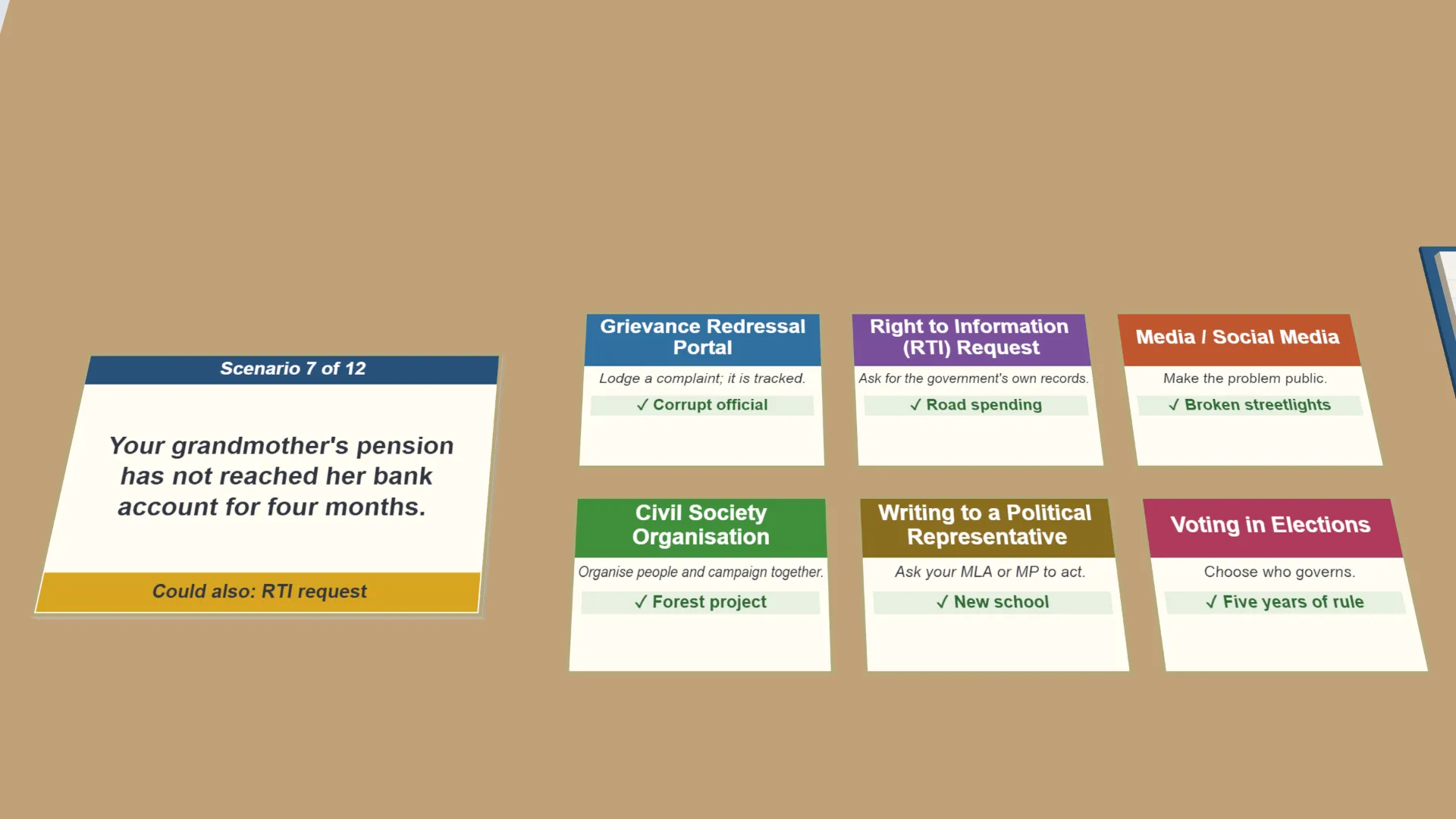
Interactive 3D Experiment
Loading simulation…
What to observe
- An RTI request gets the government's own records, such as how much was spent on a road.
- A grievance portal registers a complaint that the department must look into.
- Media and civil society organisations bring people together and make a problem public.
- Writing to an MLA or MP gets a matter raised in the Assembly or Parliament; voting decides who governs.
- Many problems suit more than one mechanism; the best one is the one most likely to get action.
Notes
- Social Science Spark: the Right to Information (RTI) Act lets any citizen ask the government for details of its own decisions and spending. In Bagepalli, a citizen's RTI request exposed poor-quality roadwork — proof that transparency alone can drive accountability.
- Precaution: some scenarios may suit more than one mechanism — justify the mechanism you consider most effective, rather than simply the first one that comes to mind.
- The first three scenario cards are the textbook's examples; the other nine are a standard set written for this simulation.