
Mapping the Three Tiers of Government
Aim
To classify everyday civic issues and government functions under the correct tier of government — Union, State or Local — and to understand the principle of decentralisation.
Apparatus
- A set of Civic Issue Cards
- A chart divided into three tiers (Union, State and Local Government)
- Glue stick or tape
- Coloured pencils
Procedure
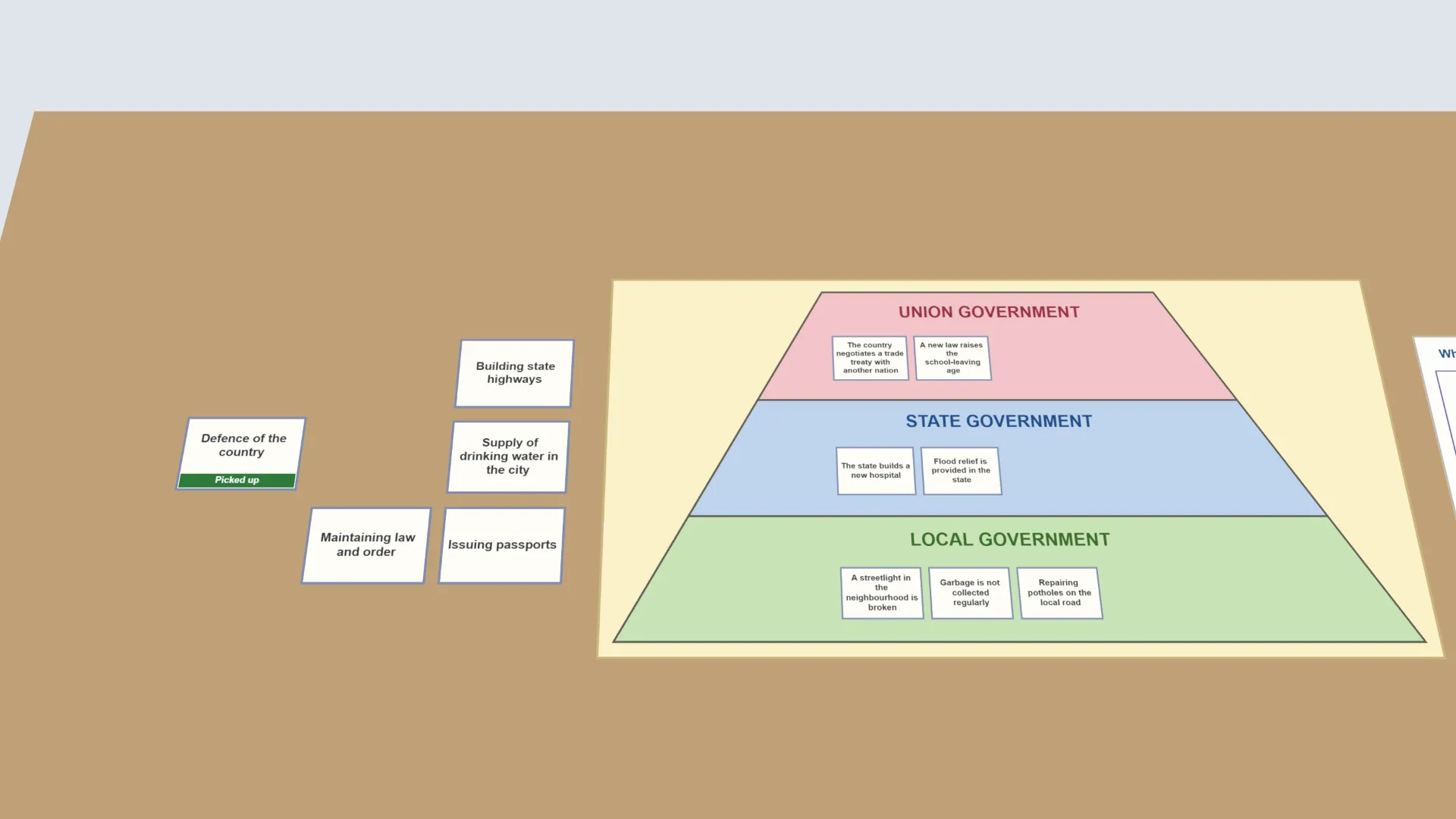
- Draw the three-tier pyramid chart (Union, State and Local Government) on chart paper.
- Read each Civic Issue Card carefully.
- Decide which tier is mainly responsible for it — local, state or national.
- Paste the card on the correct tier. Repeat for all the cards.
- Record each issue, its tier and the reason in the observation table.
- For any two issues, note why solving them close to the people works better.
Interactive 3D Experiment
Loading simulation…
What to observe
- Matters for the whole country — defence, passports, treaties with other nations, new national laws — belong to the Union.
- Hospitals, flood relief, state highways and law and order are handled by the State Government.
- Streetlights, garbage, local roads and drinking water are looked after by the local body, closest to the people.
Notes
- Social Science Spark: decentralisation does not mean weaker government — power is spread across levels so the people closest to a problem can solve it fastest. Panchayats and municipalities became a constitutionally recognised third tier only in the early 1990s.
- Precaution: read each card carefully before classifying it. Some issues involve more than one tier — discuss with your partner and justify your choice.
- The cards are those shown on the textbook page. The tiers and reasons of five of them (defence, passports, state highways, law and order, drinking water) follow the Constitution's lists as taught in NCERT.