
Mapping the Distribution of Natural Resources
Aim
To study the map of important minerals, find the regions rich in each mineral, and see how where resources lie connects to economic activity.
Apparatus
- The textbook map "Distribution of important minerals" (Fig. 1.11)
- An outline map of India
- Coloured pencils
- A notebook
Procedure
- Choose a mineral and copy its symbol into the legend of your outline map.
- Mark every place where the mineral is found with its symbol.
- Fill in its row of the table - the mineral and the states or regions where it is found.
- Find the states marked for more than one mineral and note them separately.
- Answer the reflection question: what changes when many minerals lie close together?
- Read the Social Science Spark about Odisha.
Interactive 3D Experiment
Loading simulation…
What to observe
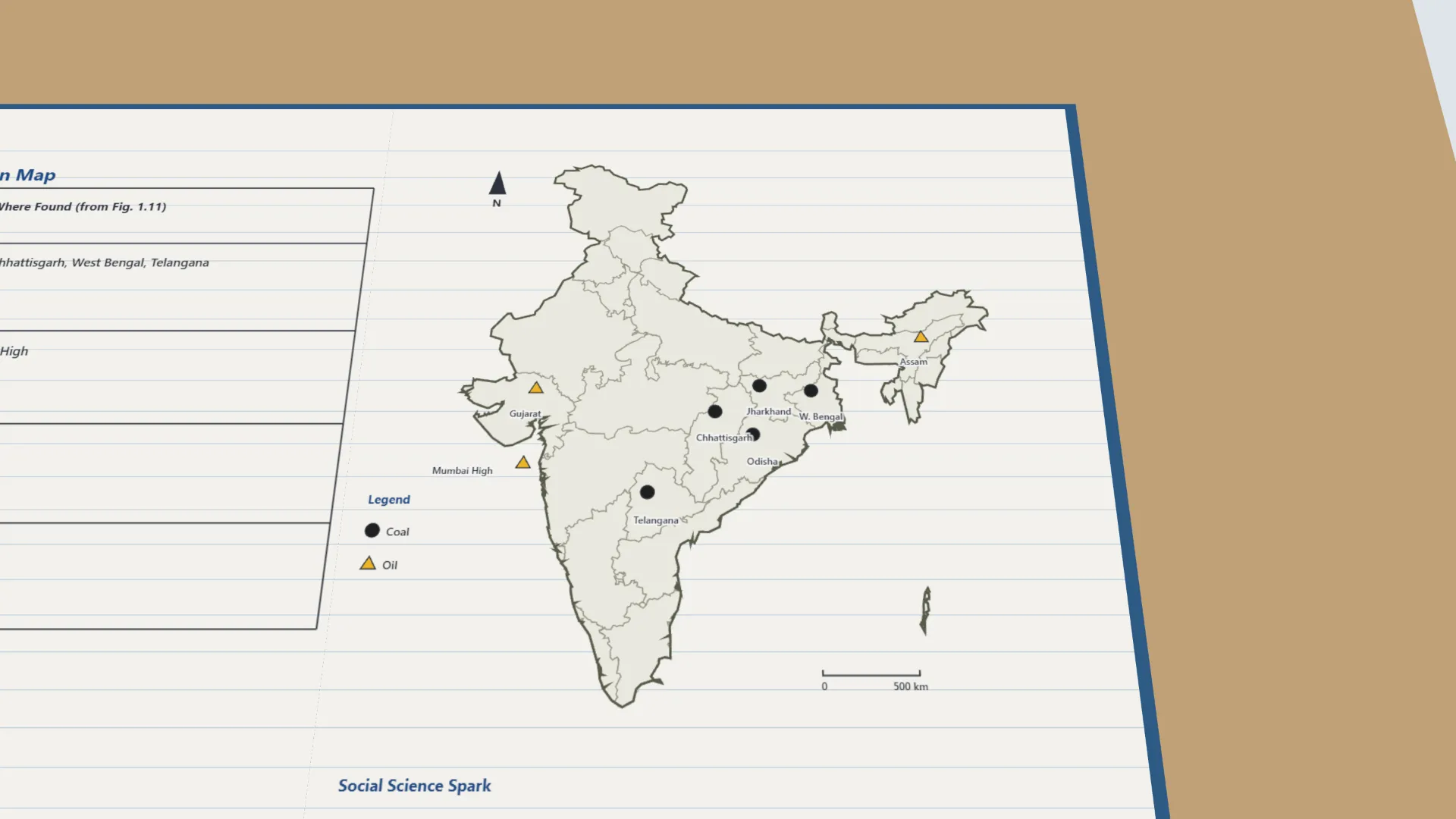
- Coal, iron ore and bauxite cluster in the east - Jharkhand, Odisha and Chhattisgarh.
- Oil comes from Assam, Gujarat and Mumbai High, an oil field in the sea.
- Odisha and Jharkhand have three of the four minerals; minerals are spread unevenly.
- Mines bring jobs, roads and towns, but also lost forests, pollution and displaced people.
Notes
- Social Science Spark: Odisha appears on the map for more than one mineral - regions rich in minerals carry both the benefits and the costs of mining.
- Precaution: copy the legend symbols accurately, and use the map's scale and compass rose when describing locations.
- The states for each mineral follow standard NCERT facts because the textbook's minerals map is not on the lab-manual page.