
Making the Lamp Glow — Building a Simple Electrical Circuit
Aim
To connect an electric cell to a torch lamp in several different ways, to predict and then test which arrangements make the lamp glow, and to state the condition for a complete electrical circuit.
Apparatus
- One electric cell and a cell holder (or electrical tape, if a holder is not available)
- An incandescent torch lamp and a lamp holder
- Four pieces of insulated copper wire, each about 15 cm long
- A roll of electrical tape and a small screwdriver
- Science notebook / lab record, pencil and a yellow colour pencil
Procedure
- Remove about 1 cm of the plastic covering from both ends of each wire.
- Attach two wires to the cell holder. Put the cell in, its − terminal towards the spring.
- Attach two wires to the screws of the lamp holder and turn the lamp into it.
- Read each arrangement in the table and write your prediction. Will the lamp glow?
- Make each connection, observe, disconnect, and record. Shade the bulb yellow if it glowed.
- With the lamp glowing, loosen one joint a little and watch the lamp. Then tighten it again.
- Compare the arrangements. What is common to all the ones in which the lamp glowed?
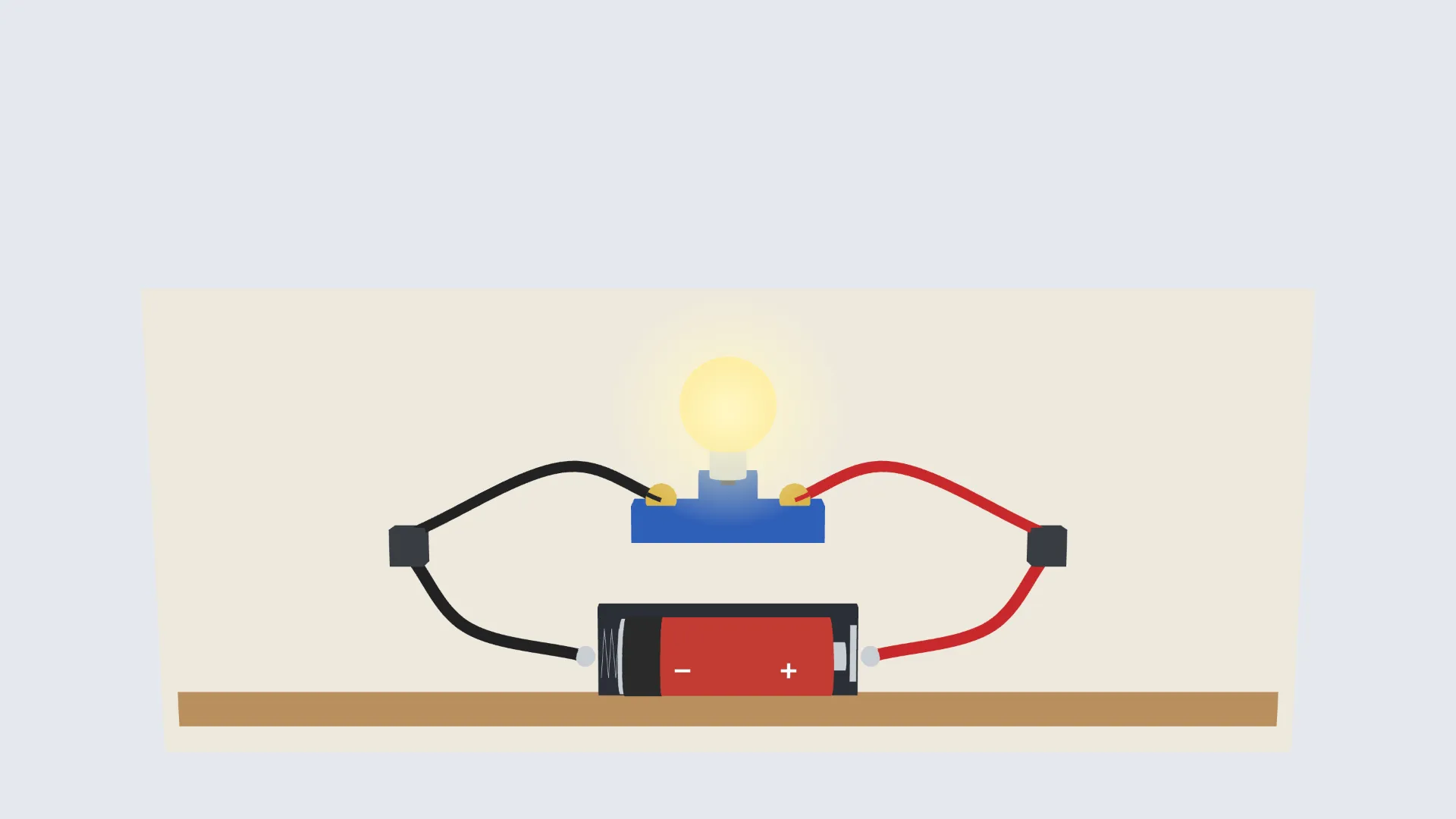
Interactive 3D Experiment
Loading simulation…
What to observe
- In which arrangements does the lamp glow? In which does it stay dark?
- What happens to the lamp when one joint is loosened and a small gap appears?
- Does it matter which way round the cell is placed?
Safety
- Power this circuit with a single electric cell only. Never connect any part of it to a mains socket, a switchboard or a plug point.
- Remove the plastic covering from the wire ends with the teacher's help, cutting away from the body. Never strip a wire with your teeth; the bared copper ends are sharp.
- Never connect the two terminals of the cell to each other without the lamp in the path. This short circuit heats the cell and the wires within seconds.
- Complete the circuit only for as long as the observation takes, then disconnect a wire. Do not touch the glass of the lamp while it is glowing or just after.
- Keep water and wet hands away from the circuit. If the cell, wires or holder becomes warm, disconnect at once and inform the teacher.
Notes
- Science Spark: the thin coiled wire inside an incandescent lamp, the filament, is made of tungsten and reaches about 2500 °C when the lamp is on. So much of the electrical energy turns into heat rather than light. When the filament snaps, the path breaks and we say the lamp has ‘fused’.