
Make Your Own Compass — Finding Directions with a Magnet
Aim
Magnetise an iron needle with a bar magnet, float it on a cork, and check that it always comes to rest along the north–south direction.
Apparatus
- Science notebook / lab record and pencil
- A permanent bar magnet
- An iron sewing needle
- A small piece of cork (or thick foam / thermocol disc)
- A glass bowl filled with water
- A few steel pins or iron filings
Procedure
- Place the needle on the table and set one pole of the magnet at one end.
- Stroke the needle in one direction only, 30–40 times, with the same pole.
- Bring the needle near steel pins. If they stick, it is a magnet.
- Push the needle through the cork and float it in the bowl of water.
- Wait until the needle stops and note which way it points.
- Turn the cork gently and let it settle again. Do this three times in all.
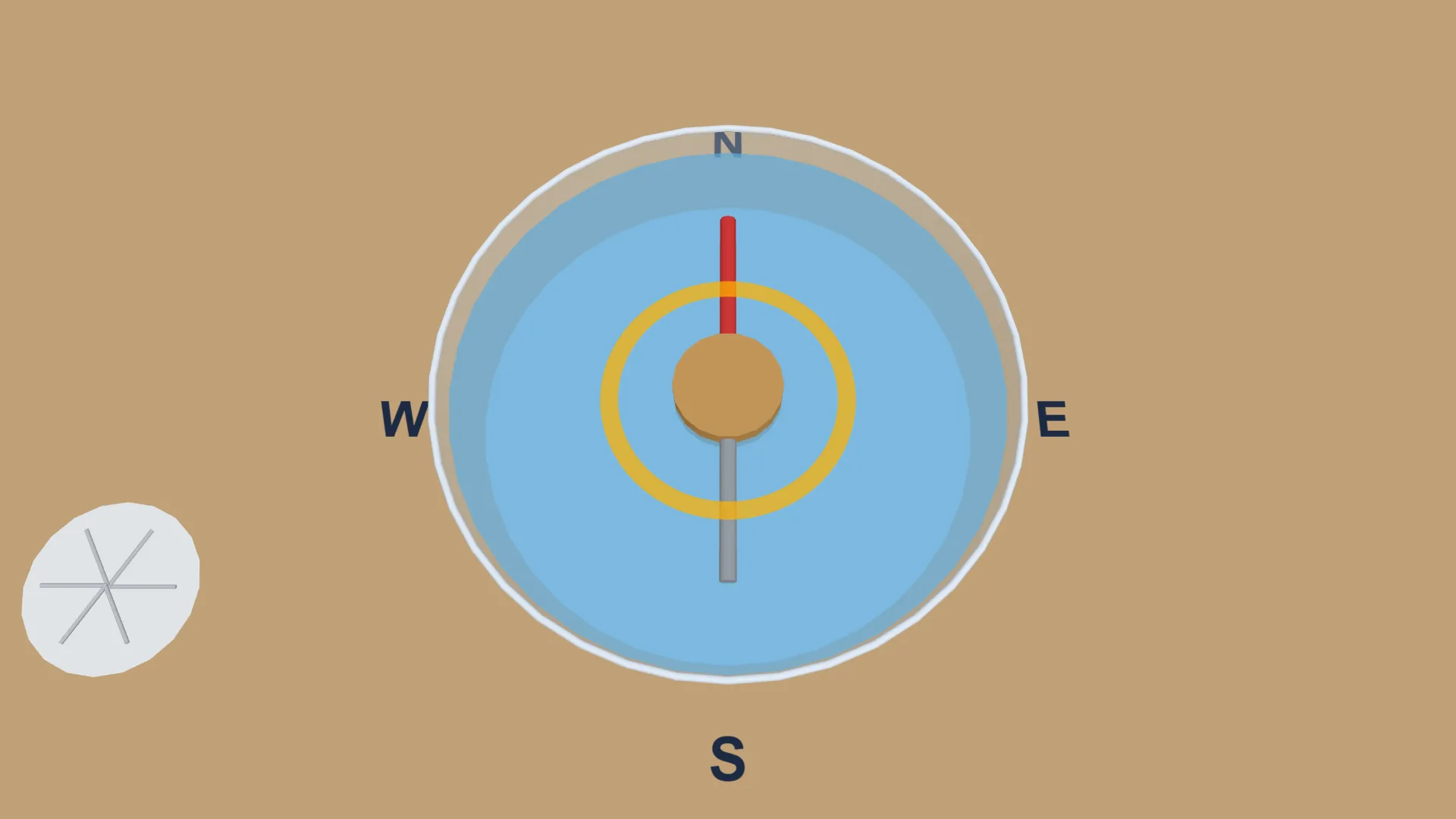
Interactive 3D Experiment
Loading simulation…
What to observe
- Do the pins stick to the needle after stroking?
- Which way does the floating needle point when it stops?
- Is it the same direction after every turn of the cork?
Safety
- The needle is sharp. Carry it point down, never wave it, never point it at anyone or hold it in your mouth.
- Push the needle through the cork slowly, away from your fingers, or ask the teacher.
- Count the needles and pins at the start and the end. Never leave one lying around.
- Fill the bowl only two-thirds, keep it in the middle of the table away from plugs, and wipe spills at once.
- Keep the compass away from iron, steel, other magnets and phones while reading it. Dry the needle and magnet afterwards.
Notes
- Indian sailors once used the matsya-yantra, a magnetised fish-shaped iron piece floating in a vessel of oil, to find directions at sea.