
Magnetic or Not? — Sorting Materials by Attraction
Aim
Guess which everyday objects a magnet will attract, test them, and sort the materials into magnetic and non-magnetic.
Apparatus
- Science notebook / lab record and pencil
- A bar magnet (or any strong magnet)
- 10–12 small everyday objects of different materials (pencil, eraser, iron nail, steel paper clip, coin, plastic scale, cloth, key, glass bead, aluminium foil)
- Table drawn in the notebook for predictions and observations
Procedure
- Lay out the objects and write each name and material in the table.
- Predict Yes or No for each object, before testing anything.
- Bring the magnet close to each object, one at a time.
- Record in the table whether the object is attracted.
- Compare your predictions with what you observed.
- Group the objects into magnetic and non-magnetic materials.
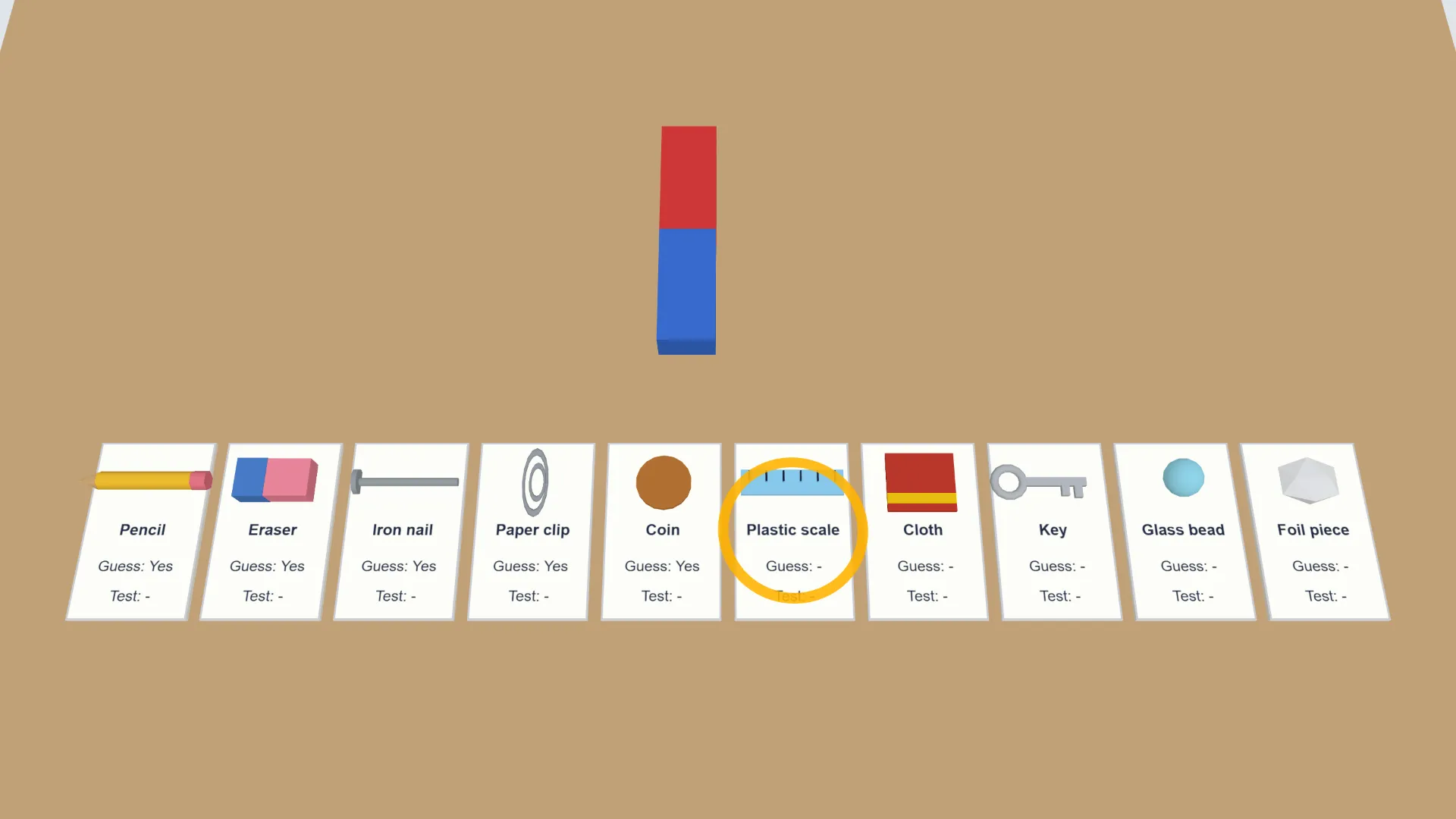
Interactive 3D Experiment
Loading simulation…
What to observe
- Which objects jump to the magnet and which stay where they are?
- How many of your predictions matched what you saw?
- Which materials ended up in the magnetic list?
Safety
- Keep magnets away from mobile phones, watches, computers, TV screens, pen drives, hearing aids and ATM or credit cards.
- Never put a magnet in the mouth or nose. Swallowing two magnets is a medical emergency.
- Do not drop, hammer, bend or heat a magnet. Bring it close gently so it does not pinch your fingers.
- Count nails, pins, keys and paper clips before and after, and hand them all back to the teacher.
- Write each prediction before testing and do not change it. Store magnets with unlike poles together.
Notes
- The word "magnet" comes from Magnesia, a region of ancient Greece where natural magnetic stones called lodestones were found. Sailors used lodestone compasses long before anyone knew why magnets work.