
The Magic of Kaprekar’s Constant
Aim
Carry out Kaprekar’s routine on 4-digit numbers and find that it always reaches the magic number 6174. Then see what happens with 3-digit numbers.
Apparatus
- Number cards 0–9 (or playing cards Ace–9)
- Notebook and pencil
- A calculator (optional, to check the subtractions)
Procedure
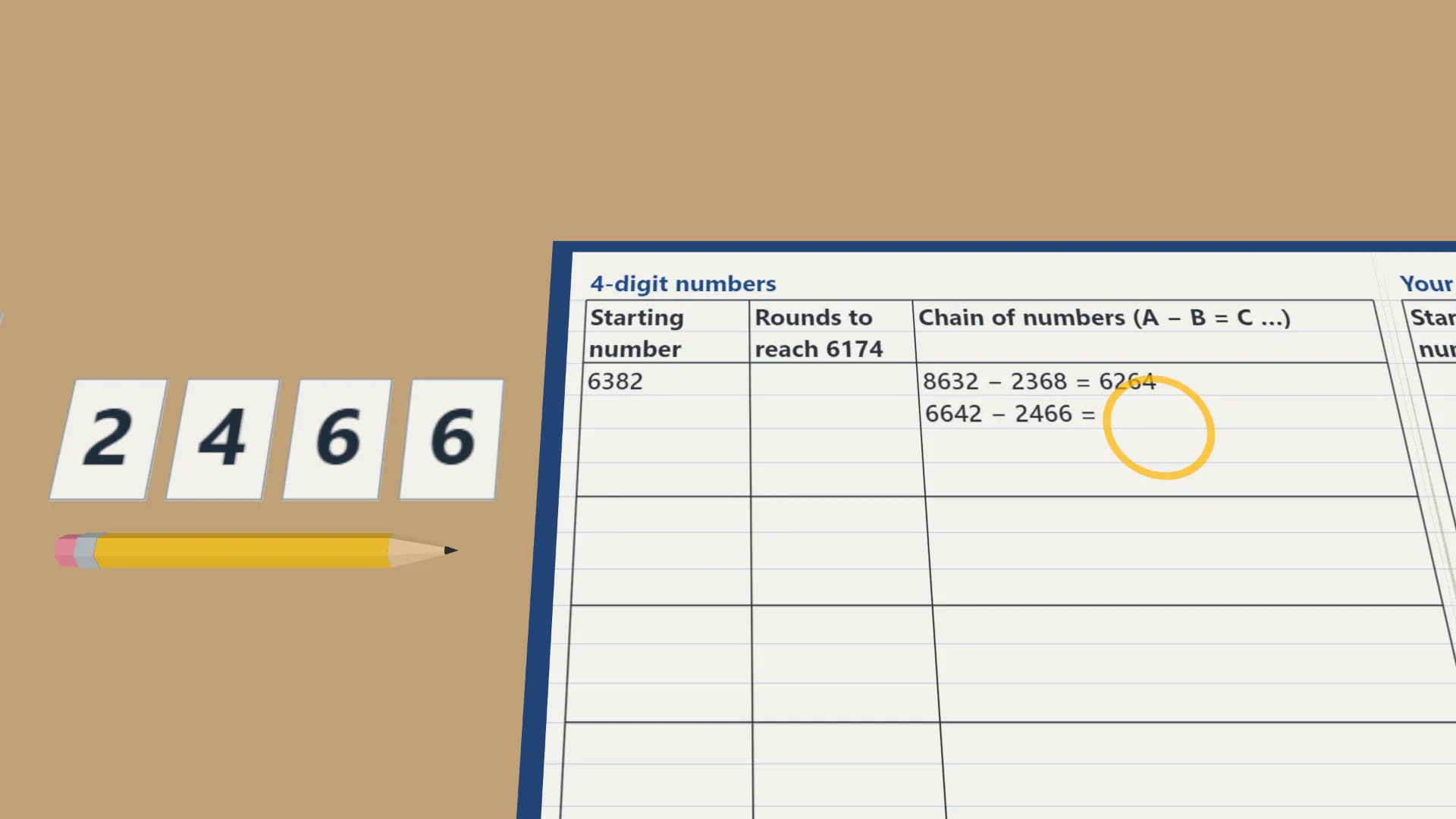
- Pick the number cards for a 4-digit number with at least two different digits, such as 6382.
- Arrange the cards to make the largest number, A, and the smallest number, B.
- Subtract to get C = A − B. Write each round on a fresh line.
- Repeat with the digits of C, not the starting number. Keep going.
- Go on until a number repeats. Write how many rounds it took to reach it.
- Try 3524, 1998, 7621 and your own birth year in the same way.
- Repeat the whole activity with a 3-digit number of your choice.
Interactive 3D Experiment
Loading simulation…
What to observe
- Does every 4-digit number reach 6174? In how many rounds, at most?
- What happens when you use the digits of 6174 again?
- Which number do 3-digit numbers settle on?
Notes
- D. R. Kaprekar (1905–1986) was a school maths teacher in Devlali, Maharashtra, who loved playing with numbers.
- In 1949 he found that this routine always reaches 6174 for 4-digit numbers, in at most 7 rounds. For 3-digit numbers it settles on 495. These are called Kaprekar constants.
- Do not choose a number whose digits are all the same (like 4444). The routine gives 0000 and stops.
- Keep leading zeros. A difference such as 0765 is still a 4-digit number when you rearrange its digits.
- Always subtract the smallest arrangement from the largest, never the other way round.
- Use the digits of the new difference for the next round, not the digits of the starting number.
- Check every subtraction (you may use a calculator). One mistake breaks the whole chain.
- Write each round on a fresh line, so the chain is easy to read and count.