
Acid, Base or Neutral? — Testing Everyday Substances with Litmus
Aim
To test common household substances with blue and red litmus paper and to classify them as acidic, basic or neutral.
Apparatus
- Blue and red litmus paper strips, and a pair of scissors
- A clean, dry white tile
- Droppers, one for each sample if possible
- Samples in small labelled bottles: lemon juice, soap solution, amla juice, tamarind water, vinegar, baking soda solution, lime water, tap water, washing powder solution, sugar solution and salt solution
- Lime water prepared a day earlier (chuna, calcium hydroxide, mixed in water, left for about an hour and filtered)
- Science notebook / lab record and pencil
Procedure
- Cut blue litmus paper into small pieces and spread them on a clean, dry white tile.
- Put one drop of each sample on a fresh piece of blue litmus and note the colour at once.
- Repeat with red litmus pieces, using a fresh piece and a clean dropper each time.
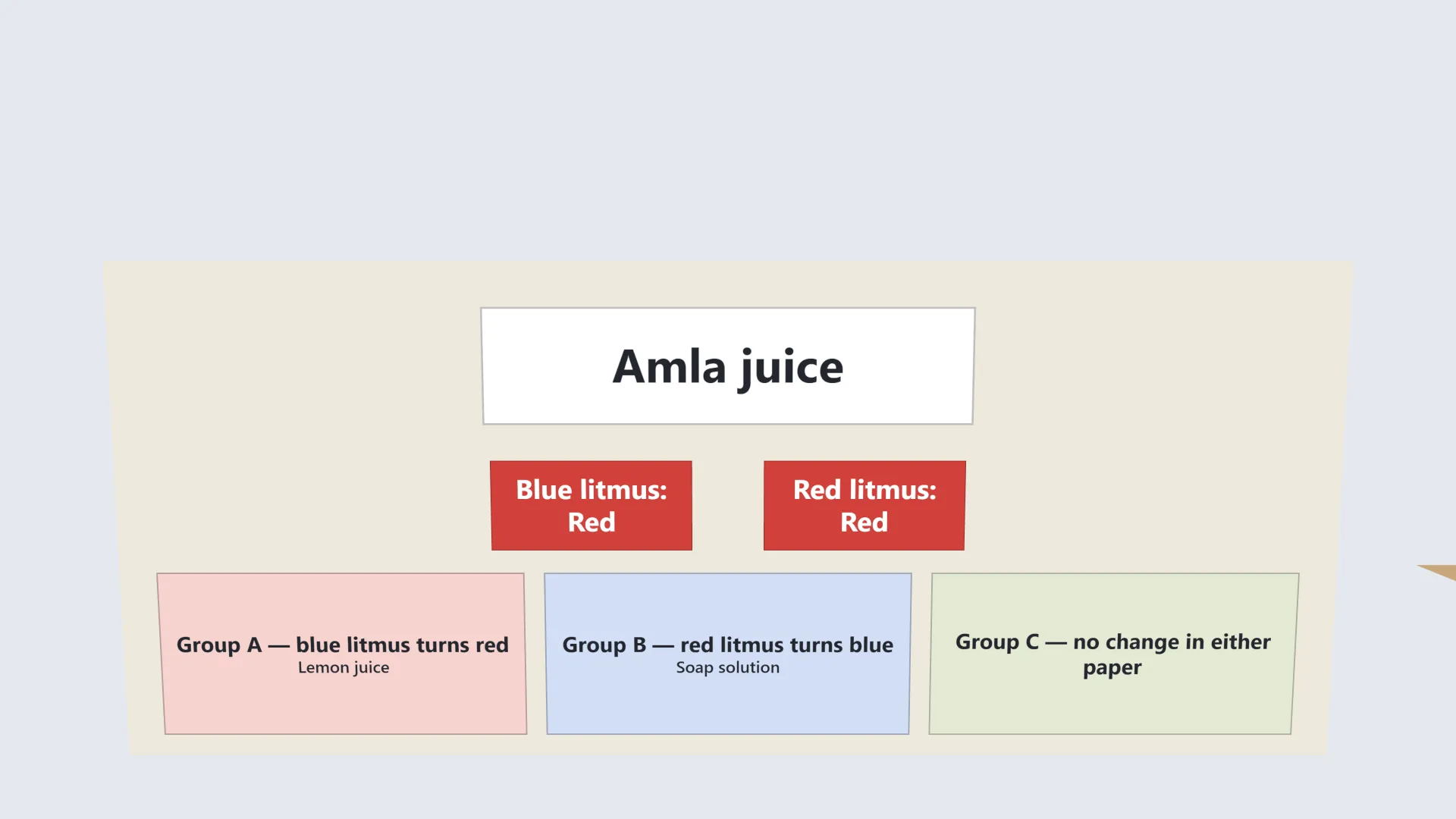
- Sort the samples into Group A, Group B and Group C.
Big Acid
Interactive 3D Experiment
Loading simulation…
Acid Bases
Notes
- Did you know? The word litmus comes from an old Norse word litmosi, meaning dye moss. The dye is taken from lichens, and a lichen is not one organism but two, a fungus and an alga living together as partners!
What to observe
- Which samples turn blue litmus red? (Group A)
- Which samples turn red litmus blue? (Group B)
- Which samples change neither paper? (Group C)