
Does Light Really Travel in a Straight Line?
Aim
To show by two independent methods that light travels in a straight line, and to distinguish luminous objects from non-luminous ones.
Apparatus
- Three empty matchboxes, with a small hole at exactly the same position in the inner tray of each
- A torch
- A sheet of cardboard to serve as a screen
- A long hollow pipe of a flexible material, such as a rubber or plastic tube
- A candle and a matchbox (to be lit only under adult supervision)
- Science notebook or lab record and pencil
Procedure
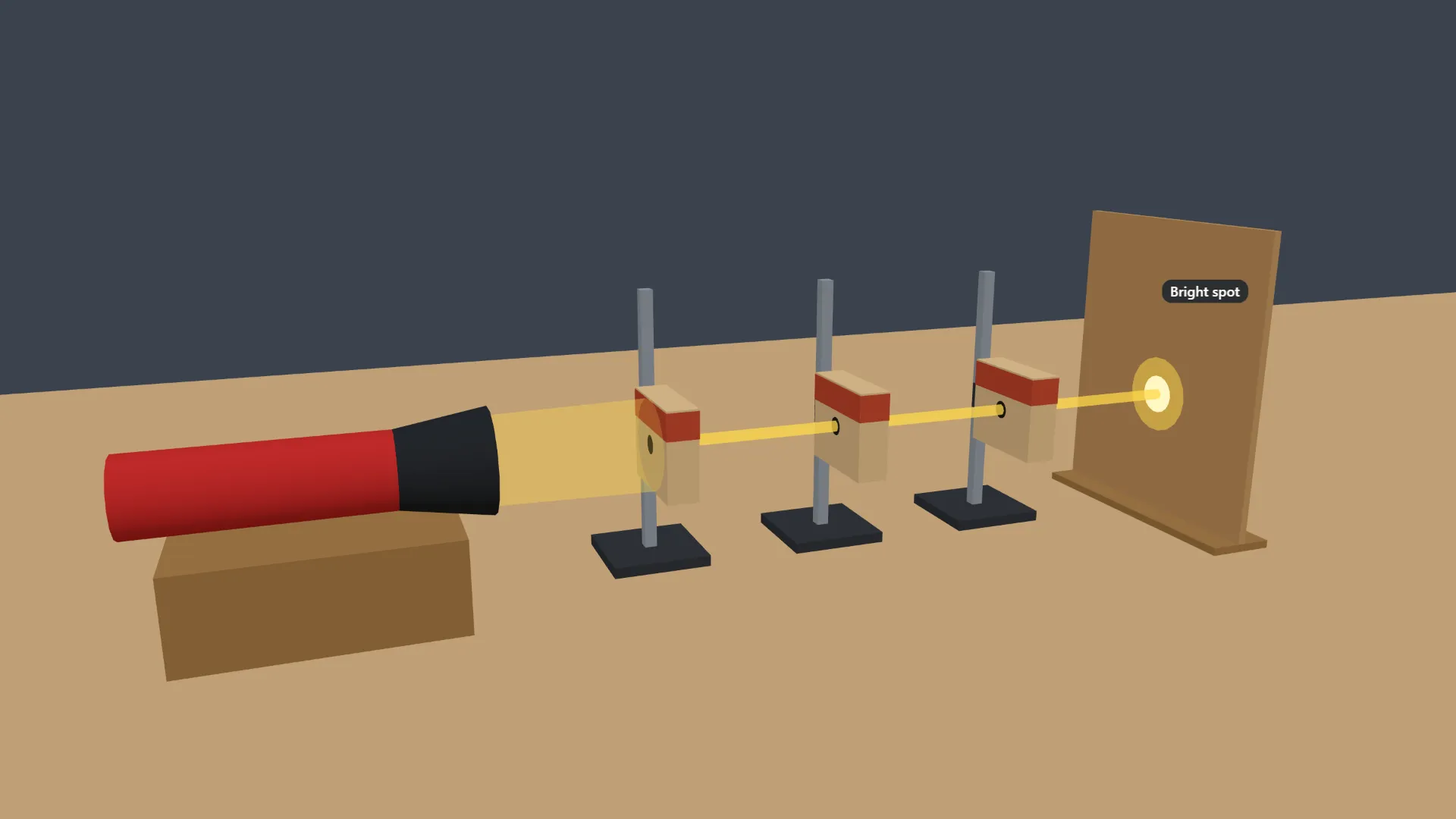
- Make a hole in the inner tray of each of the three matchboxes, at exactly the same position.
- Arrange the three matchboxes in a straight line, with all three holes at the same height.
- Place the torch on one side, its lamp at the height of the holes, and the screen on the other side.
- Switch on the torch. Adjust the heights until a bright spot appears on the screen, and record it.
- Shift the middle matchbox a little, up or down. Look at the screen again and record what happens.
- Light the candle under supervision and stand it on the table at about eye level.
- Hold the hollow pipe straight and look at the flame through it. Record whether you can see it.
- Keeping the candle and your eye where they are, bend the pipe and look again. Record what you see.
- List five objects under two headings. Do they give out their own light, or is light falling on them?
Interactive 3D Experiment
Loading simulation…
What to observe
- A bright spot appeared on the screen when the holes in all three matchboxes were in one straight line. It disappeared as soon as the middle box was shifted even slightly.
- The candle flame could be seen through the straight pipe but not through the bent pipe.
- Both observations show, by two independent methods, that light travels along straight lines and cannot bend round a corner by itself.
- Objects that give out their own light, such as the Sun, a candle flame, a lighted lamp and a firefly, are luminous.
- Objects seen only because light from elsewhere falls on them and is reflected by them, such as a book, a table and the Moon, are non-luminous. The Moon appears bright only because it reflects sunlight.
Safety
- Light the candle only under the supervision of the teacher, on a table cleared of loose paper and cloth, and fix it upright in a holder so that it cannot topple.
- Tie back long hair and roll up loose sleeves before the candle is lit, and never lean across the flame to adjust the apparatus.
- Keep the pipe, the screen and all paper away from the flame, and hold your eye well back from the end of the pipe.
- Never use this pipe, or any tube, to look at the Sun. Looking at the Sun even for a moment can damage the eye permanently.
- Do not shine the torch into anybody's eyes, never use a laser pointer in its place, and blow the candle out as soon as Part B is over.
Notes
- Science Spark: Sunlight takes about 8 minutes and 20 seconds to travel the 150 million kilometres to the Earth. The sunlight falling on this page left the Sun before your class began — and if the Sun stopped shining this very instant, nobody on the Earth would know for another 8 minutes 20 seconds!