
Life from a Cutting — Observing Vegetative Propagation
Aim
Watch new plants grow from parts of a parent plant (asexual reproduction), and see how reproduction keeps life going on Earth.
Apparatus
- Science notebook and pencil
- A money-plant stem cutting with a node
- A piece of ginger with buds ('eyes')
- A sprouted potato with 'eyes'
- Small pots, or a transparent glass or jar
- Moist garden soil (or cotton) and water
Procedure
- Take the three plant parts — the money-plant cutting, the ginger piece and the sprouted potato.
- Plant the ginger and potato in moist soil, not too deep. Stand the cutting in water, node covered.
- Keep them all where they get air, indirect sunlight and water.
- Look at them every day. Note when you first see roots, a new shoot and the first new leaf.
- Water lightly whenever the soil feels dry — do not overwater. Change the cutting's water often.
- Write each observation in the table, for about two weeks.
- Work out which part grew fastest and write your conclusion.
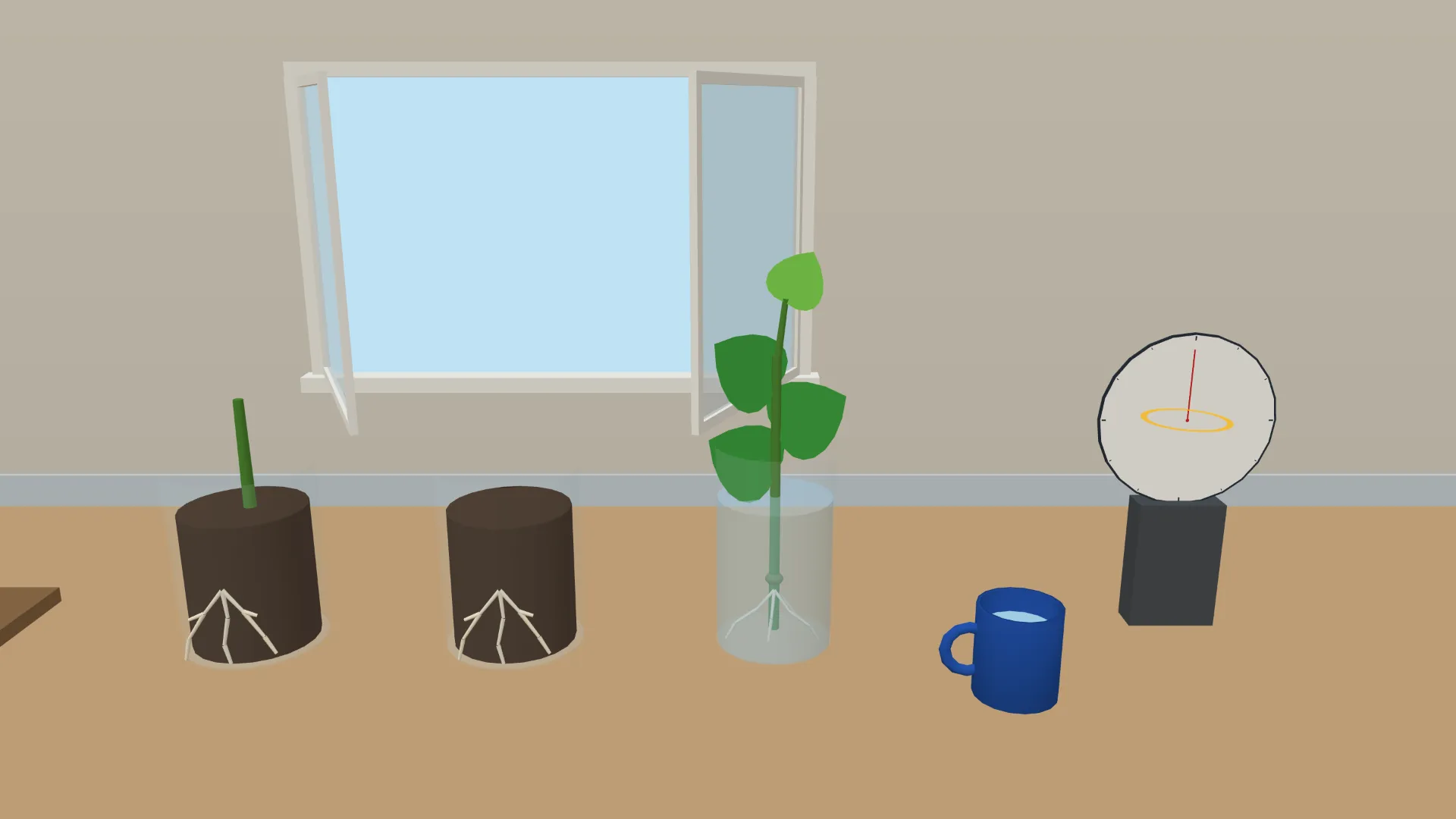
Interactive 3D Experiment
Loading simulation…
What to observe
- On every part, roots come first, then a new shoot, then its first leaf.
- The money-plant cutting roots fastest, then the potato, then the ginger.
- No seed, flower or pollen is used — one parent only, so the new plant is just like it.
Safety
- Cut the money-plant stem only with an adult's help, with a clean, sharp blade, away from your fingers.
- The cutting needs at least one node, kept under the water or soil — roots grow only from the node.
- Use healthy parts — firm ginger with buds, a potato with good 'eyes'. Avoid rotten pieces.
- Plant the ginger and potato only a little below the surface, or the shoot cannot come up.
- Give all three the same air and indirect sunlight, so the comparison is fair.
- Water lightly only when the soil feels dry. Too much water rots the cutting.
- Change the water in the glass every two or three days.
- Note the exact day of each change as it happens. Never pull a part out to check for roots.
- Wash your hands after handling soil, and be patient — growth takes about two weeks.
Notes
- Did you know? A flatworm called Planaria can be cut into pieces, and each piece grows into a whole worm.
- Hydra grows small buds that break off and become new animals. Scientists study them to learn how bodies regrow.