
Is It Alive? — Sorting Living and Non-living Things
Aim
Identify living beings and non-living things around us, and find the characteristics that set the living apart from the non-living.
Apparatus
- Science notebook / lab record and pencil
- Eight to ten everyday objects (a pencil, a book, a potted plant, a toy car, a stone, a coin, an insect seen safely in a jar, a piece of chalk)
- Chart paper and sketch pens
- A hand lens (optional)
Procedure
- List eight to ten objects, with at least two living beings and two non-living things.
- In pairs, guess whether each object is living or non-living and note the guess in the table.
- Discuss and write a reason for each guess.
- Check each guess against the seven characteristics of living beings.
- Record the correct answer and the reason for it in the table.
- Pick a non-living object that moves, such as a toy car, and discuss why it is still non-living.
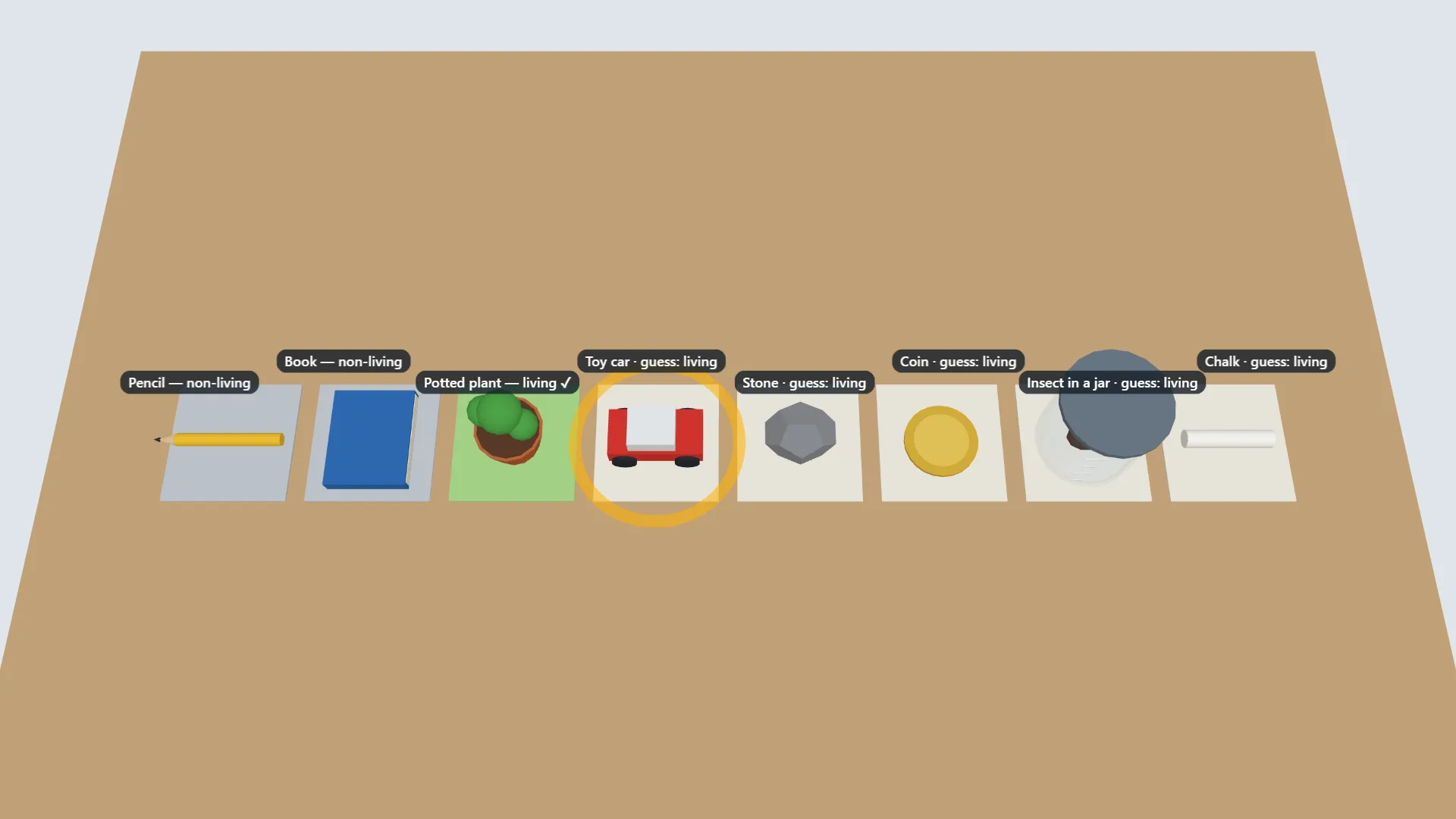
Interactive 3D Experiment
Loading simulation…
What to observe
- Which objects show the seven characteristics (movement, nutrition, respiration, excretion, growth, response to stimuli, reproduction)?
- Did every guess turn out right?
- Why is the toy car non-living although it moves?
Safety
- Never harm a creature for this activity. Never catch, hurt, pin, squash, trap for long or kill any insect or small animal.
- Keep an observed insect in a ventilated jar for a short time only, out of direct sunlight, and release it where it was found on the same day.
- Never pick up an unknown insect with bare hands, and never bring bees, wasps, hairy caterpillars, spiders or centipedes into the classroom.
- Never use the hand lens to focus sunlight onto an insect, plant, paper or skin, and never look at the sun through it.
- Handle the potted plant gently without pulling off leaves, wash your hands with soap afterwards, and report any bite, sting or scratch at once.
Notes
- The touch-me-not plant (Mimosa pudica), called chhui-mui or lajjalu in Hindi, folds its leaves within seconds of being touched — a response to stimuli so fast that people once mistook it for an animal!