
Exploring Intersecting Lines and Angles
Aim
Draw pairs of intersecting lines, measure the four angles they make, and discover the rules for a linear pair and for vertically opposite angles.
Apparatus
- Plain and graph paper
- Protractor and ruler
- Sharp pencil and eraser
- Coloured pencils or sketch pens (at least 3 colours)
- Tracing paper
Procedure
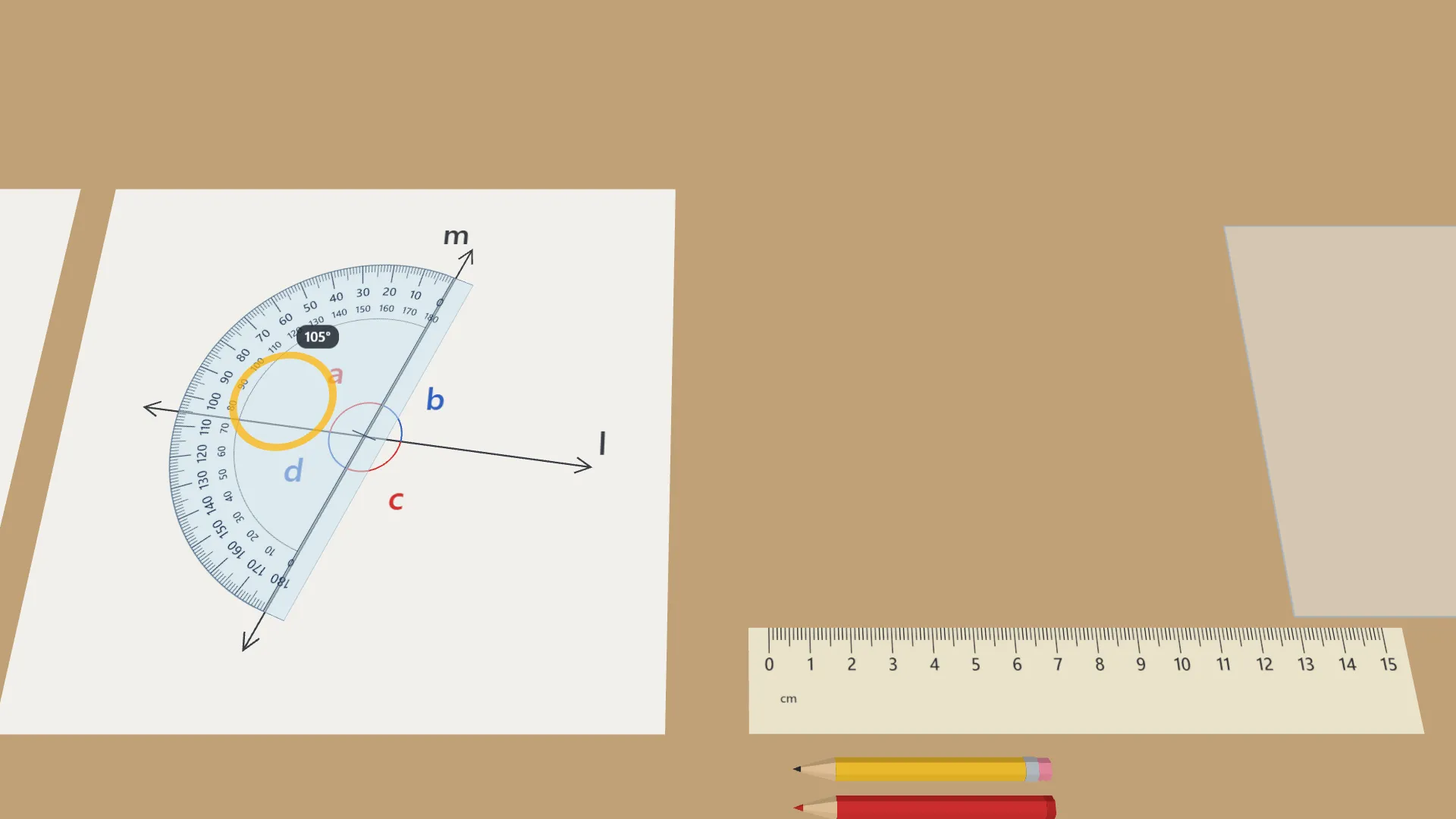
- With a ruler, draw lines l and m that cross. Label the four angles a, b, c, d in order.
- Measure all four angles with the protractor and record them in the table.
- Add each adjacent pair (a + b, b + c, c + d, d + a). What do you notice?
- Compare the opposite angles (a and c, b and d). What do you notice?
- Draw three more pairs of lines at different slopes and measure and record again.
- Trace one angle on tracing paper and place it over its opposite angle. Do they match?
- Draw a pair of lines that makes all four angles equal. Measure one angle.
- Write the rule for a linear pair and the rule for vertically opposite angles.
Interactive 3D Experiment
Loading simulation…
What to observe
- Does each pair of adjacent angles always add up to 180°?
- Are the opposite angles always equal, whatever the slope of the lines?
- When all four angles are equal, how big is each? What are such lines called?
Notes
- Vertically opposite angles being equal is one of the oldest proved facts. Thales is said to have used it over 2000 years ago, and Euclid recorded it in The Elements.
- You never need to measure the opposite angle. A straight angle is 180°, so once you know one angle, reasoning fixes the other three.
- Put the protractor's centre exactly on the crossing point and its baseline along one arm.
- Read the correct scale (inner or outer) by checking whether the angle is acute or obtuse.
- Extend arms that are too short, so they reach the protractor's scale.
- Draw thin lines with a sharp pencil; thick lines make the crossing point hard to find.
- Label the four angles in order around the point, so adjacent and opposite pairs are not mixed up.
- Treat a difference of one or two degrees as a measuring error, not a new result.