
Modelling Integer Operations with Tokens
Aim
To model adding, subtracting and multiplying integers with two-colour tokens (green is +1, red is −1) and zero pairs, and to read each result as an integer. Recall the code first: a green token and a red token together make a zero pair, because (+1) + (−1) = 0. Adding or removing zero pairs never changes a number.
Apparatus
- About 40 two-colour counters (green for +1, red for −1)
- A small paper bag or bowl, the "operation bag"
- A dot-grid or plain worksheet and a pencil
- Green and red sketch pens for recording
Procedure
- Show +5 with five green tokens and −3 with three red. Combine them, cancel every zero pair and record what is left.
- Subtract by taking away. For (+7) − (+18), start with 7 green. Add 11 zero pairs, then take away 18 green.
- Use the bag. A positive multiplier puts tokens in. Model 4 × (−2) by putting 2 red into the bag, 4 times.
- Model (−4) × (−2): take 2 red out of the empty bag, 4 times. Add 2 zero pairs each time first. Count what is left.
- For each expression, write in your own words what the tokens show, and the result as an integer.
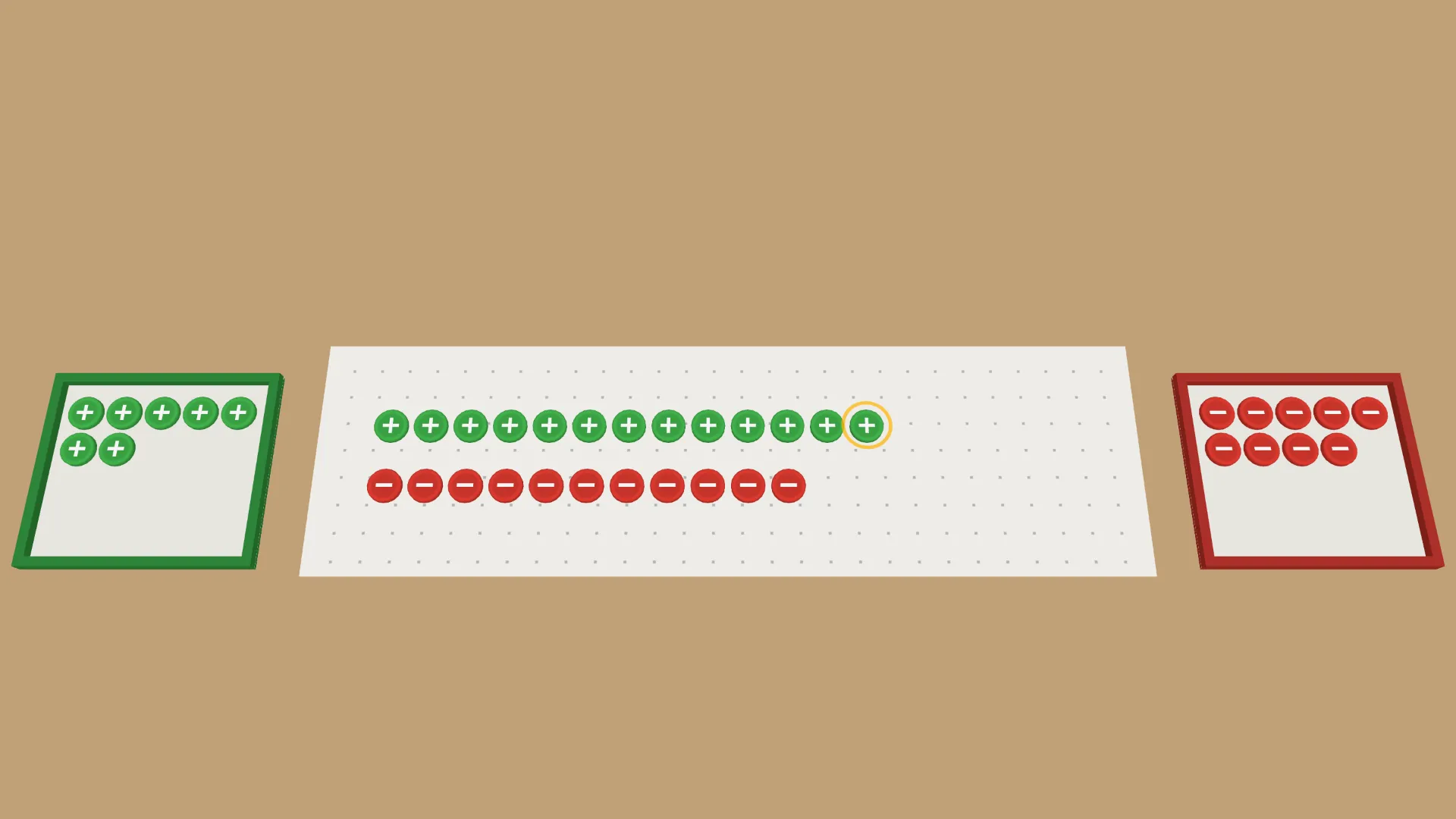
Interactive 3D Experiment
Loading simulation…
What to observe
- Zero pairs cancel: (+5) + (−3) leaves 2 green, so +2.
- To take away more than you have, add zero pairs first: (+7) − (+18) = −11.
- A positive multiplier puts tokens in the bag: 4 × (−2) = −8.
- A negative multiplier takes them out: (−4) × (−2) = +8.
Notes
- Brahmagupta wrote the first clear rules for multiplying and dividing positive and negative numbers in 628 CE.
- He called positive values "fortunes" (dhana) and negative values "debts" (rina).
- The product of two fortunes or of two debts is a fortune. The product of a debt and a fortune is a debt.
- Keep all the tokens inside the worksheet or the bag, so none are lost.