
Inside a Torchlight — Cells, Terminals and a Battery
Aim
To examine a torchlight, to identify the two terminals of an electric cell, and to find the order in which the cells must be placed so that they form a battery and light the torch lamp.
Apparatus
- A torchlight that works on two or more cells (one with a sliding switch is best)
- Two or three dry cells of the size used in that torch
- A magnifying glass, to read faint markings on the cell
- Science notebook / lab record and pencil
Procedure
- Look at the torchlight. Find the lamp and the switch.
- Slide the switch on and off and watch the lamp. Note the position in which it glows.
- Open the cell compartment, take the cells out and count them.
- Examine a cell. Find the + and − marks, the small metal cap and the flat metal disc.
- Predict, then put the cells back in each arrangement of the table and slide the switch.
- Record each arrangement, your prediction and what happened.
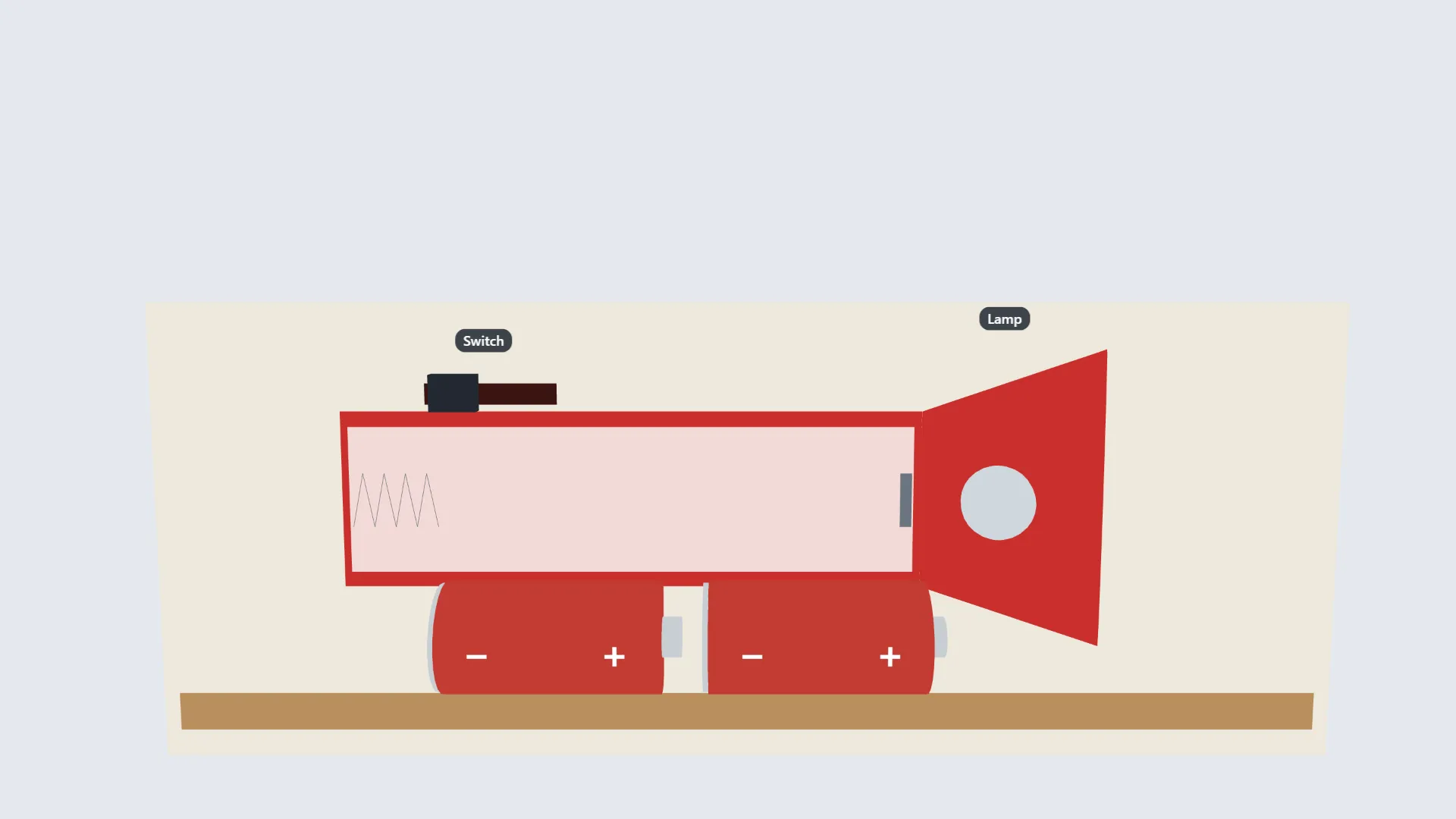
Interactive 3D Experiment
Loading simulation…
What to observe
- Which end of the cell is positive, and which is negative?
- In which arrangements does the lamp glow? In which does it stay dark?
- Does the lamp glow in every position of the switch?
Safety
- Never join the two terminals of a cell directly with a wire, a coin, a key or a paper clip. Such a short circuit heats the cell quickly and it may leak or burst.
- Do not open, cut, hammer, heat or burn a cell, and never carry a cell in a pocket where it can touch keys and coins.
- Do not touch a cell that is bulging, rusted or leaking. Report it to the teacher, who will dispose of it safely.
- Handle the torch lamp gently, its glass bulb cracks easily. Do not shine the torch into anybody's eyes or stare into the lit lamp.
- Use the magnifying glass only to read the markings on the cell, never to focus sunlight. Wash your hands afterwards and put used cells in the e-waste box.
Notes
- Did you know? In 1800 Alessandro Volta stacked discs of zinc and copper, separating each pair with cardboard soaked in salt water. His voltaic pile was the world's first battery, and the unit of voltage, the volt, is named after him.