
Hunting for Supercells
Aim
Build tables of numbers, find the supercells — numbers greater than all their neighbours — and discover how to fill a table so that it has as many supercells as possible.
Apparatus
- Small paper slips or index cards (about 20 per group)
- Ruler and pencil to draw the grids
- Coloured pencils or a green highlighter
- Number cards 0–9 (or a pack of playing cards)
Procedure
- Lay the nine numbers of Fig. 1.1 on slips, one in each cell of a strip of 9 cells.
- Compare each cell with the cells touching it, and shade every supercell green.
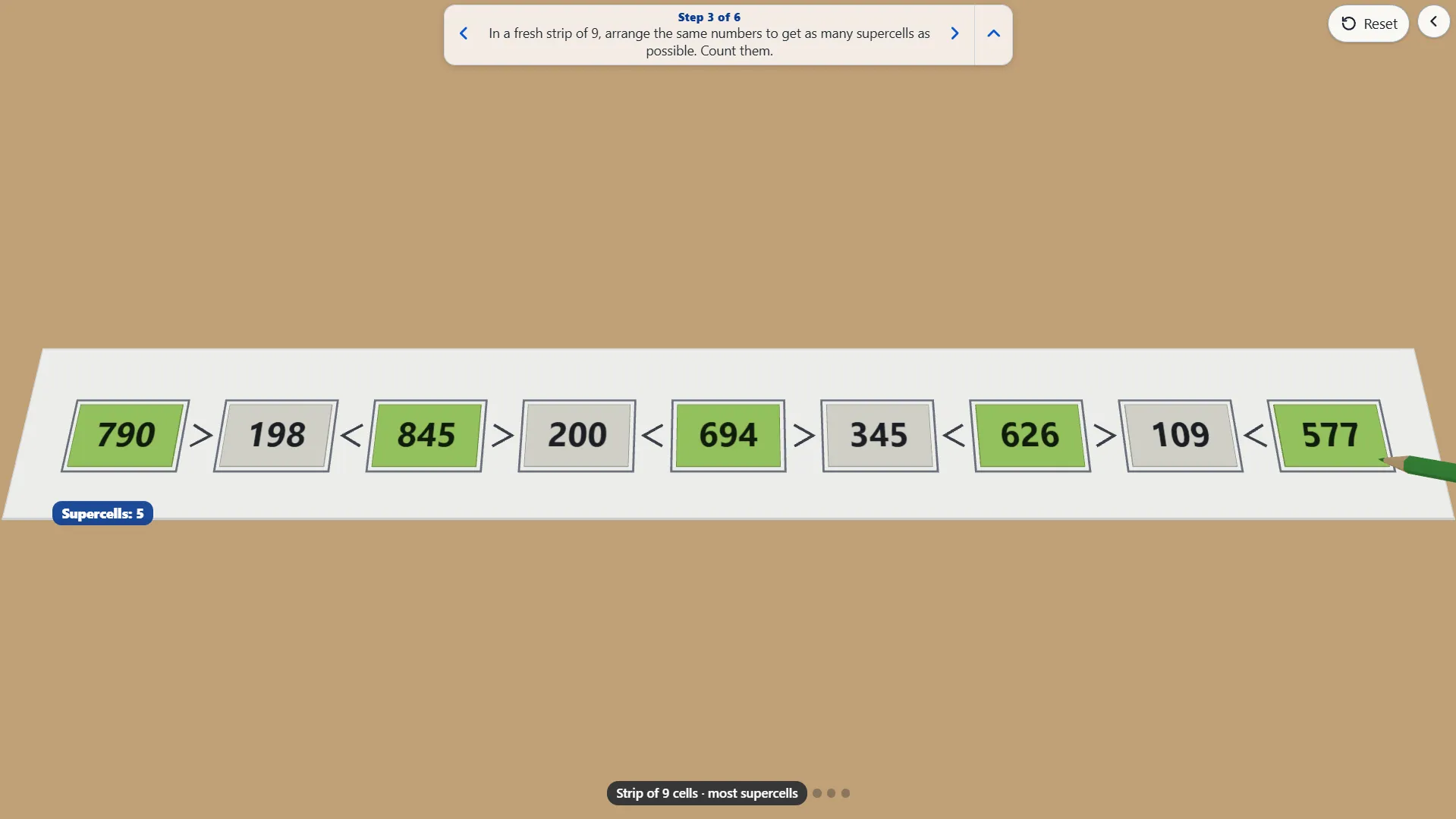
- In a fresh strip of 9, arrange the same numbers to get as many supercells as possible. Count them.
- Repeat with strips of 4, 5, 6 and 7 cells and record the greatest number of supercells.
- Fill a 3 × 4 grid and mark its supercells — compare left, right, top and bottom.
- Write the rule — where should the largest numbers go to get the most supercells?
Interactive 3D Experiment
Loading simulation…
What to observe
- In which cells are the largest numbers when a strip has the most supercells?
- How does the greatest number of supercells depend on the number of cells, n?
- Is the largest number always a supercell? Can the smallest be one? Can two supercells touch?
Notes
- The largest number in any table is always a supercell — it has no bigger neighbour. The smallest number can never be one.
- Two supercells can never sit side by side, so a row of n cells holds at most about half of them as supercells. Placing the biggest numbers in alternate cells gives the most.
- Write only different numbers in the cells; repeated numbers make the comparison unclear.
- Compare each cell with all its neighbours — left and right in a strip, and also top and bottom in a grid.
- Do not forget the end cells. They have only one neighbour, but they must still be tested.
- Shade lightly so that the numbers in the shaded cells can still be read.
- Recount the supercells after every rearrangement instead of assuming the count from before.
- Keep the paper slips face up and in order so that none is lost or turned over while rearranging.