
How Much Salt Can Water Hold? — Saturated, Unsaturated Solutions and the Effect of Temperature
Aim
Find the most salt a fixed amount of water can dissolve (its solubility), tell a saturated solution from an unsaturated one, and see how temperature changes this amount.
Apparatus
- A glass beaker or tumbler and a glass stirring rod
- About 50 mL of water
- Common salt (or baking soda) and a teaspoon
- A laboratory thermometer
- A spirit lamp with a tripod stand and wire gauze (only with your teacher)
- Science notebook and pencil
Procedure
- Take about 50 mL of water in the beaker and note its temperature with the thermometer.
- Add one level teaspoon of salt and stir until it dissolves. The solution is unsaturated.
- Keep adding salt one spoon at a time, stirring each. Count the spoons until salt settles (saturated).
- With your teacher, gently warm the saturated solution while stirring. Watch the salt at the bottom.
- Can more salt dissolve in the warm water now? Note the new temperature and what you see.
- Let the solution cool and observe it once more.
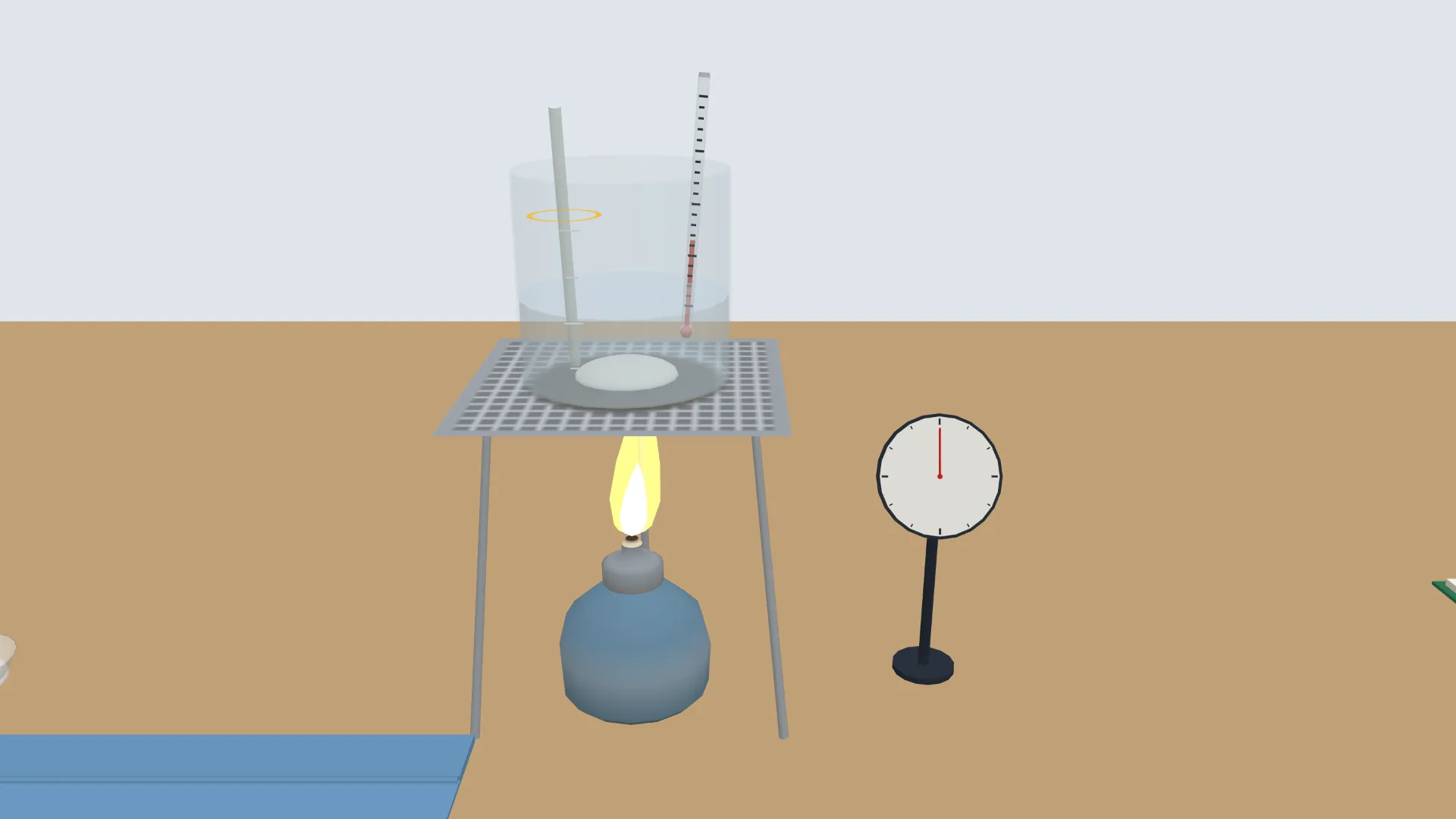
Interactive 3D Experiment
Loading simulation…
What to observe
- How many spoons of salt dissolved before the salt began to settle at the bottom?
- What happened to the undissolved salt when the solution was warmed?
- Could more salt dissolve in the warm water?
- What appeared at the bottom when the solution cooled?
Safety
- Use the spirit lamp only with your teacher. Hold hot glassware with a holder or tongs.
- Measure the 50 mL of water carefully and keep it the same all through.
- Add one level teaspoon at a time and stir well until it has fully dissolved before adding the next.
- Count every spoon and record it — the count is the result.
- The solution is saturated only when salt will not dissolve even after long stirring.
- Keep the thermometer bulb fully in the water, away from the bottom and sides; read it at eye level.
- Never stir with the thermometer — it breaks easily. Tell your teacher at once if it breaks.
- Warm gently while stirring. Never heat a dry or cracked beaker, or a closed one.
- Let the beaker cool on a heat-resistant mat. Never put hot glass in cold water.
Notes
- Gases dissolve in water too, but the other way round from solids. Cold water holds MORE dissolved oxygen than warm water, so cool, fast-flowing streams are rich in the oxygen fish need.
- The simulation shows one typical result — three level spoons dissolve and the fourth settles. The textbook gives no count or temperatures; your own count depends on your spoon and your salt.