
How Much Is That Percentage?
Aim
Find a given percentage of a quantity, and find the whole when one part is known, using bar models, double number lines and mental computation — always estimating before calculating.
Apparatus
- Graph or squared paper, ruler, pencil and coloured pens
- 100 beads, seeds, counters or bottle caps per group
- A packet of biscuits, grains or pulses with the net weight printed on it
- A measuring jug or a weighing balance, if available
- A watch or stopwatch for the estimation game
Procedure
- Draw a 12 cm bar for 120 g, divided in four. Mark 0% to 100% above and 0 g to 120 g below. Read 25% of 120 g.
- Count out 100 beads. Take a quarter and check that 25 beads is 25%. Repeat for 10% and 5%.
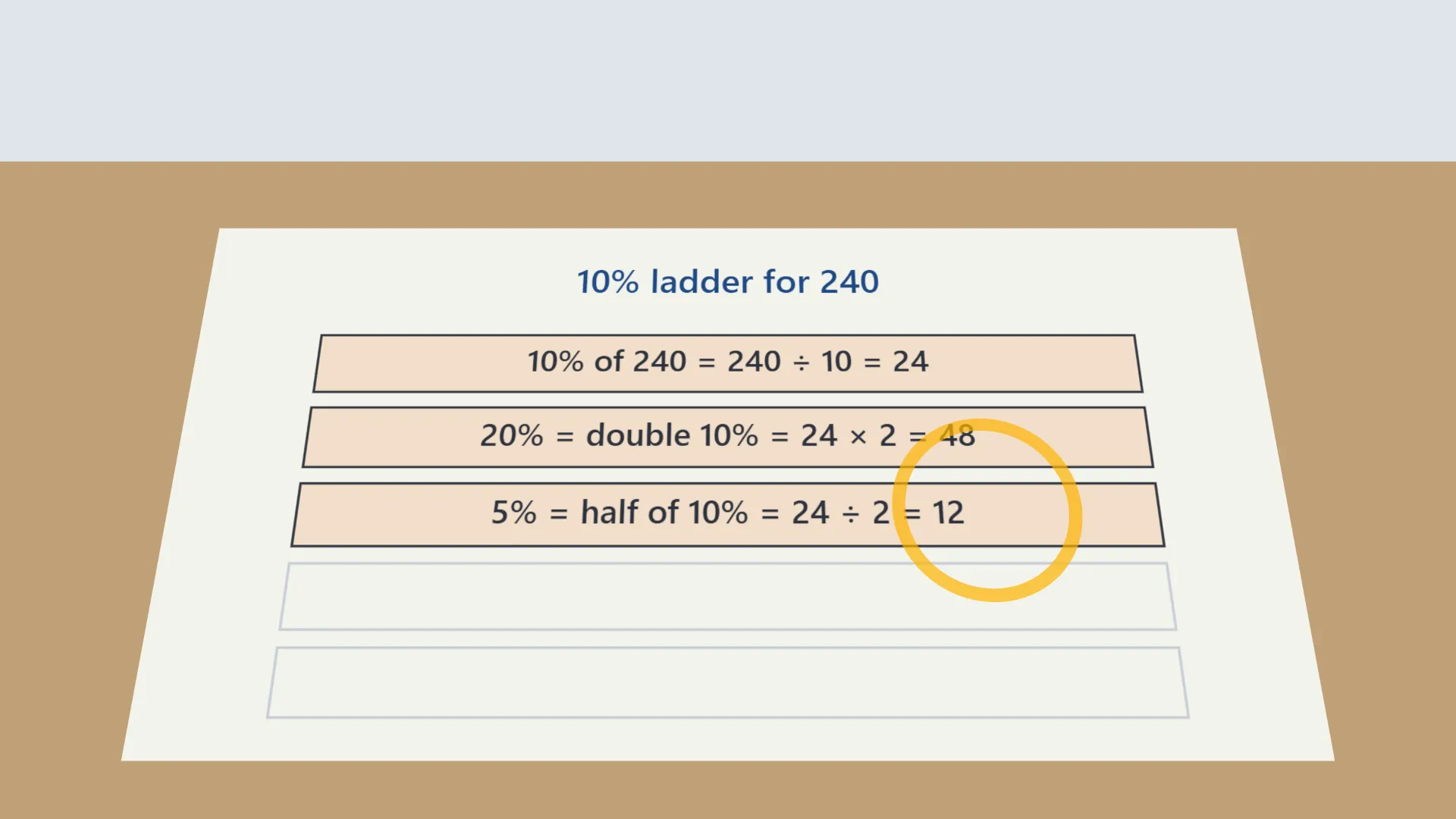
- Build a 10% ladder for 240: find 10%, double it for 20%, halve it for 5%, add rungs for 25% and 15%.
- Play ‘How Close Can You Get?’: estimate a/b as a percentage, then see the true value. Play ten rounds.
- A cyclist has covered 92 km, which is 40% of the journey. Find the whole and the distance still to go.
- Mix a kanji in the ratio 2 : 7. Write each part as a percentage, then find the amounts for 500 mL.
- For each remaining row of the table, write an estimate first, then calculate on a double number line.
- Complete the observation table with the estimate, the actual value and the method used.
Interactive 3D Experiment
Loading simulation…
What to observe
- 25% of 120 g is 30 g, and 25/100 × 120 gives the same.
- The 10% ladder gives any percentage by doubling, halving or adding rungs.
- Estimates made with 10% and 1% as benchmarks are close to the exact answers.
- If 40% is 92 km, then 10% is 23 km and the whole journey is 230 km. The bar model and the double number line use the same proportion in opposite directions.
Notes
- Math Spark: x% of y always equals y% of x, because both are xy ÷ 100. So 18% of 50 is 50% of 18, which is 9. Shopkeepers climb the ‘10% ladder’ instead of using a calculator.
- Estimate first and write the estimate down before calculating; use it afterwards to check the answer.
- Decide whether the part or the whole is being asked for before you start.
- Divide the bar model into equal parts and label which part stands for 100%.
- A percentage is always a percentage of something: state the whole in every answer.
- Keep the unit with every quantity (g, mL, ₨) and give the answer in the same unit.
- Do not add or subtract percentages of different wholes.
- Use the printed net weight on the packet as it is; do not round it before calculating.
- Handle the measuring jug or balance carefully and place it on a level surface.