
Halving a Rectangle: Area of a Triangle
Aim
Show by cutting and fitting paper that the area of a triangle is half the area of the rectangle drawn round it, so area = ½ × base × height, and that triangles on the same base between the same parallel lines have equal areas.
Apparatus
- Graph paper and coloured paper (two contrasting colours)
- Ruler, pencil and a set square (for drawing perpendiculars)
- A pair of scissors and a glue stick
- Sketch pens or highlighters
- Tracing paper or butter paper
Procedure
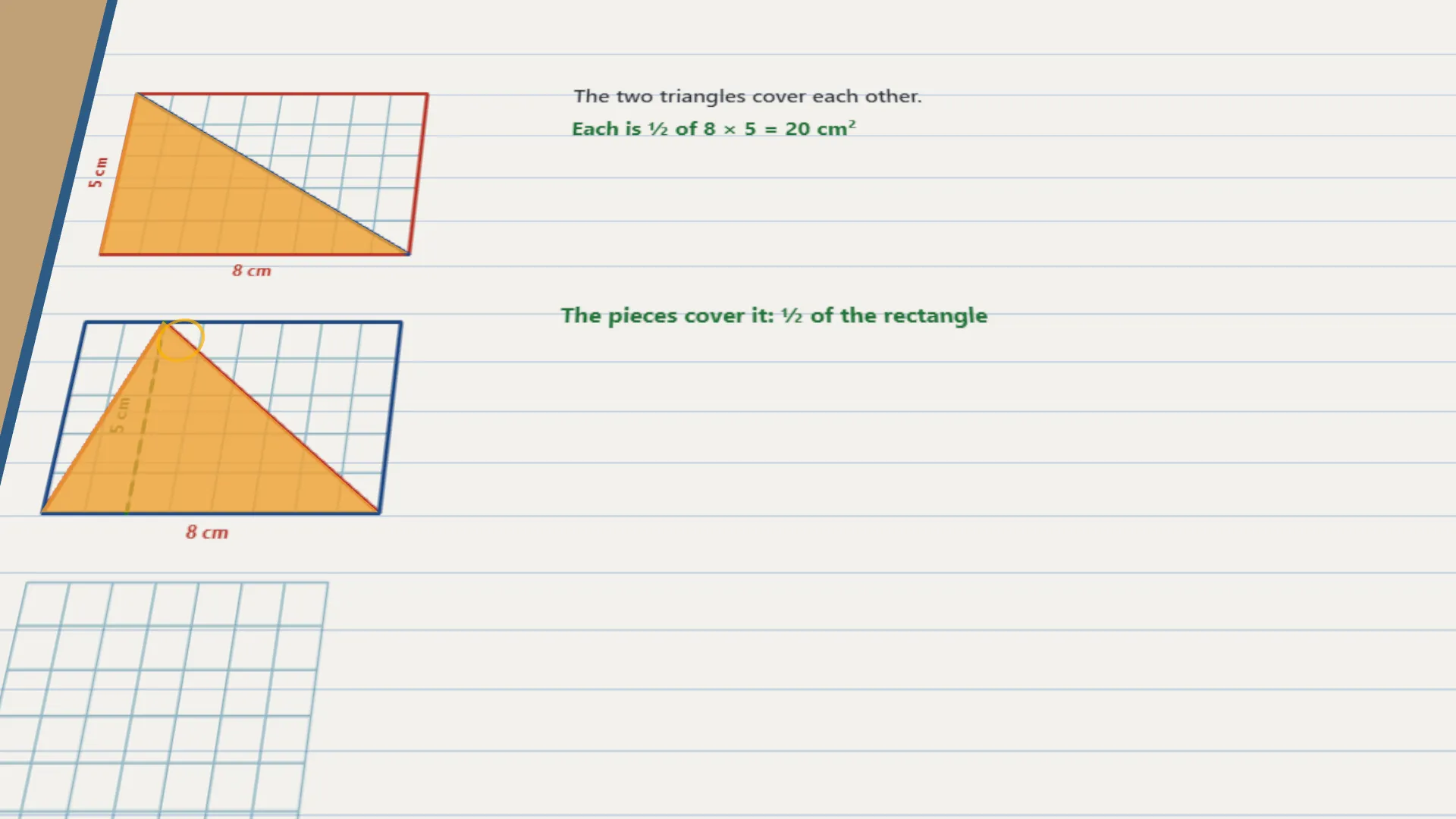
- Draw an 8 cm × 5 cm rectangle, cut it along a diagonal and place one triangle over the other.
- Draw an acute triangle on graph paper. Draw the rectangle round it on its base, and mark the height.
- Cut out the two corner pieces and place them on the triangle. What fraction of the rectangle is the triangle?
- Measure the base and height and work out ½ × base × height. Count the squares and compare.
- Repeat for a right-angled and an obtuse triangle. For the obtuse one, extend the base to draw the height.
- Draw a line l parallel to BC. Join four points on l to B and C. Compare the areas and the perimeters.
- Fill in the observation table.
Interactive 3D Experiment
Loading simulation…
What to observe
- The two halves of the rectangle cut along a diagonal cover each other exactly.
- The corner pieces of the rectangle cover the triangle exactly, so a triangle is half of the rectangle on its base and height.
- For every triangle, ½ × base × height is close to the area found by counting squares.
- Triangles on the same base with their third vertex on a line parallel to the base all have equal areas.
- These triangles can have very different perimeters. The area depends only on the base and the height.
Notes
- Math Spark: The Śulba-Sūtras, ancient Indian texts written for the exact construction of fire altars, give methods to change a rectangle into a triangle of the same area and back again — the very dissection you do here.
- The area of a triangle depends only on its base and its height, never on how slanted it is.
- Draw the height perpendicular to the base, using a set square. The slant side is not the height.
- Measure the base and its height as a pair. Changing the base changes the height.
- When the triangle is obtuse, the height may fall outside it. Extend the base and draw the height there.
- Cut exactly along the drawn lines, and check that the pieces cover the triangle with no overlap and no gap.
- Draw the parallel lines accurately with a ruler and set square. The equal-area result depends on them.
- Use the same unit for base and height, and give the area in square units.
- Use tracing paper to compare two triangles by laying one over the other before you conclude their areas are equal.
- Handle the scissors carefully and keep the cut pieces on the chart until they are pasted.