
Constructing a Timeline of the Gupta Era
Aim
To make a labelled timeline of Gupta rulers, dynasties of the same period, and key scholars and poets, and to use it to find who lived at the same time.
Apparatus
- A sheet of chart paper or graph paper
- Ruler
- Pencil
- Coloured pencils or sketch pens
- A reference list of dates (based on the textbook, Fig. 7.19)
Procedure
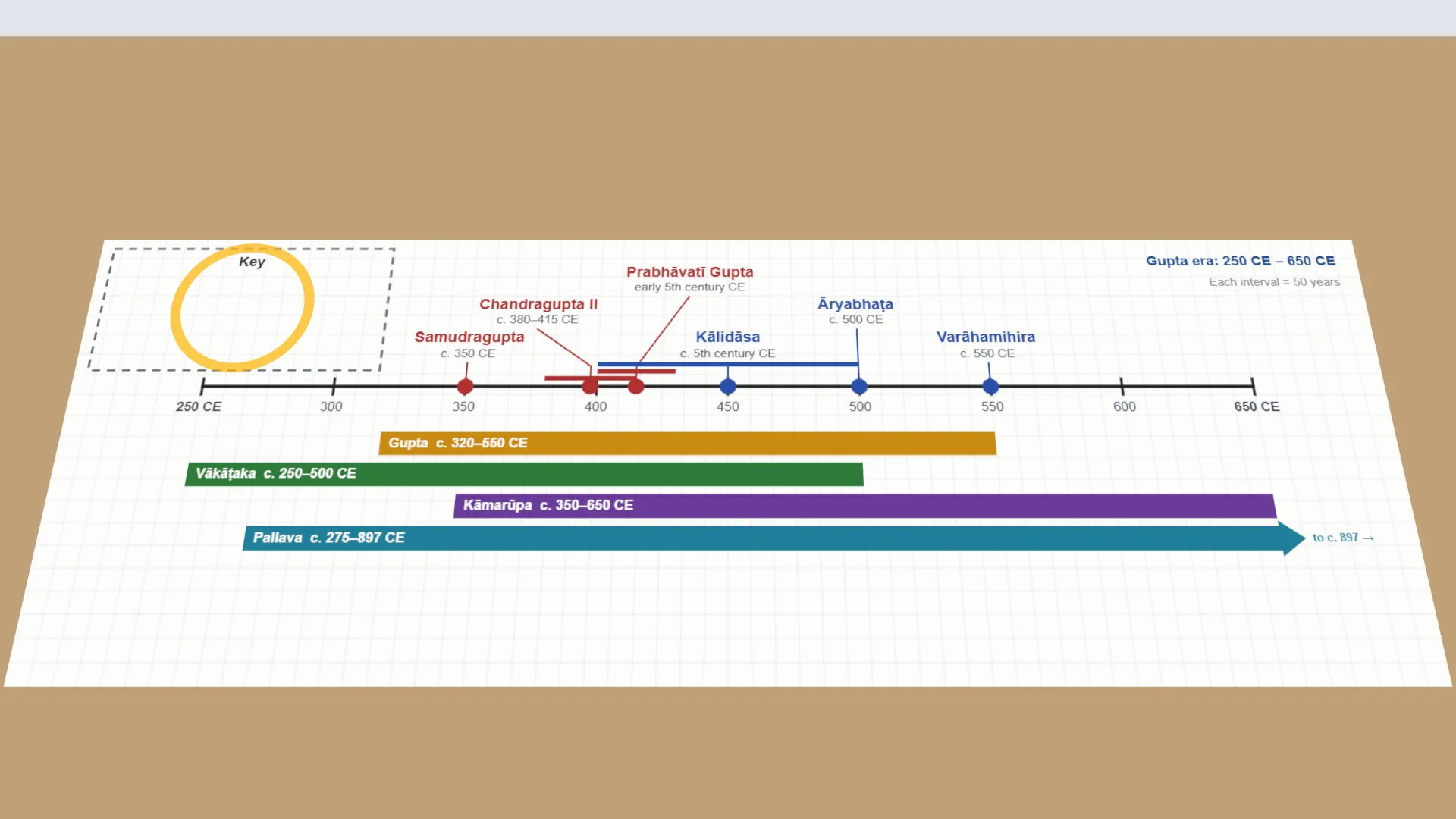
- Draw a timeline across the sheet. Mark equal intervals of 50 years from 250 CE to 650 CE.
- Mark each ruler or scholar above the line with a dot and a label at their date.
- Below the line, draw coloured bars for the Gupta, Vākāṭaka, Kāmarūpa and Pallava dynasties.
- Add a small key explaining the colours and symbols you used.
- Use the timeline to find who lived at the same time, and fill in the table.
Interactive 3D Experiment
Loading simulation…
What to observe
- People and dynasties whose dots and bars cover the same years were contemporaries.
- The Gupta, Vākāṭaka, Kāmarūpa and Pallava dynasties ruled at the same time in different parts of the subcontinent.
- Chandragupta II, his daughter Prabhāvatī Gupta and Kālidāsa all lived in the early 5th century CE.
Notes
- Timelines help historians see which rulers, scholars and events were contemporaries, even when they lived in different parts of the subcontinent. A timeline can show links, such as Prabhāvatī Gupta's marriage linking the Guptas and Vākāṭakas, that a plain list of dates cannot.
- Keep the spacing between years equal and accurate. Use a sharp pencil and a ruler for straight lines. Label each entry clearly and neatly.
- The dates are approximate ("c." means "about").