
Growing Up — Observing, Measuring and Recording the Changes of Adolescence
Aim
To observe and record the changes that take place as students grow up, to measure one's own height accurately, and to classify the changes as common to all adolescents or specific to boys or girls.
Apparatus
- A jar or box and small paper slips
- A measuring tape or metre scale that can be fixed to a wall
- A flat wooden scale, stiff book or set square (to rest level on the head)
- Science notebook / lab record and pencil
- Chart paper and sketch pens (for the bar graph)
Procedure
- On a slip, write one change you have noticed from Grade 5 to Grade 8. Write no name.
- Fold the slips into the jar, mix them well, then read them out one by one.
- Sort the changes into groups. Record the most common ones in Table 1.1.
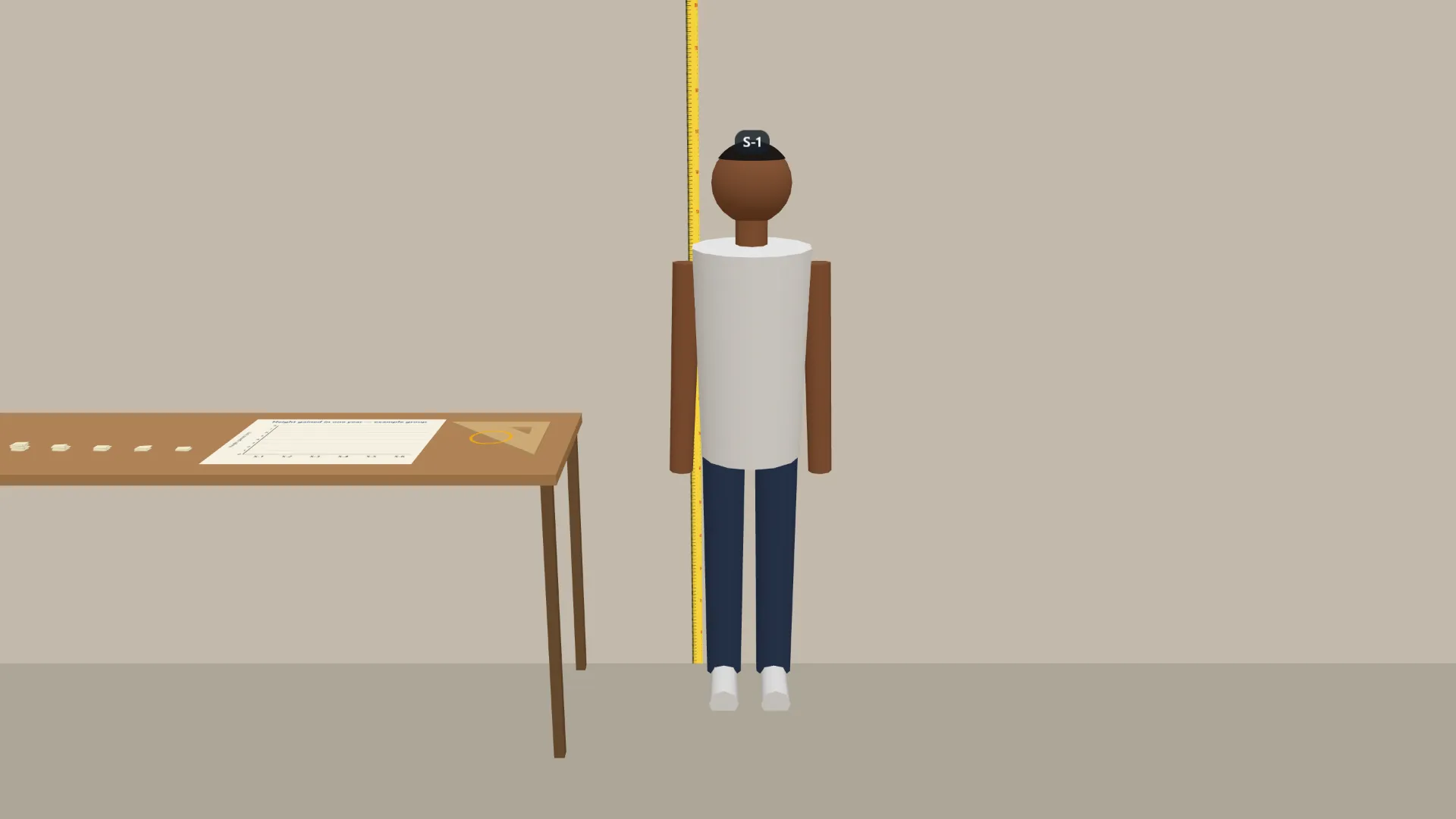
- Fix the measuring tape vertically on a wall, with its zero exactly at floor level.
- Shoes off; heels, back and head on the wall. A partner rests a flat scale on your head, reads the tape.
- Take the reading a second time. If the two differ, record their average.
- Write your height in your notebook against a code such as S-1, not your name.
- Find your height from one year ago (school health record) and work out how much you gained.
- In Table 1.2, classify the changes: seen only in boys, only in girls, or common to both.
- Draw a bar graph of the height gained by your group, with their codes on the x-axis.
Interactive 3D Experiment
Loading simulation…
What to observe
- Growing taller is the change most students notice; voice, strength, looks and mood change too.
- Some changes (height, pimples, hair in the armpits) are common to both; a moustache and a hoarse voice are seen in boys, breasts develop in girls.
- Two readings of the same height can differ a little, so the average is recorded.
- The height gained in one year differs widely from student to student — and that is entirely normal.
Safety
- Write no name on any slip and name no classmate. Record every height against a code such as S-1 and keep it private.
- Make no remark, joke or comparison about anybody's height, weight, voice or appearance. Anyone may sit out the measuring.
- Fix the tape firmly and vertically, zero exactly at floor level, on a wall without a skirting board. Stand without shoes on a clean, non-slippery floor.
- Rest the flat scale level on the head without pressing down, and do not let it slide onto the face.
- Do not climb on a stool, chair or table to read the tape; ask a taller partner or the teacher. Destroy the slips after the discussion.
Notes
- Science Spark: in adolescence the body grows faster than at any time since infancy — the growth spurt. You may gain 5 to 8 cm in a single year. The spurt starts about two years earlier in girls, so many Grade 7 girls are taller than boys of the same age; the boys catch up later.
- The page leaves the numbers blank, so the simulation uses an example group (S-1 to S-6) and example slip counts. In class, use your own group's values.