
Sorting Nature’s Variety — Grouping Plants
Aim
To group plants by height and stem type (herb, shrub or tree), leaf venation, root type and seed type, and to find how these features are related to one another.
Apparatus
- Two or three small plant or leaf samples (for example, grass, a tomato plant, a hibiscus leaf)
- Soaked chickpea and maize seeds
- Hand lens
- Khurpi or trowel, for root observation under the teacher's supervision only (optional)
- Notebook and pencil
Procedure
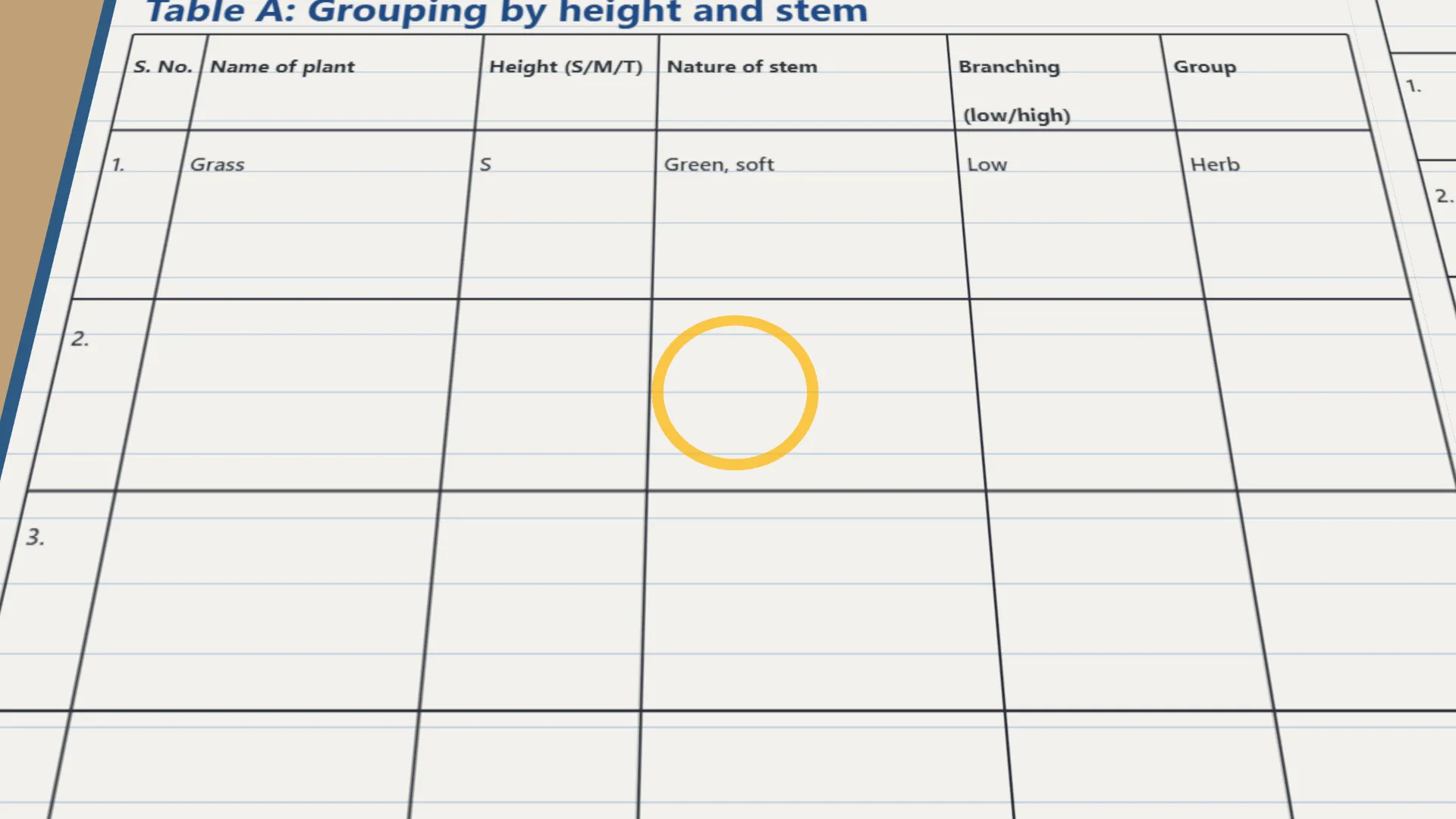
- Observe several plants. Note their height and whether the stem is green or brown, soft or hard.
- Note whether the branches start close to the ground or higher up on the stem.
- Classify each plant as a herb, a shrub or a tree and record it in Table A.
- Examine the veins of a fallen leaf. Are they net-like or parallel?
- With your teacher, gently look at the roots of small herbs. One main root or a bunch of thin roots?
- Carefully open a soaked chickpea seed and compare it with a soaked maize seed.
- Record your findings in Table B and look for a pattern in venation, root and seed type.
Interactive 3D Experiment
Loading simulation…
What to observe
- Herbs are short with soft green stems, shrubs have hard stems branching low, trees are tall with branches high up.
- Plants with parallel veins have fibrous roots and monocot seeds.
- Plants with net-like veins have a taproot and dicot seeds.
Notes
- Science Spark: Bamboo, the fastest-growing woody plant on Earth, is technically a giant grass. It has fibrous roots and parallel-veined leaves.
- Dig for roots only with your teacher, with the khurpi blade pointing down and away from you.
- Uproot only two or three common weeds, never a garden plant or sapling, and replant and water them afterwards.
- Never use the hand lens to focus sunlight, and never look at the sun through it.
- Open soaked seeds with your fingers or a blunt toothpick, never a blade. Do not eat them.
- Wash your hands with soap after touching soil, roots and seeds.