
Role-Play: Conducting a Gram Sabha Meeting
Aim
To act out a Gram Sabha meeting and see how local issues are discussed and how decisions are taken democratically.
Apparatus
- Chart paper for name tags
- A notebook to record the minutes
- A bell or gavel (optional)
Procedure
- Form groups of six to eight. Assign one Sarpanch, one Panchayat Secretary, and villagers.
- Choose two local issues, such as cleaning the village pond and repairing the school compound wall.
- The Sarpanch opens the meeting and invites villagers, one at a time, to share their views on each issue.
- Villagers give opinions, including a minority view, and suggest solutions. Take a show of hands.
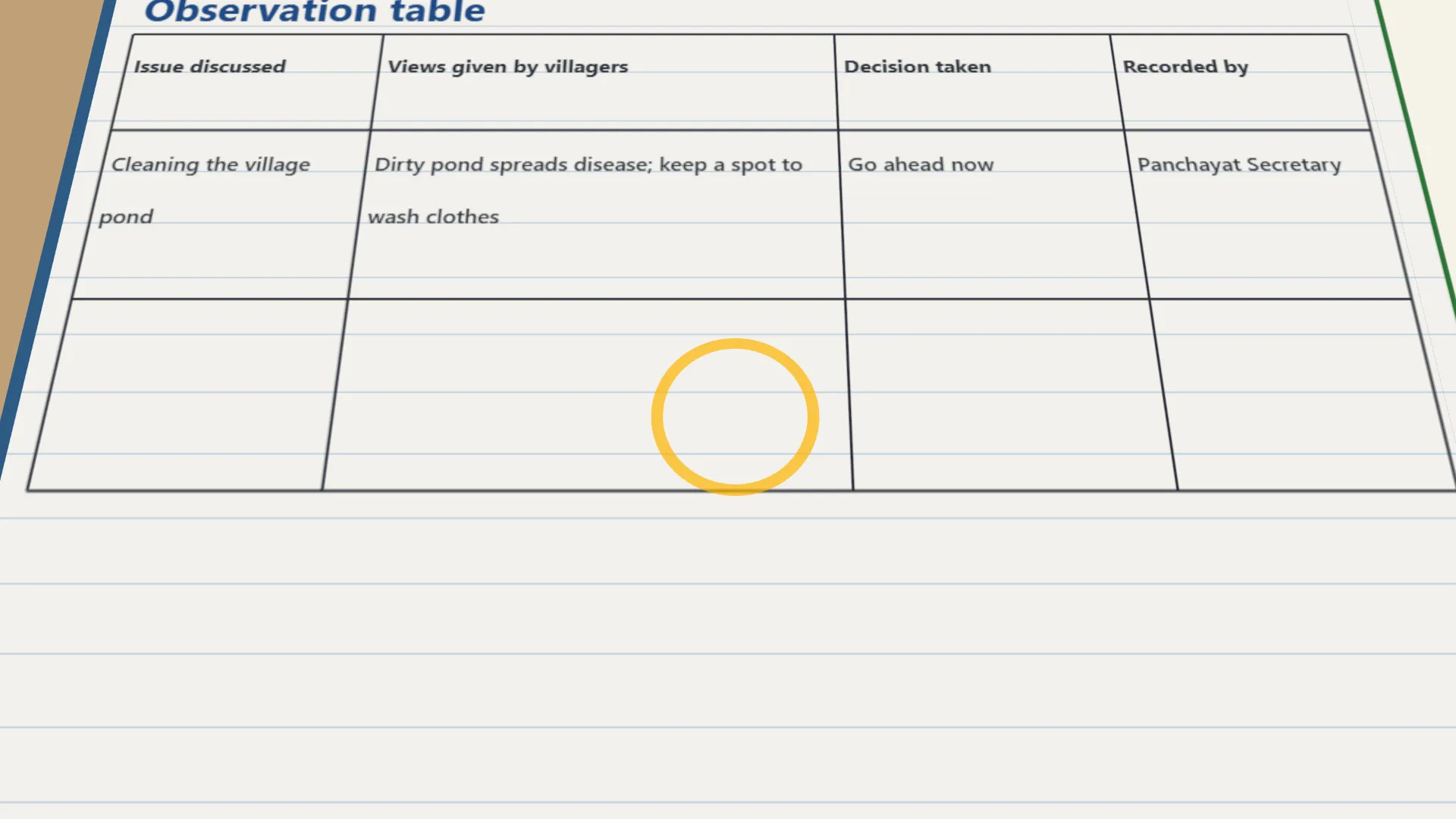
- The Panchayat Secretary notes the key points and the decision in the observation table.
- Discuss how the meeting runs and who is a member of the Gram Sabha.
Interactive 3D Experiment
Loading simulation…
What to observe
- Every villager is heard, and the majority decision is recorded.
- The Panchayat Secretary keeps the record of the meeting.
Notes
- The Gram Sabha is the only body in the Panchayati Raj system in which every adult voter of the village is automatically a member. No one needs to be separately elected to it.
- Make sure every villager gets a turn to speak. Keep order and listen respectfully to different opinions.