
Sorting the Functions of Government: Legislative, Executive and Judicial
Aim
To sort statements about a made-up country under the three functions of government, legislative, executive and judicial, and to compare democratic features across different forms of government.
Apparatus
- Textbook reference (the section Functions of Government, and Table 9.2)
- A worksheet with statement cards, or a notebook
- Coloured pencils or sticky notes
Procedure
- Revisit the three functions. The legislative function makes rules, the executive carries them out and runs the administration, and the judicial makes sure they are followed.
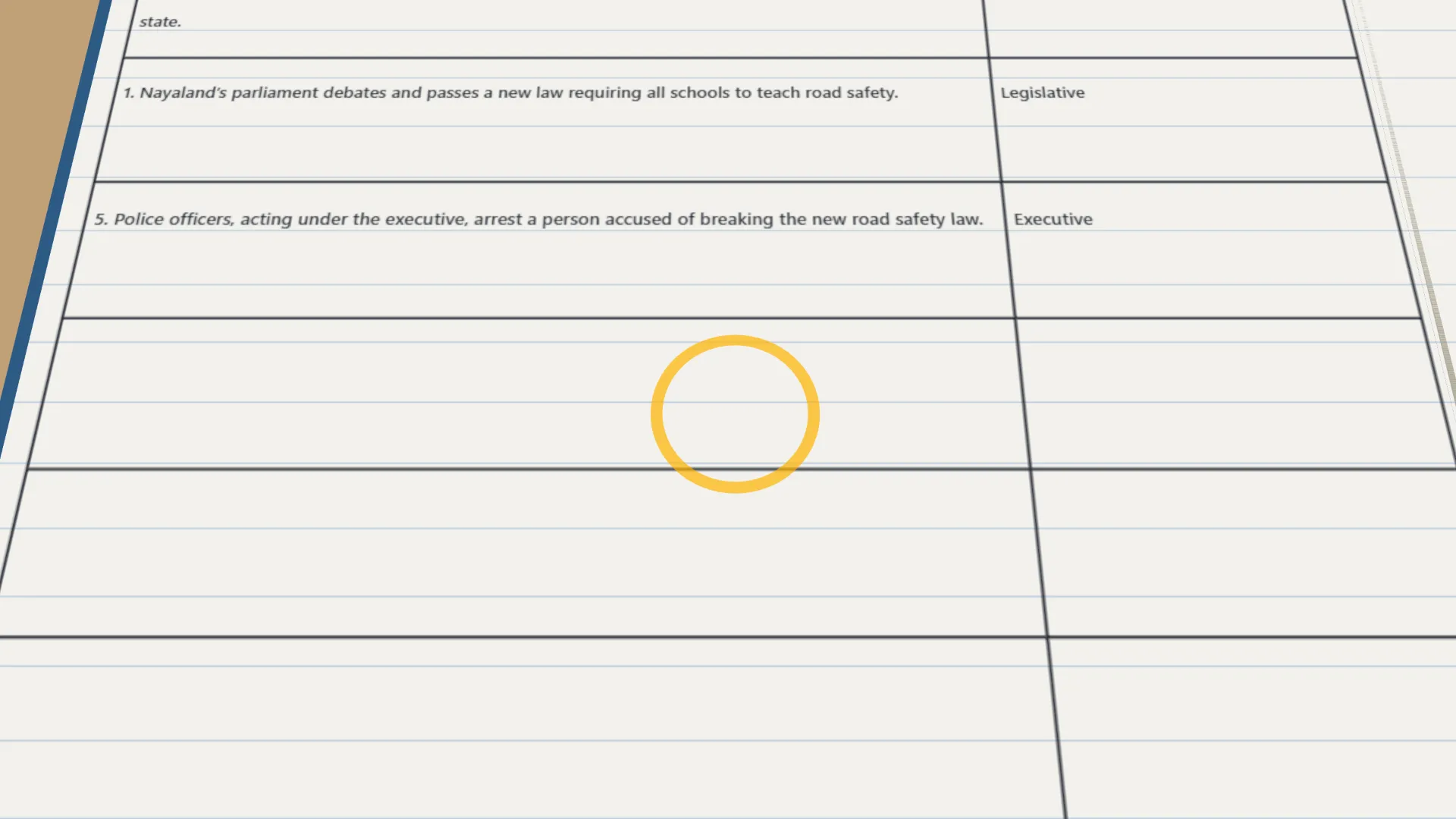
- Read the seven statements about the country of Nayaland. Say which function each one shows.
- Swap answers with a partner and talk about any statements you disagreed on.
- Fill in Table 9.2 for two countries you know something about, with Yes or No for each feature.
- Answer the reflection question about why the judiciary is kept separate.
Interactive 3D Experiment
Loading simulation…
What to observe
- Making and passing laws and budgets is the legislative function.
- Carrying out laws, opening hospitals and arresting people under the law is the executive function.
- Hearing cases and checking whether a law goes against the constitution is the judicial function.
Notes
- Social Science Spark: even though ministers in a parliamentary democracy like India belong to the legislature, India's judiciary stays completely separate. This separation of power makes sure no single branch can misuse its authority unchecked.
- Match each statement to only one function. Discuss disagreements respectfully and use the textbook definitions when in doubt. Base your Table 9.2 answers on evidence, not guesses.