
From Patterns to Expressions
Aim
Build growing matchstick patterns, count the matchsticks at each step, find the rule in words and write it as an expression with a letter-number. Then use the expression to predict far-off steps.
Apparatus
- A box of matchsticks (or earbuds or broomsticks), about 40
- Dot grid or plain paper notebook
- Coloured pencils or sketch pens
- Ruler and pencil
Procedure
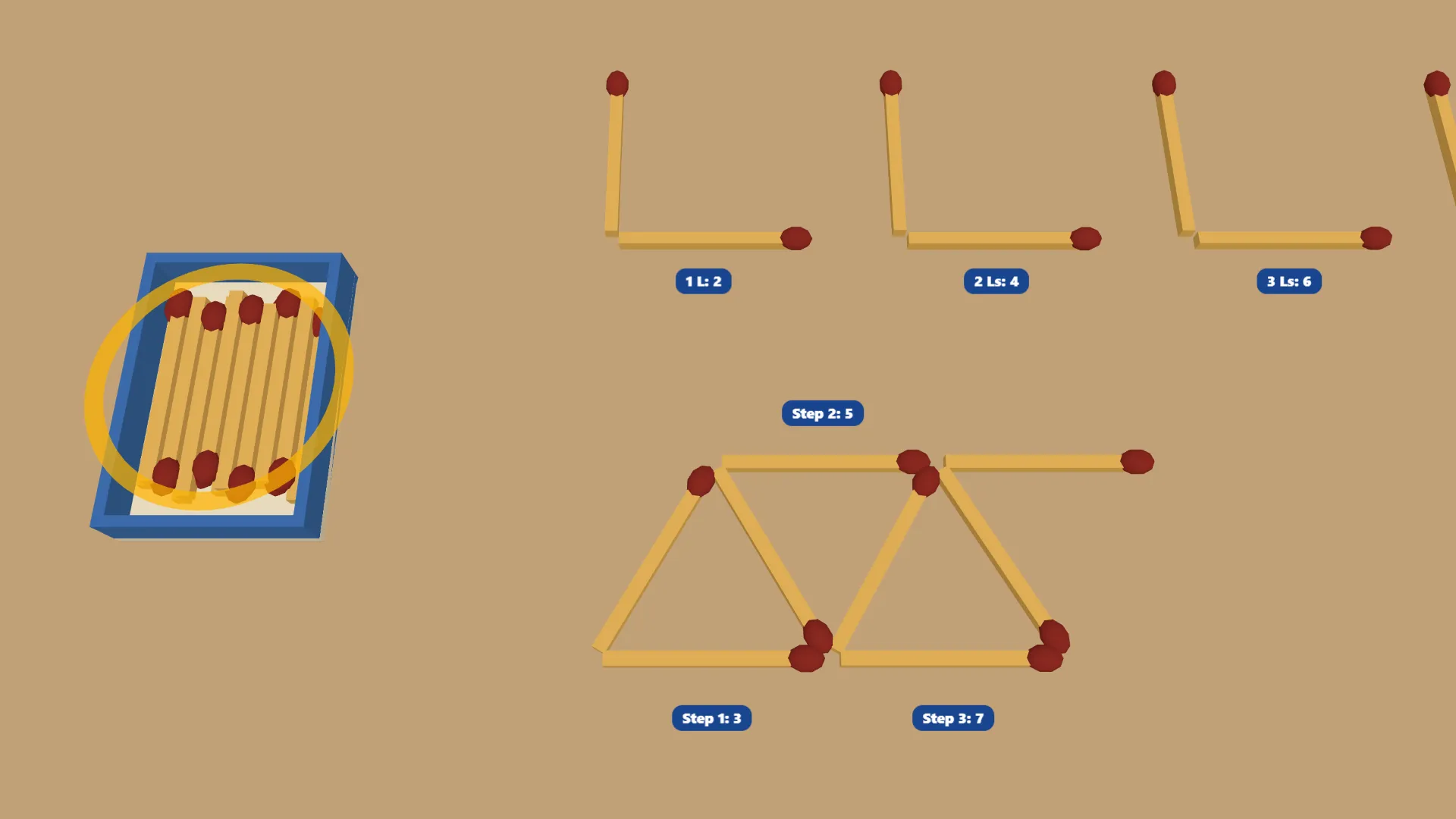
- Build the L pattern with matchsticks — 1 L, then 2 Ls, up to 5 Ls.
- Count the matchsticks for 1 to 5 Ls and record them in the table.
- Write the rule in words (2 times the number of Ls), then as 2n.
- Build the triangle strip — Step 1 is one triangle, each new step adds 2 matchsticks.
- Record Steps 1 to 5 and write the count as 3 + 2 × (y − 1).
- Simplify it to 2y + 1 and check that both forms agree for Steps 1 to 5.
- Use 2y + 1 to predict Steps 33, 84 and 108 without building them.
Interactive 3D Experiment
Loading simulation…
What to observe
- The L pattern grows by 2 matchsticks for each new L — 2, 4, 6, 8, 10.
- The triangle strip grows by 2 from 3 — 3, 5, 7, 9, 11.
- Both forms of the triangle rule give the same number at every step.
- One expression gives any step — Step 108 needs 217, and 500 Ls need 1000.
Notes
- The word algebra comes from the Arabic al-jabr, used by Al-Khwarizmi around 820 CE. It means "reunion of broken parts".
- One letter can stand for any number — 2n gives the matchsticks for step 5, step 500 or step 5,000,000.
- Count matchsticks, not shapes. A stick shared by two triangles is counted once.
- Record each count right after building the step.
- Say what the letter stands for (n is the number of Ls) before writing the expression.
- Test the rule on at least two steps you built before predicting a far-off step.
- Do not mix up the step number and the number of matchsticks.