
Analysing Primary Sources from the Freedom Struggle
Aim
To analyse four primary source extracts from the freedom struggle (1906–1947) and classify statements in them as fact, opinion or inference, to understand how historians use original sources as evidence.
Apparatus
- Copies of the four source extracts (or the textbook)
- Pencil
- Notebook
Procedure
- Read Source A (Sri Aurobindo, 1909). Note its year, its author and its context.
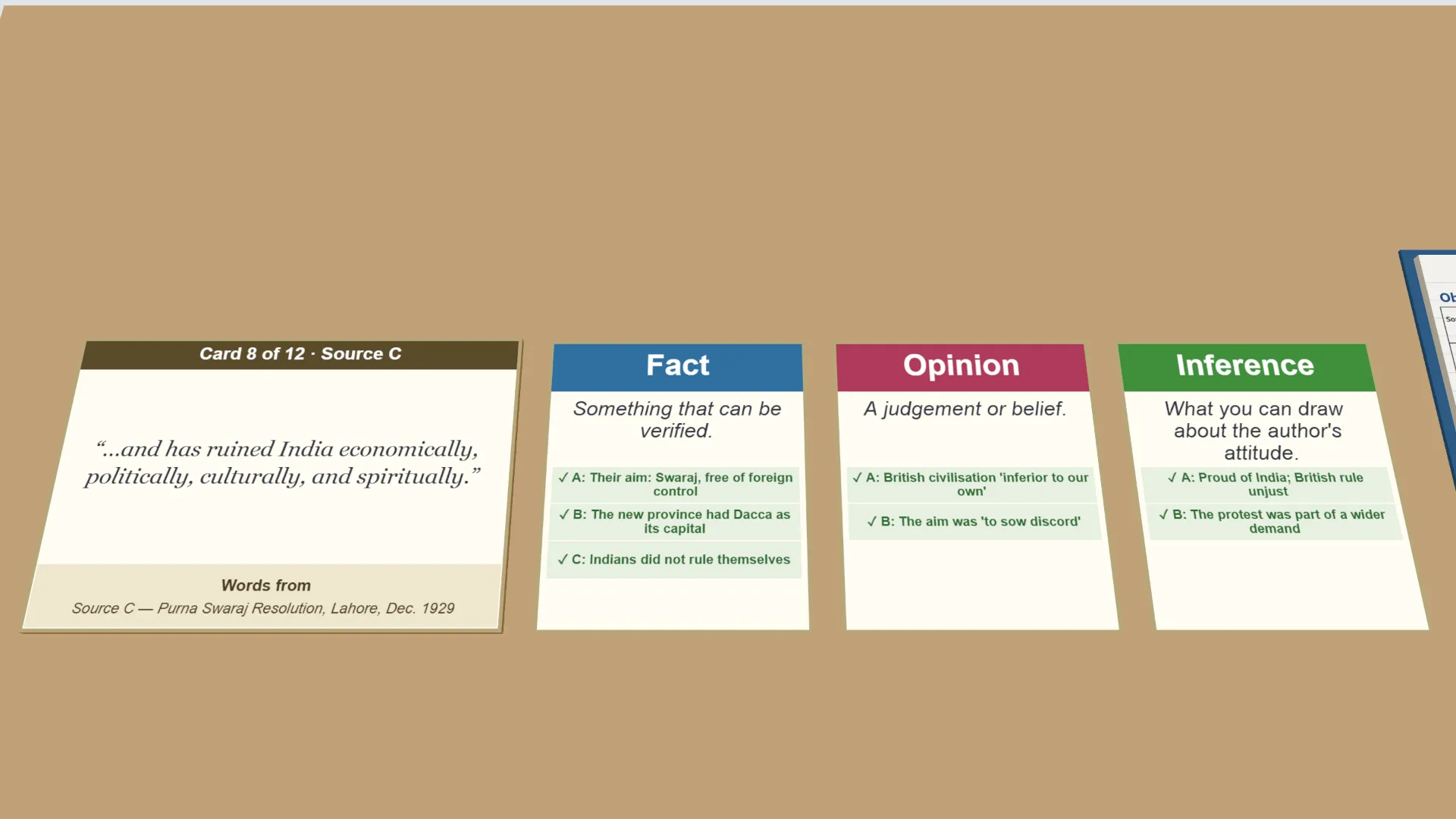
- Mark each statement: fact (can be verified), opinion (a judgement), or inference about the author.
- Repeat for Sources B, C and D.
- For each source, record one fact, one opinion and one inference in the observation table.
- In pairs, compare your classifications and discuss the ones you disagreed on.
- As a class: how did the tone change from 1909 (Source A) to 1947 (Source D)?
Interactive 3D Experiment
Loading simulation…
What to observe
- A fact can be verified, like Dacca being the capital of the new province, or India's freedom at midnight.
- Words like "inferior", "evident object" and "ruined" show a judgement, an opinion.
- An inference is not written in the source; you draw it from the author's words and tone.
- The demand grew from argument and protest (1906–1909) to complete independence (1929); in 1947 freedom had come.
Notes
- Sources (as printed in the lab manual): A — Sri Aurobindo, 1909; B — Bande Mataram daily, 4 September 1906; C — Purna Swaraj Resolution, Lahore session of the Congress, December 1929; D — Jawaharlal Nehru, 15 August 1947.
- Precautions: read each source in its historical context before classifying; do not mistake a strongly worded opinion for a verifiable fact.