
The Fraction Wall & Equivalent Fractions
Aim
Build a fraction wall and use it to find equivalent fractions, write a fraction in its simplest form, and compare two fractions by giving them the same denominator.
Apparatus
- Several paper strips of the same length (or a printed grid)
- Ruler, pencil and coloured pencils
- Notebook or graph paper
Procedure
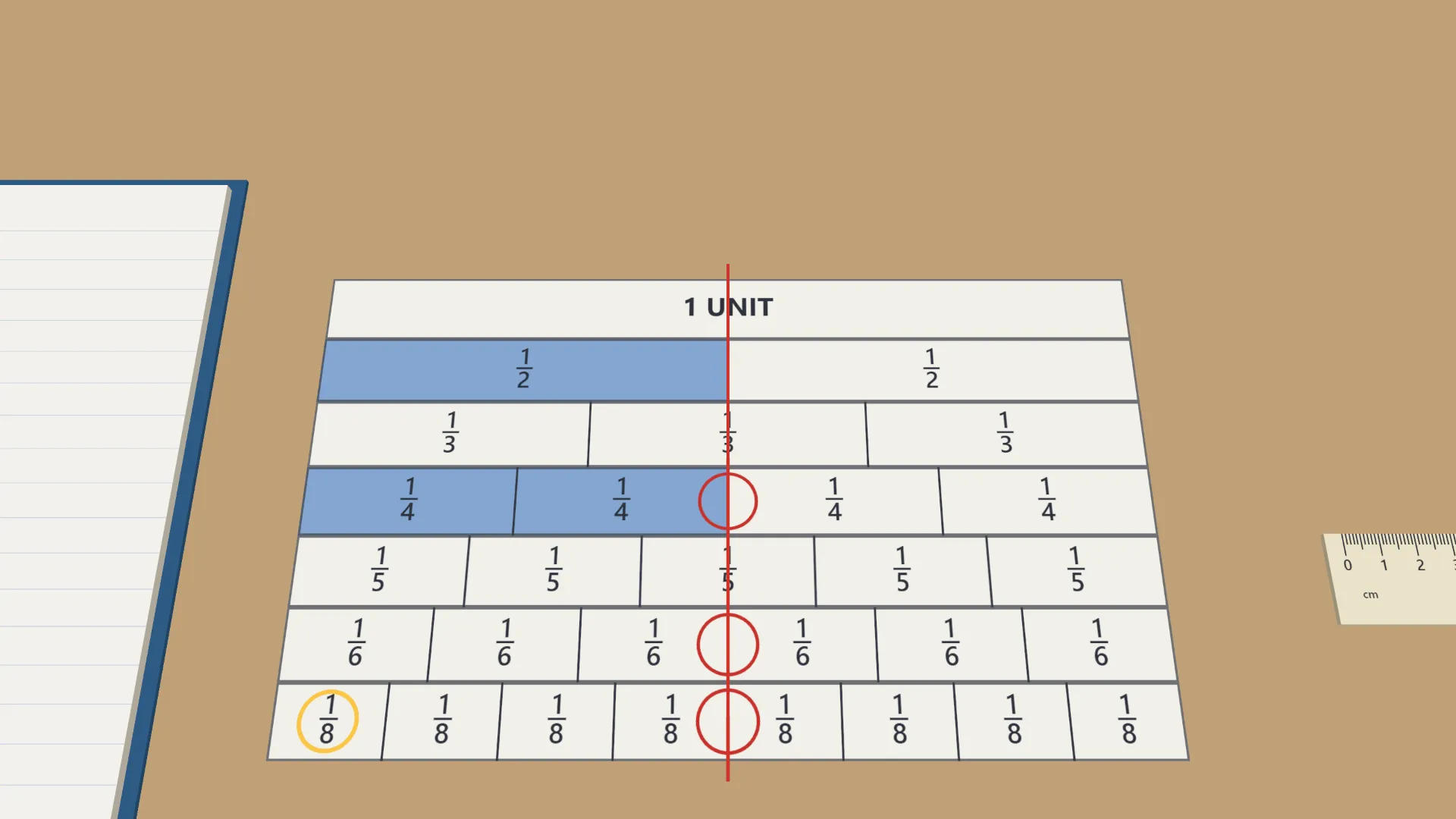
- Take a strip of the same length as the others. Keep it whole and label it '1 UNIT'.
- Mark other strips into 2, 3, 4, 5, 6 and 8 equal parts. Label each part and stack them as a wall.
- Line up the left edges. Read straight down from the end of 1/2. Which fractions reach that mark?
- Record the fractions of equal length as equivalent fractions, e.g. 1/2 = 2/4 = 4/8.
- Colour 1/2 of the halves strip, 2/4 of the quarters and 4/8 of the eighths. Do the lengths match?
- Divide the top and bottom of a fraction like 16/20 by a common factor until none is left.
- Compare 4/5 and 7/9. Rewrite both with the same denominator, then compare the numerators.
Interactive 3D Experiment
Loading simulation…
What to observe
- 1/2, 2/4, 3/6 and 4/8 all reach the same mark on the wall. They are equivalent fractions.
- The coloured lengths of 1/2, 2/4 and 4/8 match exactly.
- 1/3 and 1/5 have no mark under the end of 1/2.
- 16/20 becomes 4/5 and 36/60 becomes 3/5 when no common factor is left.
- With denominator 45, 4/5 = 36/45 and 7/9 = 35/45, so 4/5 > 7/9.
Notes
- General fractions, where the top number need not be 1, were first developed in India.
- Multiplying or dividing the top and bottom by the same number gives an equal fraction. That is why the wall lines up.
- All strips must be the same length, stacked with their left edges exactly in line.
- Divide each strip into truly equal parts. Use a ruler where folding is hard (for example, 5 parts).
- Shade every fraction from the left edge, so lengths can be compared down a column.
- While simplifying, divide the top and the bottom by the same number.
- Compare the numerators only after both fractions have the same denominator.
- Label each part of every strip with its fractional unit before stacking the strips.